Converting 1 lakh rupees to USD gives you two honest answers, not one. On the converter you just closed, ₹1,00,000 — one lakh, or one hundred thousand Indian rupees — showed as roughly $1,053.77 at Wise’s mid-market rate of 1 INR = 0.01054 USD on 20 October 2026. In your bank account, expect closer to $1,020.
Converting 1 lakh rupees to USD: how much is it right now?
The headline figure: ₹1,00,000 = about $1,053.77, based on the mid-market INR to USD rate shown on Wise on 20 October 2026 (1 INR = 0.01054 USD). The timestamp matters as much as the number — quote one without the other, and you are quoting nothing.
Read it in reverse and the scale gets easier to hold. At India’s official FBIL reference rate of ₹95.0691 per dollar on 15 October 2026, $1,000 costs ₹95,069. So a lakh and a thousand dollars are close cousins, not twins — a lakh is worth a little more.
One caution before you act on that figure: it is the mid-market rate. That is the price banks trade with each other at, not the price anyone sells you. The gap between it and your actual payout is explained in full two sections down.
If your converter showed $1,041 or $1,052 instead of $1,053, nothing is broken. Rates refresh continuously, and each site pulls from a different feed — some quote the market midpoint, others quote what they will genuinely transact at.
What exactly is a lakh, and why is it written ₹1,00,000?
A lakh is not a currency. It is a counting word in the Indian numbering system meaning one hundred thousand (100,000), exactly the way “a million” is a counting word in English. One lakh rupees is simply ₹100,000 of ordinary Indian rupees.
The odd-looking comma placement is the Indian 2-2-3 digit-grouping convention, documented on Wikipedia’s entry for the Indian numbering system. After the thousands place, separators fall every two digits instead of every three: 1,00,000 rather than 100,000, and 1,00,00,000 for a crore.
Lakh vs. crore vs. a million: the quick mapping
The Indian series — thousand, lakh, crore, arab, kharab — steps up by 100 each time. The Western series — thousand, million, billion, trillion — steps up by 1,000. That mismatch is where people come unstuck.
- 1 lakh = 0.1 million
- 10 lakh = 1 million
- 1 crore = 100 lakh = 10 million
- 1 lakh crore = 1 trillion
Why this is worth thirty seconds of your attention: reading a lakh as a million inflates the dollar figure tenfold. It is the single most common error people make with Indian salary figures, property prices and startup funding numbers.
How do you convert lakhs to dollars yourself?
The arithmetic behind 1 lakh rupees to USD is one division:
Dollars = (lakhs × 100,000) ÷ USD/INR rate
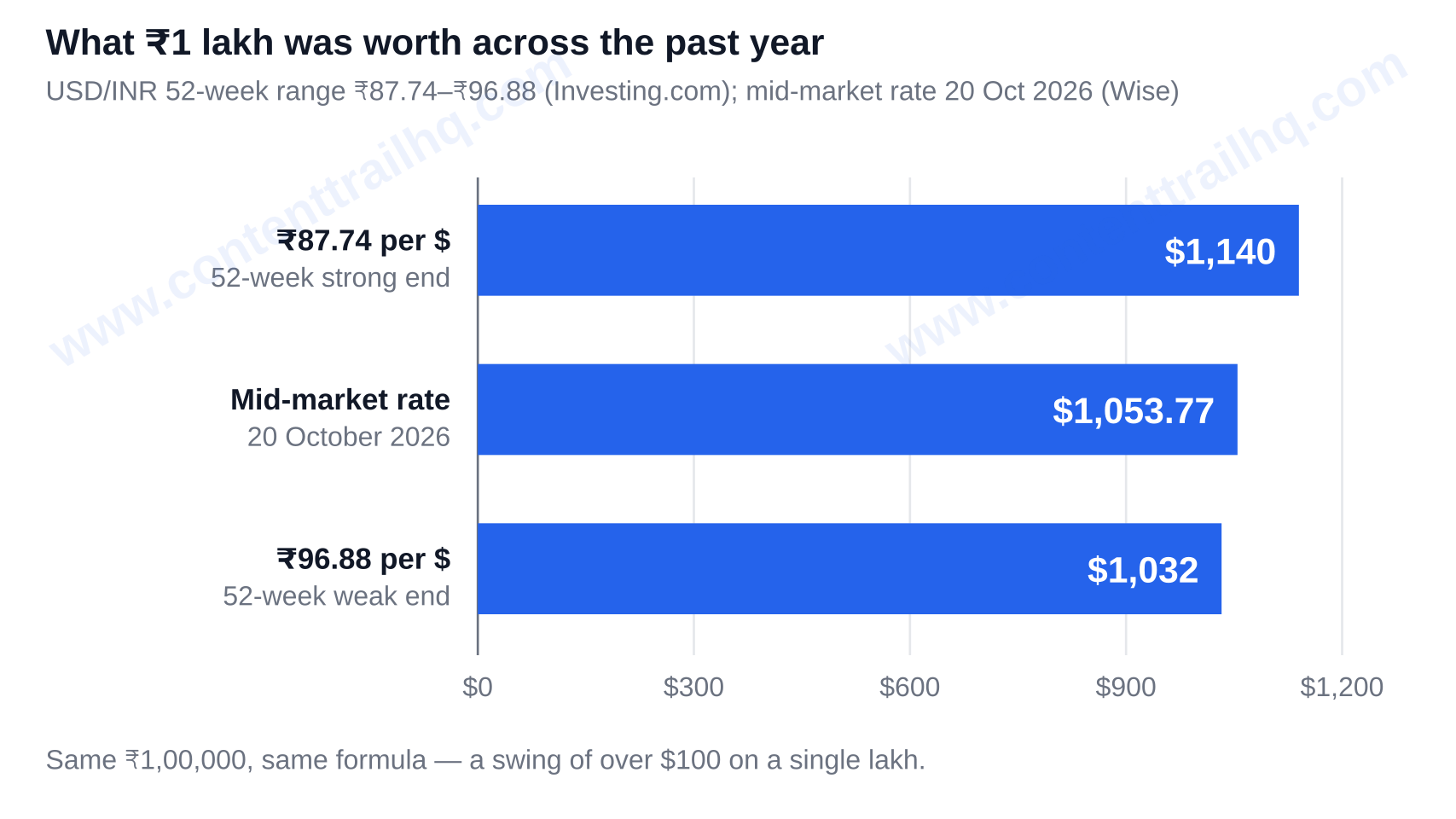
At the FBIL reference rate of ₹95.0691 per dollar, 1 × 100,000 ÷ 95.0691 gives about $1,052. Run the same sum at ₹87.74 — the strong end of the rupee’s 52-week range, per Investing.com — and you get about $1,140. Same lakh, same formula, $88 apart. The rate you feed in matters far more than the method.
For mental maths at current levels, divide your lakhs by roughly 0.95 to get thousands of dollars. One lakh lands near $1.05k; ten lakh near $10.5k. Close enough to sanity-check a quote on the spot.
Lakh to USD conversion table (1 lakh to 1 crore)
Every row below uses a stated rate of ₹95.05 per dollar, as published by inrconverter.com, so you can reproduce it with the formula above.
| Amount in rupees | Written out | USD at ₹95.05/$ |
|---|---|---|
| 1 lakh | ₹1,00,000 | $1,052 |
| 5 lakh | ₹5,00,000 | $5,260 |
| 10 lakh | ₹10,00,000 | $10,521 |
| 50 lakh | ₹50,00,000 | $52,604 |
| 100 lakh (1 crore) | ₹1,00,00,000 | $105,208 |
Re-run the division rather than reusing a saved figure. The rate changes every business day, and a table written six months ago is quietly wrong.
Which exchange rate is your ₹1 lakh being converted at?
Three different rates can all be applied to the same lakh on the same morning, and all three are legitimate. They answer different questions.
- Mid-market (interbank) rate: the midpoint between global buy and sell prices. This is what Wise, XE and Google show. It is a reference price, not an offer. On 20 October 2026 it valued ₹1 lakh at $1,053.77.
- FBIL reference rate: India’s official benchmark, calculated by Financial Benchmarks India Ltd and published on the RBI website every business day around 1:30 pm. It stood at ₹95.0691 on 15 October 2026, valuing ₹1 lakh at about $1,052. This is the rate used for accounting, customs and tax purposes.
- Retail board rate: what a bank, money changer or remittance provider will actually transact at, with a spread built into both sides. BookMyForex’s board on 20 October 2026 showed buy 95.28, sell 95.06 and a money-transfer rate of 96.0575 — that transfer rate alone pulls ₹1 lakh down to roughly $1,041.
Why two converters show different dollar figures for the same ₹1 lakh
Those three answers sit about $12 apart. Nobody is lying. One is quoting the market’s midpoint, one is quoting India’s official daily benchmark, and one is quoting a price it will honour at a counter — and each pulls from a feed that refreshed at a different second. When you compare two converter pages, you are usually comparing a reference price against a sale price.
What you actually receive when you convert ₹1 lakh
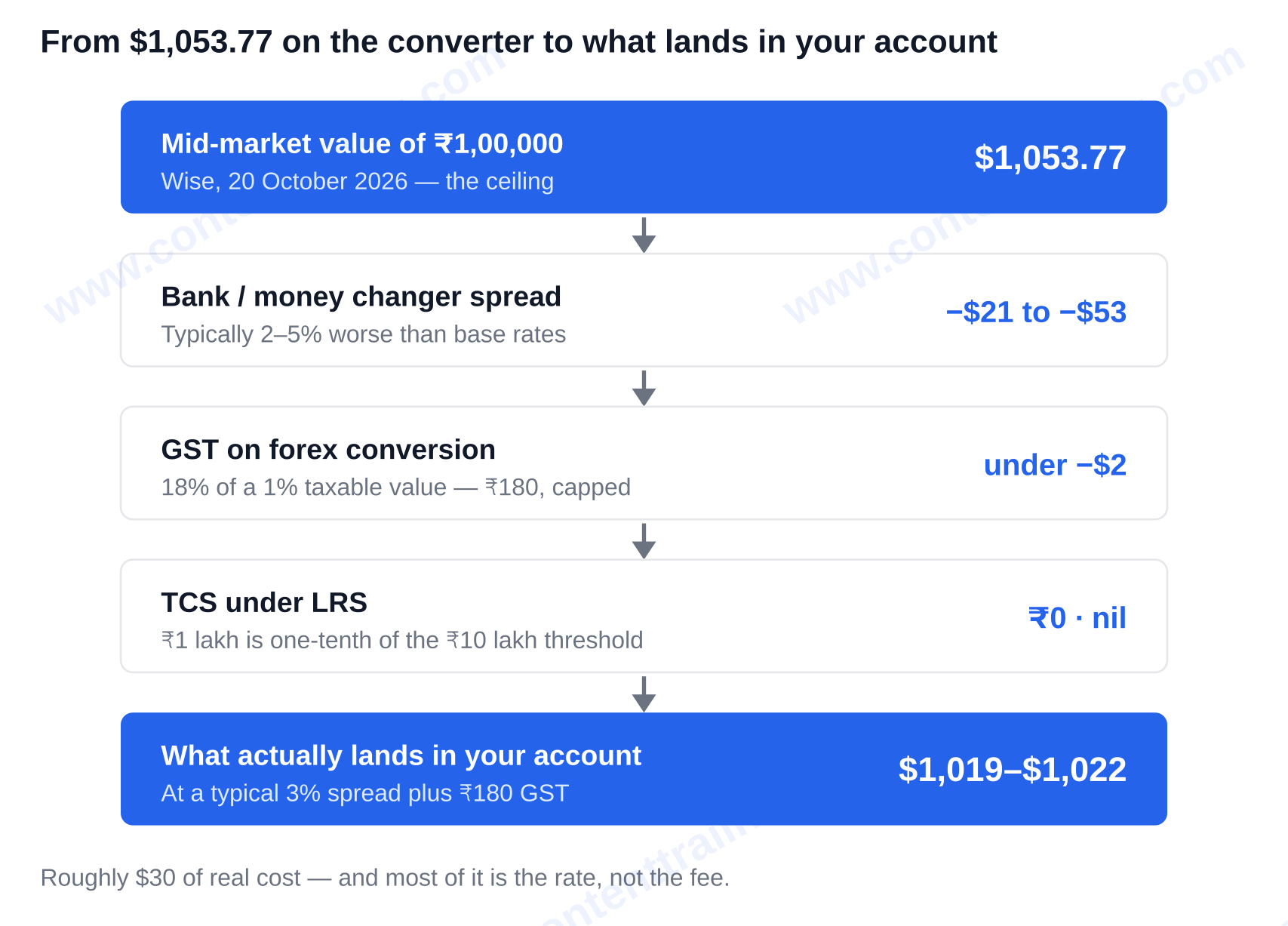
Treat $1,053 as the ceiling, not the expectation. In practice, three things sit between the converter and your account, and only one of them is big.
Cost one — the spread. This is where the money goes. BookMyForex notes that banks and offline money changers typically price 2 to 5% worse than base rates: ₹2,000 to ₹5,000 on a lakh, or $21 to $53 off your dollar total. Airport counters run up to 15% markup — a ₹15,000 haircut on ₹1 lakh for the convenience of converting in the departures’ hall.
Cost two — GST, and it is smaller than people fear. GST on forex is charged on a notional taxable value, not on the whole amount. Per ExTravelMoney’s breakdown of GST on foreign exchange transactions, for amounts up to ₹1 lakh the taxable value is 1% of the amount with a ₹250 floor, and 18% GST applies to that. So ₹1,00,000 tops out at ₹1,000 of taxable value and ₹180 of GST. Anything up to ₹25,000 pays just ₹45.
Cost three — TCS, which on this amount is zero. Covered in the next section, but the short version: ₹1 lakh is one-tenth of the threshold.
The real cost of converting ₹1 lakh: spread, GST and TCS compared
| Line item | What it costs on ₹1,00,000 | Effect on your dollars |
|---|---|---|
| Mid-market value (Wise, 20 Oct 2026) | — | $1,053.77 (the ceiling) |
| Typical bank / money changer spread (2–5%) | ₹2,000 – ₹5,000 | −$21 to −$53 |
| Airport counter markup (up to 15%) | up to ₹15,000 | avoid |
| GST on forex conversion | ₹180 (capped at this amount) | under −$2 |
| TCS under LRS | ₹0 | nil |
Put together at a typical 3% spread plus ₹180 GST, a ₹1 lakh transfer lands somewhere around $1,019–$1,022. Call it $30 of real cost that no converter page puts in front of you — and note that roughly $30 of it is the rate, not the fee.
So compare providers on their all-in dollar total, never on their advertised fee. A zero-fee transfer with a 4% spread is more expensive than a ₹500 fee at near mid-market.
Can you legally send 1 lakh rupees out of India, and is it taxed?
Yes, comfortably. Under the Liberalised Remittance Scheme, a resident individual may remit up to USD 250,000 per financial year (1 April to 31 March) for permitted purposes — education, medical treatment, travel, gifts, maintenance of relatives abroad and foreign securities. At about $1,053, ₹1 lakh uses roughly 0.4% of that annual cap. The cap is cumulative across the year, not per transaction, so keep a running total if you often remit.
On tax, the number to know is zero. TCS on a ₹1 lakh remittance is nil, because ClearTax’s guide to foreign remittance tax puts the TCS threshold under LRS at ₹10 lakh per financial year, counted cumulatively across all purposes. One lakh is one-tenth of it.
Worth correcting the “20% TCS” panic while you are here. That rate is marginal, not flat, and applies only to the portion above ₹10 lakh for investment, gift, and property remittances. ClearTax’s own worked example: on a ₹13 lakh investment remittance, 20% applies to the ₹3 lakh excess, so ₹60,000 is collected — not ₹2.6 lakh.
Category rules differ once you scale up. Education and medical remittances are nil up to ₹10 lakh and 2% above it; overseas tour packages attract 2% with no threshold at all. And TCS is collected tax, not a cost — it is creditable against your income tax liability, or refundable.
How much has the dollar value of 1 lakh changed in the past year?
Enough that any undated figure you find is suspect. Investing.com puts the USD/INR 52-week range at roughly ₹87.74 to ₹96.88, which means the same ₹1 lakh was worth about $1,140 at the rupee’s strong end and about $1,032 at its weak end — a swing of over $100 on a single lakh.
The direction has been one-way. Per The Wire, the rupee has depreciated about 7.04% in calendar 2026, against full-year moves of 4.9% in 2025 and 2.9% in 2024. For historical context, CEIC data shows the RBI reference rate hit an all-time high of 96.844 on 20 May 2026, against a record low of 45.897 on 2 September 2011.
It moves inside a single month too. The FBIL rate went ₹95.9927 on 1 October 2026, ₹95.032 on 14 October, then ₹95.0691 on 15 October 2026.
Practical consequence: check the date stamp before you quote a lakh-to-dollar figure from a blog post or an old reference table. Several percents of error are normal in a year-old number.
Is ₹1 lakh a lot of money — and should you even be converting it?
Separate two questions that look identical. Converting is for money that crosses a border. Comparing is for money earned and spent inside one country. The dollar figure answers only the first.
A ₹1 lakh monthly income converts to roughly $1,053 a month, and that number misleads badly if the salary is earned and spent in India. In Indian terms, ₹1 lakh a month is a solidly upper-middle urban salary. In US terms, $1,053 a month sits below most cost-of-living floors. The arithmetic is right, and the conclusion is wrong.
The conversion becomes the correct number when money genuinely moves: US tuition, a remittance to family, a dollar-denominated purchase, a foreign investment. As a lump sum, ₹1 lakh is meaningful in India — a few months of metro rent, or a decent used two-wheeler.
So ask yourself which job the figure is doing. Pricing something? Use the mid-market rate. Moving something? Use the provider’s all-in rate.
The bottom line
One lakh rupees is ₹1,00,000, worth about $1,053.77 at the mid-market rate on 20 October 2026 — and realistically $1,019–$1,022 in hand after a typical retail spread and ₹180 of GST, with zero TCS because ₹1 lakh sits far below the ₹10 lakh threshold. Before you convert or send, check the FBIL reference rate on the RBI site for the official benchmark, then get an all-in quote — rate plus fees, not fees alone — from two providers and take the better dollar total.
Rule of thumb: divide your lakhs by 0.95 for a quick dollar figure, then knock 3% off — the first number is what the rate says, the second is what you actually get. For more like this, explore Content Trail HQ.