


You’re typing a message, and you can’t help but wonder whether Mom takes a capital M. The answer rests on one question: what is a common noun, and is Mom working as one in your sentence?
So what is a common noun? A common noun is a general noun that names a member of a class of person, place, thing or idea — dog, city, teacher, happiness. Common nouns stay lowercase unless they begin a sentence or sit in a title. A proper noun is the name of a specific person, place, thing, or idea and is always capitalized — Fido, Paris, or Mount Everest.
What is a common noun in simple terms?
A common noun is a general or broad term that can include many members of a class. A proper noun is a term that describes a single member of that class. For example, teacher is a common noun that describes anyone who teaches. A proper noun could be Ms. Okafor.
See how it works in a sentence? The teacher parked her car near the school. Teacher, car, and school are the common nouns here. Her is a pronoun and near is a preposition, so neither qualifies, and nothing in the sentence names one particular individual.
Here is a starter set covering the four kinds of thing a noun can name: teacher, doctor, school, park, dog, cat, book, car, happiness, truth. Four people and places, four physical objects, two ideas. Every member is lowercase.
Are common nouns ever capitalized?
Yes, but only for reasons outside the word itself. A common noun at the start of a sentence takes a capital: “Dogs bark” is capitalized because the word opens the sentence, while “I have two dogs” is not. Title case is the other exception, where common nouns inside a heading or title take capitals too. Merriam-Webster sets out the same split between the two noun types.
There are other ways to classify nouns, such as concrete and abstract. Every noun in English is either common or proper, and those other classifications — concrete, abstract, countable, collective — stack on top of that split rather than replacing it.
Why are they called “common” nouns?
When used in this sense, “common” means “shared by a class,” as in “held in common” — not “ordinary” or “plain.” That distinction is easy to miss, and it is the part most short definitions leave out.
The term is a translation. In Latin grammar the pair was nomen proprium against nomen appellativum: a proper noun names one particular person or thing, while an appellative noun denotes things only in so far as they belong to a class — a name belonging to several things of one kind. Latin grammarians used appellativum rather than commune, and that term carried from antiquity through the Early Modern period before English settled on “common.” The word noun itself is a calque of Latin nomen, “name.” Thus, “common noun” means “shared name” in a strict sense.
Reading it this way eliminates the need to memorize the capitalization rule. A capital letter signifies individual identity. A lowercase letter signifies group membership. That single idea is more useful than a list of exceptions.
And if the label is really about class membership, then a word’s status can move — which is exactly what happens when the public starts treating a brand name as a category.
Can a proper noun turn into a common noun?
Yes. And trademark law records roughly when. This phenomenon is known as genericization, or genericide: a brand name becomes so widely used for the whole category that it stops naming one company’s product.
| Word | What happened | When |
|---|---|---|
| escalator | A registered trademark of the Otis Elevator Company, then ruled too common a term for all moving stairways | Trademarked until 1950 |
| thermos | Refers generically to vacuum-insulated containers in the US, while staying trademarked elsewhere | Generic in the US since 1963 |
| heroin | Bayer lost the trademark in some nations under the Treaty of Versailles | 1919 |
| aspirin | Generic in the US, but still a Bayer trademark for acetylsalicylic acid in about 80 countries, including Canada and much of Europe | Split status, present day |
Aspirin is the oddest case: the same word is a common noun in one country and a proper noun in another. Cellophane and zipper also appear on the same list of genericized trademarks.
Lowercase is often a judgment about public use, not a fixed grammar fact. Canadian federal style, for instance, capitalizes the trade names of drugs and manufactured products — unless those names have become established as common nouns. That exception does a lot of work, which is why a memorized list of cases will only take you so far, and why a reusable test is worth more than the list.
Common noun vs proper noun: how do you tell them apart?
Check the pairs first: dog / Fido, city / Paris, mountain / Mount Everest, girl / Gigi, company / Otis, river / the Nile. The ones on the left name a class, and the ones on the right name a member of the class.
Now you can test any word, including ones no list covers:
- Determiner or plural? If a word is preceded by a, the, my, your, or her, or if it is plural, it is functioning as a common noun and should be left lowercase.
- Could a real name be substituted for the word? If so, then that word is functioning as a proper noun in that sentence. Capitalize it.
Mom, president, south, spring: the test applied
Let’s look at some troublesome areas:
- Family terms: “My mom” is lowercase, but say “Hi, Mom,” which could also be “Hi, Diane,” and it’s capitalized.
- Job terms: “The president spoke” is lowercase, but “President Lincoln spoke” is capitalized.
- Directions: “Drive south” is lowercase, but “She grew up in the South” is capitalized, where the word names a region rather than a direction.
- Seasons: spring, summer, autumn, and winter are lowercase in English. There is no proper noun equivalent to flip to.
Yes, the same word can be both. Capitalization tells you what the word’s function is in the sentence, not something fixed about the word itself.
The one case the test doesn’t settle: a common noun swallowed by a proper name, as in the street in Oxford Street or the university in Harvard University. Those take a capital as part of the whole name, whatever a determiner would suggest.
What are the types of common nouns?
The guidelines differ: some name three types, others five. They don’t oppose each other. They describe overlapping axes rather than rival lists, and that is the part most explanations skip.
- Concrete or abstract describes what the thing is: a chair can be touched, happiness can’t be touched.
- Countable or uncountable describes how the word behaves: whether it takes a plural and a number.
- Collective sits on top of both as a label for a single word naming a group — team, family, committee.
Stack them on one word each and the confusion dissolves. Water is common + concrete + uncountable. Team is common + concrete + countable + collective. Happiness is common + abstract + uncountable. Car is common + concrete + countable.
And yes, water is a common noun. The uncountable label is why it feels different from car or cup — you don’t say “two waters” in most contexts — but it has no bearing on whether the word names a class. None of these labels changes the capital letter either. Every common noun stays lowercase.

How do you find the common nouns in a sentence?
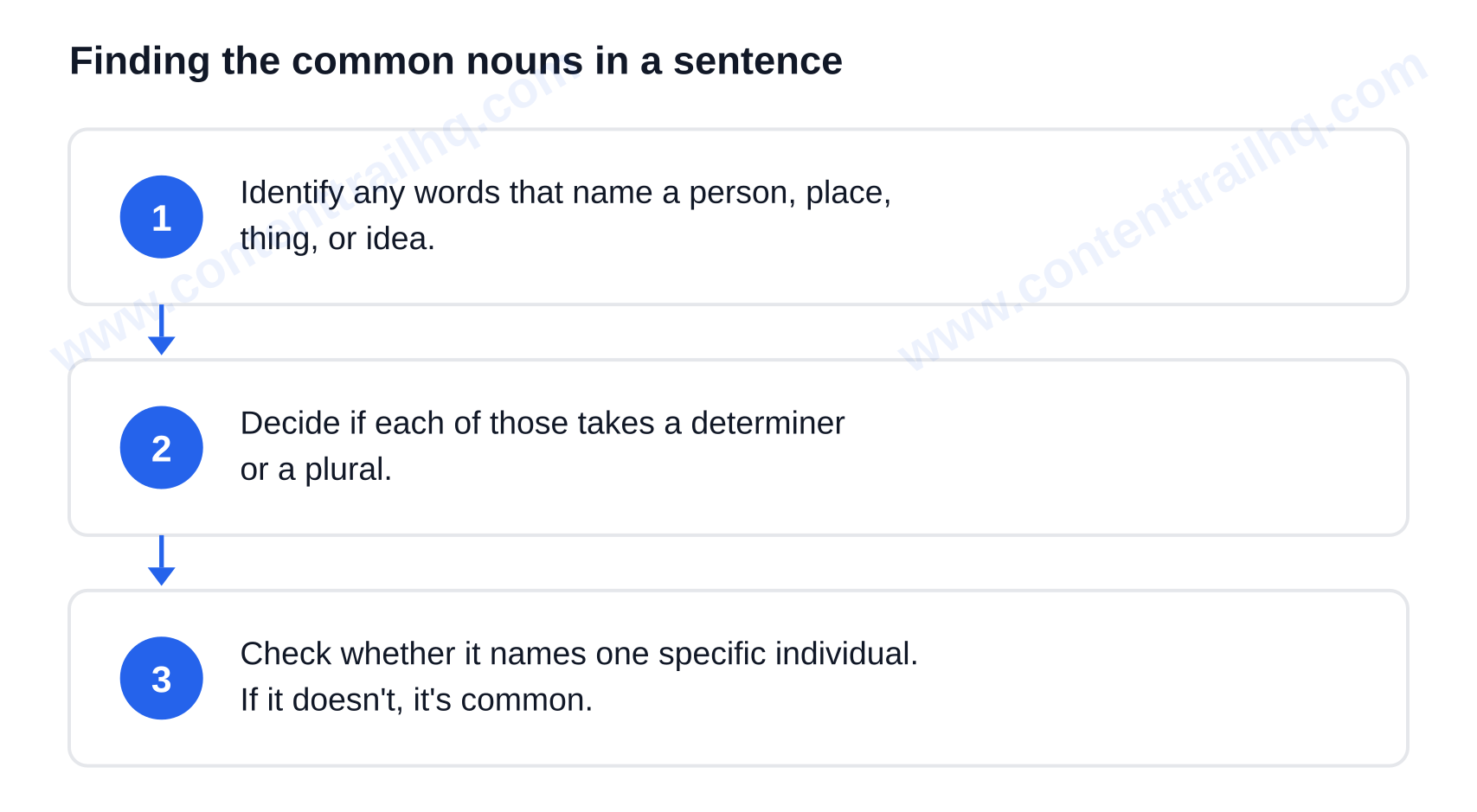
There are three steps:
- Identify any words that name a person, place, thing, or idea.
- Decide if each of those takes a determiner or a plural.
- Check whether it names one specific individual. If it doesn’t, it’s common.
Worked example: My brother drove the car to a hospital in Leeds. Brother, car, and hospital are all common nouns as each has a determiner in front of it. Leeds is proper as it names one city.
Trickier: I asked Mom versus I asked my mom. Same word. Two different jobs. The determiner in the second sentence drops the capital.
Try it: five quick sentences
- The dentist in Glasgow sent a reminder.
- Every spring, our neighbour repaints the fence.
- Senator Harris met the senator from Ohio.
- We took the escalator to the second floor.
- Her patience with the committee surprised everyone.
Answers: dentist, reminder / spring, neighbour, fence / senator (the second one only) / escalator, floor / patience, committee. Glasgow, Ohio, and Senator Harris are proper. Note that escalator only belongs in that list because of a 1950 ruling.
The mistakes to look for are predictable: capitalizing seasons, capitalizing a job title after a determiner, and lower-casing a common noun that’s been absorbed into a proper name.
The one line to keep
What is a common noun, in one line? It is a word that names a class. A proper noun names a member of that class, and “common” means held in common — not ordinary. The determiner-and-plural test will settle almost any capital letter question you hit, even words no list covers.
What is still moving is the boundary itself. Every few decades another brand name crosses it, and the lower case decision follows public usage rather than leading it. So go back to the sentence you were questioning when you did the search. Put a, the, or my in front of the word. If the sentence still sounds okay, leave it lower case and move on. You’ll find more guides like this across Content Trail HQ.
Quick Answers
What are 10 examples of common nouns?
Teacher, doctor, school, park, dog, cat, book, car, happiness, and truth. This set names all four things that a noun can represent — people (teacher, doctor), places (school, park), things (dog, cat, book, car), and ideas (happiness, truth). All ten are lowercase, unless they start a sentence or are in a title.
Do you capitalize “mom” and “dad”?
Only capitalize if it’s representing the person’s name. For example “Hi, Mom” can be “Hi, Diane” in the same spot, so it gets a capital. “My mom called” does not get a capital, because in that case, “my” is telling you that the word is naming a role, not a specific individual. The same is true for dad, grandma, and uncle.
Is “water” a common noun or a proper noun?
Water is a common noun because it is the name of a substance in general. It does not name a particular instance of the substance. Therefore, water stays lower case. Water is also an uncountable noun, which is why it behaves differently from car or cup — you do not normally pluralize it. You also do not normally put a number in front of it. That’s just a grammatical quirk, and it does not affect whether it’s common.
Can the same word be both a common noun and a proper noun?
Yes, and it happens constantly. President, mom, south, and river all switch depending on the job they do in the sentence. “The president spoke” is common. “President Lincoln spoke” is proper. A capital letter indicates how the word is functioning in that sentence, not something fixed about the word itself.
Are days of the week and months common nouns?
No. Monday, Tuesday, January, and July are proper nouns in English and always take a capital. The only exception that catches people off guard is the seasons: spring, summer, autumn, and winter are common nouns and stay lower case, with no capitalised counterpart to switch to.
Is a common noun always a thing you can touch?
No. Common nouns split into concrete (chair, dog, rain) and abstract (happiness, truth, freedom). Abstract common nouns name ideas, qualities, and states you can’t see or hold. Just like concrete nouns, they stay lower case unless they start a sentence or are in a title.









1 comment