You’ve been invited to one, and you’re not quite sure how to act. Should you treat it like a birthday party? No. Should you treat it like a wedding? Also, no. We’ll go over what a quinceanera is, the word itself (which doesn’t actually mean what most sites say it means), where it originates, what happens minute by minute, what it costs, what happens when you cross a border, and what to wear if you’ve been invited.
So, what is a quinceanera? Spelled quinceañera in Spanish, it’s a Latin American coming-of-age celebration for a girl turning fifteen. It is a festive expression of thanksgiving to God for having reached this special stage in her life, and for the fifteen years of her existence. It represents her passage from childhood to young womanhood. The name joins quince (fifteen) and años (years). It traditionally pairs a church blessing with a large family reception built around a formal waltz, a court of honor, and three symbolic rituals: the last doll, the changing of the shoes, and the father-daughter dance.
What is a quinceanera, and where does the word come from?
It is a rite of passage at fifteen, celebrated predominantly in Mexico, Central America, South America, the Caribbean and in the U.S. with Latino communities. There are variations in the traditions, but the overall concept is the same. The shape varies. The milestone doesn’t.
What the quinceañera really does is recognize that the honoree is no longer a child, and thank the family and God for all the years of life and support. That is why it is bigger than a normal birthday party.
Quinceañera, quince años, or quince: which word do you actually use?
Here’s the correction almost no page makes. “Quinceañera” is the feminine noun for the fifteen-year-old girl herself. It’s extended to the celebration, but more precisely the event on its own is fiesta de quince años, quince años, or simply quince. That’s why families say “her quince,” not “her quinceañera.” In a sentence, the girl is the quinceañera. You can find more information about the history and definitions of the words and terms where the etymology and terminology are laid out on Wikipedia’s quinceañera entry.
The masculine form is quinceañero, and was traditionally just grammar — the male counterpart of a word nobody needed. It is now used to identify an event teenage boys throw for themselves.
The word “quince” is pronounced KEEN-seh. “Quinceañera” is pronounced keen-seh-ah-NYEH-rah. The “ñ” is pronounced like the “ny” in canyon. If you are a guest, just say “congratulations on your quince” to the honoree. You’ll be correct to say “congratulations” to the parents as well.
Why the fifteenth birthday and not another age
Fifteen is the age the original rites marked, the divide between girlhood and the beginning of adult duties and responsibilities. Sixteen is an American invention, and eighteen is a legal age, not a cultural one. The tradition of celebrating a girl’s fifteenth birthday has held, even as the reason for the celebration changed.
A quinceañera is a big deal for the entire family, not just the girl. Parents host the event, godparents pay for various aspects of it, and the guest list extends far beyond their immediate circle. Many aunts, uncles, cousins, school friends, the court, neighbors, and often much of the parish are invited. If you are not family and you received an invitation, the hosts are not being thoughtless; it is by design.
Where did the tradition come from, and how has its meaning changed?
Originally this was a fertility rite, a rite of passage to mark a young woman’s readiness for motherhood. Later it was adapted to mark her transition to marriageability. Now, quinceañeras have morphed to include the celebration of a young woman’s faith as well as maturity. Three different purposes, one unbroken thread.
From Mesoamerican rite to Catholic ceremony
The traditions originate with the coming-of-age rituals among the Maya and Aztec peoples of ancient Mesoamerica — the region covering what is now Mexico, Guatemala, Honduras, Belize, El Salvador, and Costa Rica. They were part of a ritual to celebrate a woman’s readiness to be a mother.
That changed in the 1500s. Catholic Spanish missionaries and colonizers transformed the rituals and reshaped them into Roman Catholic form. They shifted the focus from the woman’s readiness to be a mother to her readiness to be a wife. In the process, they incorporated a Catholic Mass, the hooped gown of European court, a court-inspired crown and other trappings of the European upper class. History.com traces this transformation in detail. The ballgown and tiara you’ll see at a quince in 2026 are, in essence, borrowed European court dress layered onto an Indigenous ceremony.
What the celebration means today
Over the years, as the customs and rituals surrounding the celebration continued to evolve, so did the purpose for which the celebration was held. Today the purpose is less to mark a girl’s readiness for motherhood and marriage, and more for the family and community to celebrate her faith, her maturity and her responsibility to her family and community.
Folklorist Norma E. Cantú of Trinity University has the sharpest insight on this point: the celebration requires the community’s participation, and that participation identifies the honoree’s obligation to the community. The crowd isn’t an audience. It’s the mechanism. Cantú also notes that Cinderella is, by far, the most prevalent theme for parties today.
In practice, that looks like a parish hall or banquet center with Cinderella décor, the honoree in a full ballgown, a court of a dozen friends in matching dresses, and a professionally choreographed dance that will be on TikTok by midnight. The quinceañera is a public declaration of heritage for Latinos in the United States, a statement of the family’s pride in their culture — not just a milestone party.
What happens at a quinceañera, in order?
The Mass, which takes about an hour, is followed by a lengthy reception of five to six hours. The whole celebration commonly runs from late morning into the night. Plan accordingly.
The church ceremony
A Mass of thanksgiving is said — Misa de Acción de Gracias. During the Mass the honoree receives Holy Communion. She also makes an act of consecration to the Blessed Virgin Mary and presents a bouquet of flowers to her, often Our Lady of Guadalupe. The priest blesses and presents gifts she’ll keep, including a Bible, a rosary, a ring, a tiara, or a necklace.
The reception, step by step
- Formal entrance and presentation. The court enters, then the honoree, announced.
- Toasts and speeches. Parents and godparents first, usually.
- Food. Expect to eat later than usual.
- The symbolic rituals. Last doll and changing of the shoes.
- El vals. The formal waltz.
- The surprise dance. What people really remember.
- Cake. Late. Don’t leave before it comes.
The three symbolic rituals: last doll, shoes, and waltz
La última muñeca — the last doll. She receives a doll, frequently dressed to match her gown, and often the doll is then given to a younger girl, typically a younger sister or cousin. She is giving up her childhood and giving the doll to a girl who is still a child.
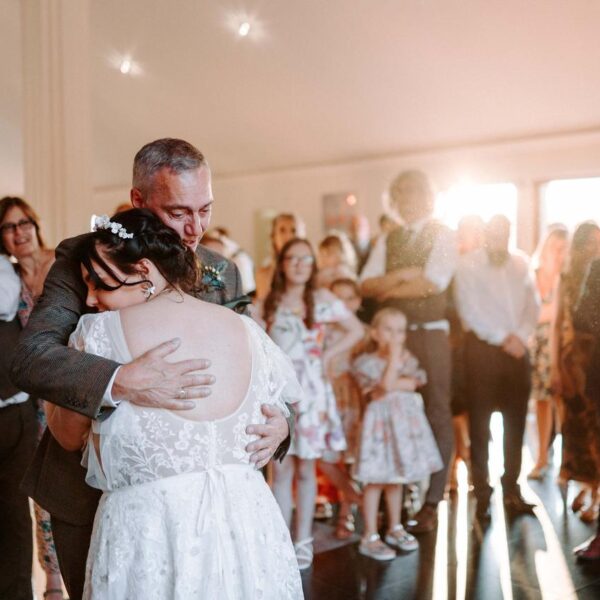
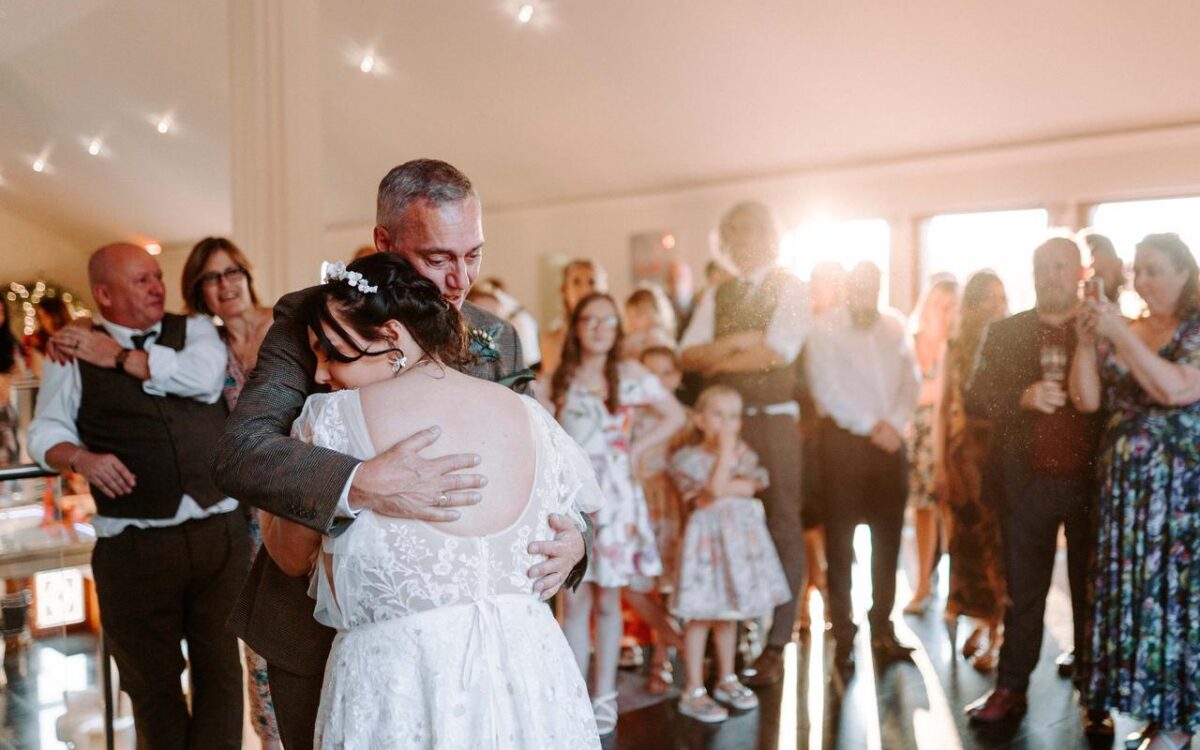
Changing of the shoes. Her father kneels and swaps her flat slippers for high heels. It’s the clearest visual shorthand for the entire transition, and it’s the moment the room goes quiet.
El vals. This formal waltz is danced with her father, grandfather, or godfather, and then the court joins in. She carries a scepter and wears a tiara, the symbols of a princess in her family’s eyes.
What people really remember is the surprise dance, which breaks the spell on purpose: pop or reggaetón, heavily rehearsed, typically the court in a second outfit.

What the ranking guides get wrong about the church rite, the cost, and the court
Three things almost every other page glosses over. In practice, these are the three that matter most to a family actually planning one.
The rite has an official name and a 2007 confirmation date
The Catholic portion is not an improvised “special Mass.” It is a named bilingual rite — Bendición al cumplir quince años / Order for the Blessing on the Fifteenth Birthday — approved by the full body of US bishops and confirmed by the Vatican’s Congregation for Divine Worship and the Discipline of the Sacraments in a letter dated July 10, 2007, for use in US dioceses. The rite contains elements to be integrated in the Mass and elements to be celebrated outside of it.
The prerequisites are the parts that are generally not disclosed. According to the Archdiocese of San Antonio’s published quinceañera recommendations, diocesan policy commonly requires:
- Baptism, Reconciliation, and Holy Communion already received — and Confirmation in many, though not all, parishes
- Registration in the parish or a letter of good standing from her pastor
- Attendance at a quinceañera retreat by the honoree plus her damas and chambelanes, with the certificate of completion filed at the home parish
- The celebration held in a parish church or chapel — as a Mass or a Liturgy of the Word, individually or for a group
In comparison, a simple blessing outside of Mass is a much lighter lift — sometimes as little as a coordinator meeting two months ahead. That gap between the two paths is the most helpful planning information on this page.
What a quinceañera really costs — and who pays
Most sites just repeat a range of $5,000–$20,000 with no survey behind it. A Mi Padrino survey covering 525,000 quinceañeras reported an average of $21,781 in 2019, which, according to KPBS reporting from June 2026, would be roughly $28,372 in 2026 dollars. Families in the reporting say $25,000–$30,000 is normal, and $50,000–$80,000 is the high end.
| What most guides say | What the sourced reporting says |
|---|---|
| “$5,000–$20,000,” unsourced | $21,781 average (Mi Padrino survey, 525,000 quinceañeras, 2019); ~$28,372 in 2026 dollars |
| No figure for a high-end celebration | $50,000–$80,000 at the top end; $25,000–$30,000 described as typical |
| Silent on how families afford it | Dress layaway plans starting around $200 a month; some families take on debt |
| “It usually starts with a Mass” | A named rite, Vatican-confirmed July 10, 2007, with documented prerequisites |
| “14 damas and 14 chambelanes” | Courts commonly run 7 to 15 pairs; all-damas or all-chambelanes is fine |
How families really pay for it is a better story. Madrinas and padrinos (godparents and sponsors) each take on an individual element, the dress, the music, the photography, the cake. This spreads the cost out across the extended family, and honors those relationships. A sponsored cake is not a discount, it is a role. Beyond that, layaway plans start around $200 a month for a dress, some families go into debt, and KPBS quotes one venue manager who says 90% of his bookings are quinceañeras.
Do you need 14 damas and 14 chambelanes?
No. Courts of honor commonly run from 7 to 15 pairs of damas and chambelanes, and the honoree has the choice to select all damas, all chambelanes, or no pairs whatsoever. The recurring “14” frequently stated as a rule is symbolic and represents her fourteen previous years, the same symbolism behind the fourteen candles in Cuban celebrations.
The decision rule, for any family hitting conflicting advice: pick the number from those who are actually closest to her, and not from a number you read online.

How does it differ by country — and who does the standard description not fit?
“Mass first, then the reception” is a specific Mexican Catholic template. It doesn’t universally apply, and assuming it does will only lead you to expect the wrong things about several of these.
Country by country: what changes and what disappears
- Cuba. The focus is music and choreography. The primary attraction is fourteen couples waltzing around the honoree, and fourteen candles for her fourteen previous years. Mass is absent from the center.
- Argentina. Similar format, but without chambelanes or a choreographed court.
- Brazil. The Portuguese-speaking equivalent is the festa de debutantes or festa de quinze anos, where the honoree dances with every male relative plus one boy her own age.
- Puerto Rico. A baile de debutantes is common, presenting her to society.
- Colombia. Can cost as much as a year’s wages.
- US Latino communities. A blend of the previous ones, with a larger focus on production and a relaxation of religious standards.
Quinceañera vs. Sweet Sixteen, bat mitzvah, and debutante ball
| Celebration | Age | Religious component | What the ritual claims |
|---|---|---|---|
| Quinceañera | 15 | Often a Catholic Mass or blessing; frequently secular | Passage into young womanhood, with responsibility to family and community |
| Sweet Sixteen | 16 | None | A milestone birthday; no claim about status |
| Bat mitzvah | 12–13 | Central — a synagogue service | Religious adulthood and obligation to Jewish law |
| Debutante ball | Usually 16–18 | None | Formal presentation to society |
Quinceañeros, queerce, and secular alternatives
The tradition has expanded past its original gendered framing. Reported as an up-and-coming Gen Z tradition, teenage boys across the US are increasingly having their own version — the quinceañero — keeping the age-15 milestone and the party, and modifying the traditions to be more of their own and less of a court-and-gowns celebration.
Trans, queer, and nonbinary teens are holding “queerce” and adapted celebrations that keep the fifteenth-birthday milestone and are leaving behind the binary “you are a woman now” framing entirely. Secular and non-Catholic families are choosing to hold ceremonies outside the Catholic church, or skipping the party all together to take a family trip instead. You do not have to be Catholic to have a quince.
You’ve been invited to one — what do you actually do?
Dress up more than you think. A long night awaits and don’t forget to stick around for the cake. That’s most of it.
What to wear (and why not white)
Dress semi-formal and err on the side of cocktail. Two hard rules: never wear white because that competes with the gown, and never wear anything that upstages the honoree. If you know the court’s color, avoid that too. You don’t want to get mistaken for part of the lineup.
If there’s a Mass, arrive on time, silence your phone, and if you are not Catholic, stay seated during Communion. Nobody will mind. Walking up to Communion when you shouldn’t is the only awkward thing to do.
What to give, and how much
A religious keepsake, a piece of jewelry, a photo book, or a contribution toward whatever she’s doing next are all great gifts, or you can go with the old reliable money in a card. No one will think less of you for that.
On the amount: there’s no “right” amount, and any page claiming to know the “answer” is just pulling a number out of a hat. Set it by how close you are to the family and what is customary in your area — your co-worker’s daughter and your goddaughter are not the same line item. If you’re not sure, ask another guest what they plan to give.
How long it runs and when to arrive
Expect the Mass to last about an hour. Plan for the reception to last about five to six hours. Plan for dinner to be served later than you are used to. The waltz and surprise dance occur mid-way through the reception, and the dancing runs late.
Several small things that are more important than they sound: congratulate the parents, not just the honoree. Stay for the waltz. And if you’re not family, come anyway — it is the duty of the community to celebrate the quinceañera, which is the entire point of it.
A quinceañera is a 15th birthday turned into a public passage into young womanhood. But the word names the girl as much as the party, the church portion is a specific rite with real prerequisites and lead times, and the version you attend depends heavily on which country’s traditions the family keeps. Because variations of this celebration can occur anywhere, ask your host family one question — is there a Mass before the reception? — because the answer determines what you wear, when you arrive, and how long your day will be.
Rule of thumb: dress like it’s a wedding, give like it’s a graduation, and stay like it’s family. We have lots of practical guides like this across Content Trail HQ.
Quick Answers
What is the purpose of a quinceañera?
It publicly marks a girl’s passage from childhood into young womanhood on her 15th birthday. There have been shifts over the years regarding the purpose of this tradition. First, with the Maya and Aztec rites, readiness for motherhood was celebrated. In the 1500s, with colonization by the Spanish, this rite of passage changed to mark a young woman’s transition to marriageability. Today, a young woman’s maturity is celebrated, including her faith and her responsibility to family and community. According to folklorist Norma E. Cantú of Trinity University, the community has to participate in the ritual — the crowd is part of the ritual, not an audience for it.
Do you have to be Catholic to have a quinceañera?
Not at all. Lots of families celebrate entirely secularly or hold celebrations in a church that is not Catholic, and some families opt to take a trip instead of holding a party. But a Catholic rite does require real prerequisites. Diocesan policy commonly requires that the young woman has already received Baptism, Reconciliation, and Holy Communion (and Confirmation in many parishes), registered-parishioner status or a letter of good standing, and a retreat attended by her as well as her damas and chambelanes. A simple blessing outside of Mass would be a much easier, lighter process to coordinate.
Can boys have a quinceañera?
Yes! It’s called a quinceañero, the masculine form of the word. Reporting says that across the US, teenage boys are increasingly holding their own version, an up-and-coming Gen Z tradition. They keep the age-15 milestone and the party, but rather than follow the gown-and-court template they customize the traditions to the honoree’s personality. Likewise, queer, trans and nonbinary teens are holding ‘queerce’ celebrations, which keep the fifteenth-birthday milestone and leave behind the gendered framing.
What is la última muñeca, the last doll?
La última muñeca is the moment the honoree receives her last childhood doll — often dressed to match her gown — and then gives it away, frequently to a younger sister or cousin. Handing the doll to a younger girl is the symbolic act of passing childhood on. It’s one of three signature rituals, alongside the changing of the shoes (her father swaps her flats for high heels) and el vals, the formal waltz with her father, grandfather, or godfather.