David Buss studied 37 cultures and 10,047 people and found kindness and intelligence rated highest as attractive by both men and women, so when you ask what do women want? The answer is simple. Women want kindness and intelligence. Women want dependability. Women want honesty and emotional safety. Women want to feel desired. The gap between the sexes is priority and proof, not the wanting itself.
This page will give you the list. Other pages, masquerading as high value, are less forthcoming. Ranking is provided where possible and likely. Stated trait preferences are weak predictors of real attraction. The items on these lists might give you a nudge in the right direction, but two things do move relationship satisfaction: carrying the mental load, and understanding responsive desire. These things appear on almost none of those lists, so this page will give them to you.
So What Do Women Want, in One Clear Answer?
What do women want? The same things men want. The difference is largely behavioral and ranked differently. In Buss’s 37-culture dataset, kindness and dependability are strong convergences along with good health. In the same study, along with kindness, women reported long-term partner desirability with understanding.
There is one consistent divergence. Women in 36 of those 37 cultures rated “good financial prospects” as more important than men did. Women want good financial prospects not in the sense men want a girlfriend with money, but rather security and self-sufficiency — can you run your own life — not a price tag.
Three different questions hiding inside one search
People ask this question looking for three different things. The most common is looking for relationship advice, which is the bulk of what is contained in this article. Other seekers look for the science of female desire. Freud’s “Was will das Weib?”, and the contrary book by Daniel Bergner are in this category. Lastly there are those looking for the 2000 Nancy Meyers film in which Mel Gibson plays a chauvinist Chicago ad executive who starts hearing women’s thoughts. After making $182 million domestically and $374 million worldwide on a $70 million budget, it was loosely remade in 2019 as “What Men Want” with Taraji P. Henson. The relationship advice comes first.
Why a Trait List Won’t Predict What She Actually Wants
Generally, stated preferences indicate the standards people will hold you to, but are often unrelated to reasons for attraction. In Eastwick and Finkel’s speed-dating research, the ideal preferences participants stated before the event failed to predict who people desired to date. Further, in the study, the famous sex difference — men saying looks matter and women saying earning prospects matter — vanished entirely in face-to-face interaction.
The 2025 update is a refinement, not a shift. Writing in the European Journal of Personality in August 2025, Zhao, Sidari, Lee and Zietsch found that in fact stated preferences do align with attraction in speed-dating, but with small effect sizes.
How to use the list anyway
You can use this list any way you want, but I encourage you to think of it as a standard of excellence and not as a formula. A standard, as opposed to a formula, encourages self-auditing against a list of behaviors instead of adjectives. Some men, after reviewing a list like this, changed the way they audited themselves. Instead of auditing themselves against a list of adjectives, they reviewed their conduct over the last two weeks and audited the promises they made, what they noticed, and what they let slip. Attributes are claims. Behaviors (or a lack thereof) are the proof, and behaviors are the half the research keeps pointing at.
What Do Women Want From Men Emotionally?
Emotional safety is what women want most, and it’s the foundation of everything on the list. Emotional safety means, in part, that she can be fully vulnerable without judgment or ridicule, and without having her vulnerability quoted back to her and used against her in an argument. No other part of this list works without it.
After that, this part of the list is consistent, and it mirrors the trait structure Suzanne Degges-White describes in Psychology Today: moral integrity and relational sensitivity, and satisfying intimacy. Respect is all-or-nothing — honesty, fidelity, and owning your own behavior without being managed into it. Reliability compounds: small broken promises cost more than grand gestures earn. No one wants to be told what to do, and the woman in your life is no different. The easiest way to satisfy her is to actively reflect and paraphrase to her what she says, and to ask whether she wants input or company before you supply a plan. It costs you nothing, and it shows her you’re actively listening. Most of the time, she doesn’t want you to tell her what to do. The highest and best use of your time is to simply be with her and present for her.
The other half is attention, and it’s cheap. Frequency beats expense:
- A text in the middle of the day about something specific, not “hey.”
- Remembering the name of her difficult coworker and asking how that went.
- Desire said out loud, not only initiated in bed — chosen, not merely available.
- You initiate conversations because she’s not pulling that from you.
- Rooting for her to win, including when it’s inconvenient for you.
This breaks down when you perform attention during the pursuit and withdraw it during the commitment. The latter can read as a bait and switch because it is one.
Does She Want Help With Chores, or the Mental Load Gone?
She wants the management job gone and no list on the internet tells you that. Mental load — who notices, remembers, plans and delegates — is not the same as physical labor. Researchers Klein, Ascigil, Oschatz and Kahalon found in 2026 that mental load plays a bigger role in relationship satisfaction compared to physical housework or women’s gender ideology, and that partners systematically underestimate the burden, with it being most pronounced with college-educated, employed women.
The raw load gap is also present. Research on household labor shows women cooked, cleaned, and did yard work for nearly two hours a day while male partners did about half that, and women carrying a disproportionate share report higher depression, stress, burnout and dissatisfaction in their relationship.
So “share responsibilities” and “just tell me what to do” are the wrong phrases. A man who executes tasks on request still leaves her holding the clipboard. Taking charge of cognitive load also means taking control over the noticing, the remembering and the deadline — take two or three whole domains end to end, all school logistics, or all vehicle and home maintenance. The test is simple. If you still need to be reminded to do it, you haven’t taken charge of it.
What Do Women Want in Bed — and What Does the Science Say?
Two specifics the advice pages skip, both of which alter what you would quit doing. The first is something called responsive desire. Rosemary Basson’s non-linear model holds that many women don’t experience desire the way men do. Instead of spontaneous desire, many women experience responsive desire. This means a woman may feel no initial desire, with desire emerging after stimulation and emotional intimacy begin. A common mistake many men make is thinking that the woman should come to bed already wanting it — that misreads the sequence. Build the context — warmth, novelty, low pressure, no resentment carried over from the chores — and treat “not right now, but start and see” as normal rather than rejection.
The second omission is something called arousal non-concordance. In men, there’s roughly a 50% overlap between how turned on a man feels and his genital response. For women, that number drops to about 10%. Lubrication is not consent or interest, and its absence is not rejection. Again, don’t read a woman’s body as a gauge; ask.
What women want in bed after that is usually non-transactional: adventure, intellectual stimulation, her pleasure treated as the point rather than a courtesy, and no keeping score. Daniel Bergner’s What Do Women Want? Adventures in the Science of Female Desire pushes back on the whole inherited frame — that women aren’t visual, have lower drive, or are aroused by love rather than sex — and lands on female desire as an underestimated and constrained force.

What If She Doesn’t Want a Relationship Right Now?
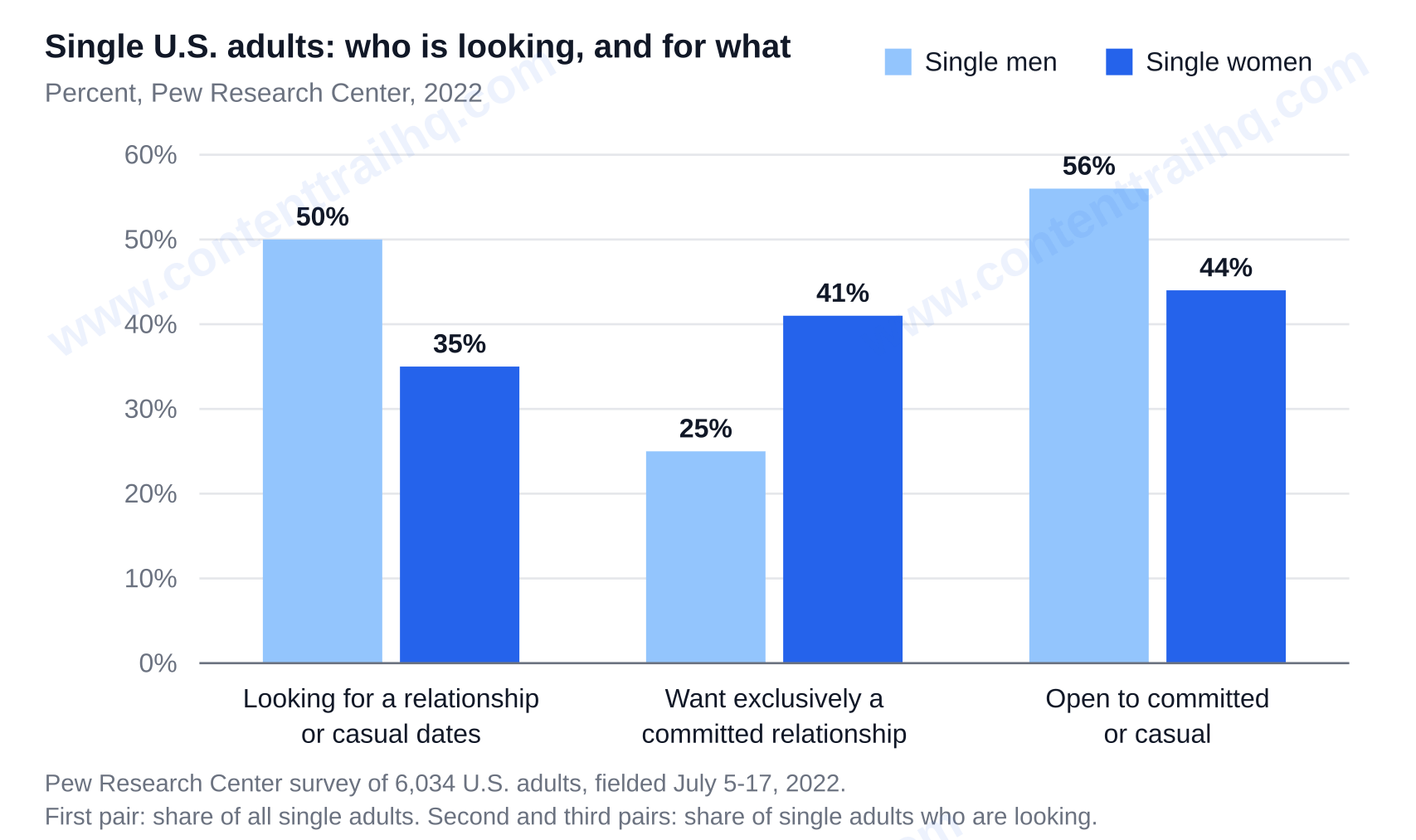
Sometimes the honest answer to what do women want is “right now, not this.” The advice pages assume demand for male attention is constant. At population level it isn’t. A survey of 6,034 U.S. adults by Pew Research Center, fielded July 5–17, 2022, found that 30% of U.S. adults are single and 57% of single adults are not currently looking for a relationship or casual dates — with 50% of single men looking for romance versus 35% of single women.
Among those who are looking, the mismatch is often about terms rather than interest: 41% of women want exclusively a committed relationship versus 25% of men, while 56% of men stay open to either committed or casual versus 44% of women. The share of single Americans seeking romance also fell from 49% in 2019 to 42% in 2022, with men’s interest dropping 11 points while women’s stayed relatively stable. The Survey Center on American Life adds that 45% of single women say having more important priorities is a major reason they aren’t dating, and that college-educated women especially report not finding someone who meets their expectations.
The shift is not to run the list any harder at someone that is not looking. It’s raising your baseline for the traits the cross-cultural data calls near-universal.
Which of These Should You Work On First?
Behavioral data, preference data, and the advice lists live on different pages. Here they are in one grid — what she’ll say she wants, whether cross-cultural preference data backs it, and what behavioral research says actually moves anything.
| What she’ll say she wants | Cross-cultural support (Buss, 37 cultures) | Predicts actual attraction or satisfaction? | First action this week |
|---|---|---|---|
| Kindness and empathy | Strong — top-rated by both sexes | Yes as a long-term standard; weak as a short-term lever | One unprompted kind act a day |
| Dependability and follow-through | Strong — named point of convergence | Yes — it’s a behavior, not a claim | Keep every small promise for 14 days |
| Honesty, respect, fidelity | Not separately quantified in that dataset | All-or-nothing; no partial credit | Drop one habitual small deception |
| Emotional safety, non-judgmental listening | Not measured in that dataset | Strong — gates everything else | Ask “help or company?” before advising |
| Intelligence and conversation | Strong — rated most attractive by both sexes | Modest; small effect sizes in speed-dating (Zhao et al., 2025) | Bring one real thing to talk about |
| Good financial prospects / self-sufficiency | Strong — rated higher by women in 36 of 37 cultures | Stated weight didn’t predict desire in person (Eastwick & Finkel) | Fix your own logistics; never lead with income |
| Physical attractiveness and effort | Not among the sourced top-rated traits | Stated preference didn’t predict in-vivo desire | Sleep, train, dress one notch up |
| Confidence and self-regulation | Not measured in that dataset | Indirect — it shows up as her emotional safety | Stop outsourcing your moods to her |
| Sustained attention and small gestures | Not measured in that dataset | Yes — frequency beats expense | One specific midday message daily |
| Cognitive ownership of the household | Not measured in that dataset | Strongest recent signal (Klein et al., 2026) | Take two domains end to end |
| Responsiveness and prioritizing her pleasure | Not measured in that dataset | Yes, via responsive desire (Basson) | Build context; ask instead of reading her body |
| Support for her ambitions | Not measured in that dataset | Plausible; not isolated in the sourced studies | Clear her calendar for one thing she’s chasing |
The pattern that emerges: the universals are character traits, not performances, and the strongest predictors are ongoing behaviors rather than attributes. The most important gates are safety and reliability. Fix those rows before optimizing anything below them.
Four questions worth asking out loud
There is no substitute for asking this woman specifically. Each list here, including this one, describes a population, and you are with one person. Men often skip this question because they are afraid it might suggest failure and/or bring on a verdict. Approach this from the standpoint of maintenance. After that, ask: what do you wish I did more of? What are you handling that you would like me to take over? When you’re upset, do you prefer I do something or just be with you? What do you want more of in bed? Choose a calm moment to ask. Don’t defend during the answer, and write it down. Change one thing within a week based on it, so the asking looks sincere. Repeat it on a cadence, because preferences move with workload, health, kids, and age.
The biggest opportunity this week? Pick a household domain and own it end to end, noticing and remembering included. That’s the best single bet for most readers, because it’s the item with the strongest recent evidence and the one no competing page will tell you. The field in this space is clearly trending away from self and trait evaluations, toward the observation and documentation of behavior — the 2025 and 2026 research is quietly shifting the question from which traits women rate highly to which behaviors actually predict satisfaction. Expect the next round of advice on what do women want to be written in verbs, not adjectives. The trait lists are going to get new dates on top, but will not get new answers. Keep digging on Content Trail HQ.
FAQ
What do women want most in a relationship?
She wants to feel emotionally safe, and thus, be able to be fully vulnerable — without judgment or having it used against her later. After that comes dependability, honesty, attention, and feeling desired. Buss’s 37-culture study of 10,047 people puts kindness, dependability and good health at the top for both sexes, so being kind and being healthy are certainly not exclusive to women. What’s unique is the order of what she wants, and the fact that she isn’t swayed by how you introduce yourself, rather what you demonstrate over time.
What do women find most attractive in a man?
In Buss’s cross-cultural data, kindness and intelligence were rated most attractive by both men and women. But Eastwick and Finkel’s speed-dating study found that preferences didn’t predict who people actually desired in a face-to-face meeting, and the 2025 follow-up by Zhao and colleagues found only small effect sizes. Therefore, consider the attractiveness list as the standard she will hold you to long-term, not as a formula for sparking attraction now.
Do women want a provider or a partner?
Mostly a partner and not a liability. In Buss’s cross-cultural data, women rated “good financial prospects” as more important than men did in 36 of 37 cultures, which suggests a preference for security and self-sufficiency rather than a specific income. Notably, Eastwick and Finkel found that stated preference for earning prospects didn’t predict who people desired in a face-to-face situation. Hence, it is more important to run your life competently as a partner than to demonstrate your earning power.
Why is ‘what do women want’ considered an unanswerable question?
Freud primarily framed the question that way. His “Was will das Weib?” and his theory that women have a weaker sexual instinct turned it into a rhetorical shrug. Daniel Bergner’s book argues close to the opposite, that women’s desire is an underestimated and culturally constrained force. The “unanswerable” framing primarily serves as a convenient excuse to not ask the woman in front of you.
Is it bad to ask a woman directly what she wants from you?
No, it’s the most reliable way of figuring it out, and lists are a poor substitute. The reason people say it goes badly is because of the way it is executed, not because of the question. Ask when things are calm, do not defend yourself while she answers, write down the answer, and change one thing she mentions within a week. Asking without a visible follow-up change is worse than not asking, because it can appear as a survey.
Do men and women actually want different things from a relationship?
No, not to the extent the headlines say. Buss’s data shows men and women converged on kindness, dependability and good health, with the main divergence being that women rated good financial prospects higher in 36 of 37 cultures. Eastwick and Finkel found the famous stated sex difference vanished entirely in live interaction. Where real gaps show up is the mental load — Klein and colleagues (2026) found it predicts relationship satisfaction more strongly than physical housework, and partners underestimate it.