For the most part, Nike and adidas agree on sizing, and at the same published US sizes for men’s both sit at 27.1 cm (US 10). Convert your foot length to centimeters and then see where the model you’re looking at fits in the size chart. Air Force 1s run large. The adidas Samba runs narrow.
Does Nike or Adidas Run Bigger? The Short Answer
Nope. Lined up by foot length, the charts agree. According to size.ly’s chart-by-chart comparison, Nike US 9 and adidas US 9 both sit at 26.2 cm (EU 42 2/3). US 10 is at 27.1 cm (EU 44) and US 11 is at 27.9 cm (EU 45 1/3). No hidden half sizes are sneaking around in the published range.
So your best bet is a two-step method. First, convert your foot length to centimeters and match it against the brand’s size chart. Second, use the model’s fit note. The name on the box is the least helpful step in the process.
People still feel a difference, and that feeling is real. Nike tends to build a narrower forefoot with tighter midfoot lockdown; adidas uses a more relaxed last. Upper constructions make a difference too. A forefoot that is locked down too tightly can make a shoe feel smaller. Different materials in the upper — a Flyknit or Primeknit knit against leather — can make a shoe feel bigger or smaller despite having the same length. Different models can feel completely different even if they are the same size.
The only thing that breaks straight-across conversion is women converting between the two brands. That’s covered below.
So should you size up, size down, or keep your size?
Size-for-size is the default — keep your centimetre-matched size. For a model like the Air Force 1, a half size down, and a Nike Dunk Low is your usual size. If the forefoot is pinching, a width change is in order, but not a length change.
Nike vs. Adidas Sizing Chart: US, EU and Centimetres Compared
Read across from your foot length in the left-most column. All the rows below are backed up by the brands’ published charts rather than estimated, so the ranges are tight. If your measurement is between rows, head to the brand’s chart with your centimeter value.
| Foot length | Men’s US (Nike & adidas) | Nike women’s US | adidas women’s US | EU (adidas labelling) |
|---|---|---|---|---|
| 24.6 cm | 7 | 8.5 | 8 | — |
| 26.2–26.3 cm | 9 | 10.5 | 10 | 42 2/3 |
| 27.1 cm | 10 | 11.5 | 11 | 44 |
| 27.9 cm | 11 | 12.5 | 12 | 45 1/3 |
In men’s adidas’ own men’s chart, a US 9 is a UK 8.5 / EU 42 2/3 with a 26.3 cm foot, which is the same foot Nike labels US 9.
Why the two women’s columns diverge
See the middle columns? Those aren’t errors. Nike pairs up men’s sizes to women’s sizes 1.5 up, while adidas pairs women’s sizes 1 up from men’s, so they share the same feet, but have different labels. Of course, that’s where the half-size myth comes from, and it’s covered in the next section.
Reading adidas’ EU thirds (42 2/3, 45 1/3)
adidas prints EU sizes in thirds because its grid is derived from UK half sizes, which don’t divide evenly into whole EU numbers. A more tidy conversion can be found on Nike’s site, which publishes entire and half EU sizes — but the result either way is one foot and two different-looking EU numbers, and neither brand is wrong. In both cases the EU label can be disregarded and the centimetres can be trusted.
The Half-Size Myth: Why Everyone Says Nike Runs Smaller
When talking about women’s Nike and adidas shoes, there is a clear “half-size myth” perceived by consumers. The “Nike runs half a size smaller” rule is mostly a labelling artefact, and this myth stems from a number of factors — none of them shoe length.
Nike’s women’s +1.5 vs. adidas’ +1
Do the arithmetic. An adidas women’s 8 and an adidas men’s 7 are both 24.6 cm. Nike’s chart maps a men’s US 8 to a women’s US 9.5 — half a number further apart than adidas. So Nike’s women’s +1.5-step correlates to a half size further than adidas’ +1 women’s step, resulting in a built-in half-size error before the shoe is even manufactured. This is exactly what is repeated and cited across review sites, lifted from a size chart and mistaken for a shoe.
What 36,578 measured pairs actually show
Model variance swamps any brand rule. According to Feetlot’s owner-reported dataset, there are 36,578 verified pairs across 200 Nike models, including 13,834 pairs of Nike Air Force 1s checked October 2026, rating Nike’s sizing consistency as “LOW, one of the least consistent brands measured”. Since Nike is that inconsistent, there can’t be a single offset. The question “does Nike run small?” is the wrong one; ask which Nike.
Why width gets mistaken for length
People think a narrow forefoot means that shoe is small, and therefore assume the problem is length. To fix the problem, they purchase a larger size. This creates a longer shoe, which adds toe room nobody needed, pushes the flex point past the ball of the foot, and causes the heel to slip. The length-based size-up causes more returns than it prevents, so just order your centimetre-matched size and change the model or the width instead.
Model-by-Model Fit: Where the Brand Rule Breaks Down
Here is the fit note that should override anything you’ve read about brands. Nike’s own size guidance contradicts itself within two of their lifestyle silhouettes — which is the point.
| Model | How it fits | What to do |
|---|---|---|
| Nike Air Force 1 | Runs large; roomy toe box, loosens further with break-in | Half a size down — unless you have wide feet, then stay at your usual size |
| Nike Dunk Low | True to size, per Nike | Half up for wide feet, half down for a snug fit |
| Nike Blazer Low, SB Dunk Low | Run large | Consider half down |
| Nike Air Max 95/97/Plus/270, Air Huarache, Cortez, Tanjun | Run small | Try half up, especially with thicker socks |
| Nike Kyrie 6 | Small by nearly a full size | Size up and try before committing |
| adidas Superstar (1,678 pairs) | True to size | Order your centimetre-matched size |
| adidas Ultraboost 2.0/20/3.0 (451 pairs, UB 2.0) | True to size but snug and sock-like through the Primeknit midfoot | Keep your size; skip if you need forefoot volume |
| adidas Gazelle (906 pairs) | Slightly large and narrow | Keep your size; narrow feet suit it best |
| adidas Samba Classic (489 pairs) / Samba OG | True to size but feels narrow | adidas advises wide-footed buyers go half a size up |
Pair counts are Feetlot’s owner-reported figures as published; Air Force 1 and Dunk guidance comes from Nike’s own sizing pages. The rule for the Air Force 1s is different from the rule for the Dunk Lows. Read the first two rows again: the difference between the two Nike models is greater than the alleged difference between the two brands.
Lifestyle vs. running vs. basketball vs. football boots
For models not listed above, use category logic. Lifestyle and court silhouettes tend to run generous and boxy, true to size and consistent through the size run. Running models tend to be a little smaller and fitted and tapered, and may require going up a half size. Basketball is built performance-tight and can also require going up a half. Football boots are deliberately tighter than your lifestyle size — that’s the design, not an error.
Which Fits Wide Feet Better, Nike or Adidas?
Nike — and that inverts the usual advice. Adidas builds more of a relaxed last in general, but Nike is the brand that publishes true graded widths. At a men’s US 8, the grades run approximately as follows: B (8.73 cm), standard D (9.68 cm), wide 2E (10.64 cm) and extra-wide 4E (11.59 cm). Offered on in-line models like the Pegasus. Adidas offers wide options far less consistently.
The principle here is that a width problem needs a wider shoe, not a longer shoe. A larger size relieves forefoot pressure, but buys unnecessary length and loses heel lockdown.
- Wide feet, Nike: graded-width running models in 2E or 4E first; otherwise a roomier lifestyle shape like the Air Force 1 at your usual size.
- Wide feet, adidas: Superstar or Ultraboost over the narrower Samba and Gazelle — and if you want the Samba, take adidas’ own advice and go half a size up.
- Narrow feet: go for the adidas Samba OG and Gazelle; Nike’s tapered running uppers suit you too.
- Avoid if wide: Air Huarache, Air Max 270 and Primeknit adidas models punish forefoot volume.
Check width availability on the actual product page each season. Nike ties 2E and 4E stock to specific in-line models such as the Pegasus 42, not to whole ranges.

How to Measure Your Foot and Check the Fit Before You Buy
Measurement of your foot is important if you want to buy the right size shoes, and doing it once means you never have to guess at nike vs. adidas sizing again. Measuring your foot is not as complex as it looks. Stand with your back against the wall with a piece of paper and a pen. Mark the places where the longest toe is and the heel is, then measure the distance between the two and write it down. Measure both feet and use the larger. This measurement should be done at the end of the day as your foot swells a bit and measures the largest size. You can also use the Brannock device found in stores to get your measurement and width grade.
Once you have the centimetre measurement written down, you can take it to each brand’s chart to compare, instead of carrying a US number between brands. Measurement should be done with the kind of socks you will wear — a thick crew sock can eat half a size of volume on its own.
The four-point fit check
- One thumb’s width should be the space between your toes and the end of the shoes.
- Your heel should be fixed in place, with no lift when you walk.
- The flex point of the shoes should be at the ball of your feet, not behind it.
- No side to side movement of the shoe when you cut.
Both brands have half sizes across most of their men’s and women’s lines, and both allow free returns and exchanges within their stated time frame. Leather lifestyle shoes take time to break in and mold to your foot. The knit uppers do not have the same stretch and mostly don’t. So it’s best to measure your foot and order the size that corresponds to that measurement. Test it indoors on carpet to see if it will work for you, and exchange it if it doesn’t rather than just ordering the next size up and hoping it will work.
Three Things to Remember
Stop acting like this is a brand question.
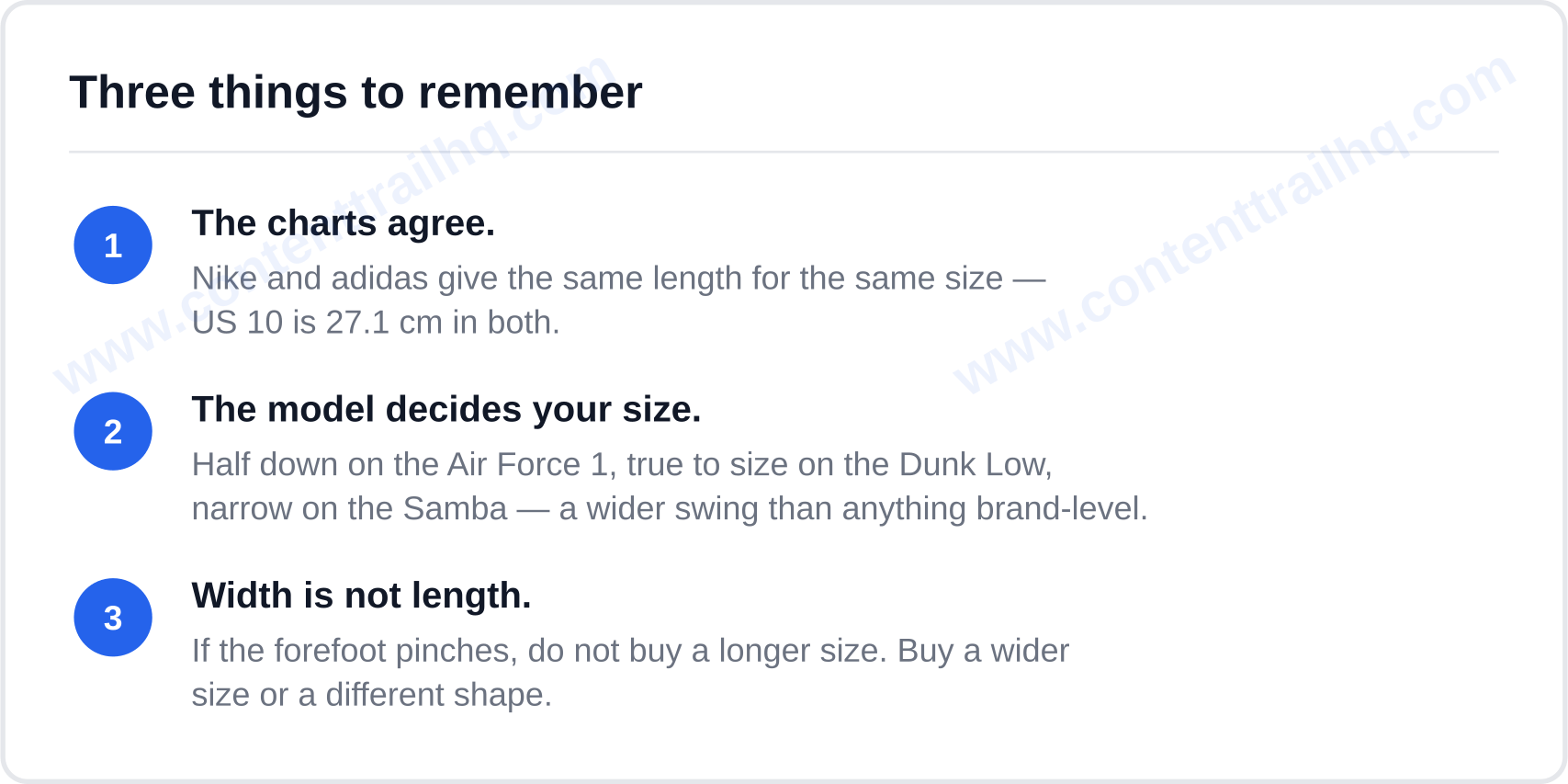
- The charts agree. Nike and adidas have the same length for the same size — US 10 is 27.1 cm in both.
- The model decides your size. Half down on the Air Force 1s, true to size on Dunk Lows, narrow on Sambas — a wider swing than anything brand-level.
- Width is not length. If the forefoot pinches, do not buy a longer size. Buy a wider size or a different shape.
Next step: measure your feet in centimetres tonight, identify your row on the conversion table above, then check that exact model’s fit note before you add to cart. You can find many other helpful guides like this around Content Trail HQ.