
Fun facts for kids are surprising statements that are often used for story-time at school, classroom games, icebreakers, and trivia games — like “an octopus has three hearts” or “sharks are older than trees”. The best ones are short, run one sentence, are appropriate for the age of the audience, and endure the test of time: “is that really true?”
That’s where most lists stop. I looked through the pages that are currently ranking for this topic and not one of them cited a source for a single fact. Some repeat disputed claims that have been debunked for years, including one on nih.gov. This list does two things the others don’t: it provides a named source for every statement and sorts the facts by the age band they’re appropriate for.
What makes a good fact (and how to use this list)
For this list to be useful, facts had to meet these three criteria:
- The fact had to be short. If multiple sentences were needed to explain the fact, it is not a fact.
- The fact had to be surprising. A good fact is something a child doesn’t already know and wouldn’t be able to find on their own (i.e. not “cows eat grass”).
- There had to be a named source. The source for this list can’t be another list, it has to be NASA, the Smithsonian, a museum, or a peer-reviewed paper.
Facts are organized by category and age range, and there’s a selection table further down to help you find the facts quicker instead of scrolling two hundred items. Teachers and homeschoolers, here’s your rebuttal. The “hard-to-believe” tier includes citations you can show on the screen, allowing students to fact-check for themselves.
Which “fun facts for kids” aren’t actually true?
Most kids have learned at least one of the following, and now you can teach them the sources to set the record straight.
- “It is physically impossible for pigs to look up at the sky.” Not true. The NIEHS Kids’ Fun Facts page on nih.gov says “pigs can’t look up at the sky.” The short, muscular rooting neck of a pig does limit how far up it can look, but doesn’t prevent it. Make a noise above a pig and it looks up.
- “You swallow eight spiders a year in your sleep.” The same NIH .gov page says “every year we swallow 70 insects and 10 spiders in our sleep.” There are no specimens of insects or spiders, and no eyewitness accounts. Scientific American traces this “fact” to a 1993 magazine article where the author deliberately created fictitious “facts” to show how fast an unverified claim can spread, and the Burke Museum says the same. A person sleeping breathes, has a beating heart and snores. Those vibrations warn spiders to stay away.
- “Brontosaurus never really existed.” Outdated as of 2015, when Tschopp and others published a revision to Diplodocidae in PeerJ, based on analysis of 81 skeletons and 477 skeletal characters, reinstating Brontosaurus as a valid genus alongside Apatosaurus. The better fact: Brontosaurus was erased for roughly a century, then returned.
- “There are nine planets.” Pluto has been a dwarf planet since the International Astronomical Union’s vote on 24 August 2006 because it has not cleared its orbital neighbourhood in the Kuiper Belt. Five dwarf planets are officially recognised by the IAU (Ceres, Pluto, Haumea, Makemake and Eris), and the IAU expects more than a hundred may still be undiscovered.
How to fact-check a fact in 30 seconds
To fact-check, name what the claim is about and then add the name of the relevant institutional source: “Pluto NASA,” “spider myth museum,” “Brontosaurus PeerJ.” If the only sources quoting and repeating the claim are listicles, treat it as folklore. And when a child says it and it’s a dud, explain the real answer, and make it fun: “That one turned out to be wrong, and here’s how scientists worked it out.”
Space and the solar system (ages 8–12)
- Mars has Olympus Mons, the tallest volcano in the solar system, at roughly 3 times the height of Mt Everest.
- One year on Uranus is 84 Earth years and it’s tipped almost on its side, so one season lasts about 21 Earth years.
- Ganymede, a moon of Jupiter, is larger than Mercury. A moon, bigger than a planet.
- Pluto lost planet status in 2006 because astronomers found similar worlds deeper in the Kuiper Belt, and NASA Science explains the reclassification in a way that satisfies 10-year-olds’ appetites.
- You do weigh very slightly less at the Equator than at the poles, because gravity is not perfectly even across Earth. This one is a hit with ten-year-olds, because they can use it to challenge an adult.
Animals, ocean creatures and bugs (ages 3–7)
- An octopus has three hearts — two pump blood to the gills, one to the rest of the body.
- A blue whale’s heart is the size of a small car, and it’s the largest heart of any animal that has ever lived.
- Sea otters hold hands while they sleep so the group doesn’t drift apart on the current.
- Hummingbirds are the only birds that can fly backwards.
- Butterflies taste with their feet, and then check if a leaf is proper for laying eggs.
- A flamboyance of flamingos is a collective noun for a group of flamingos, and like most common nouns it doesn’t need capitalization.
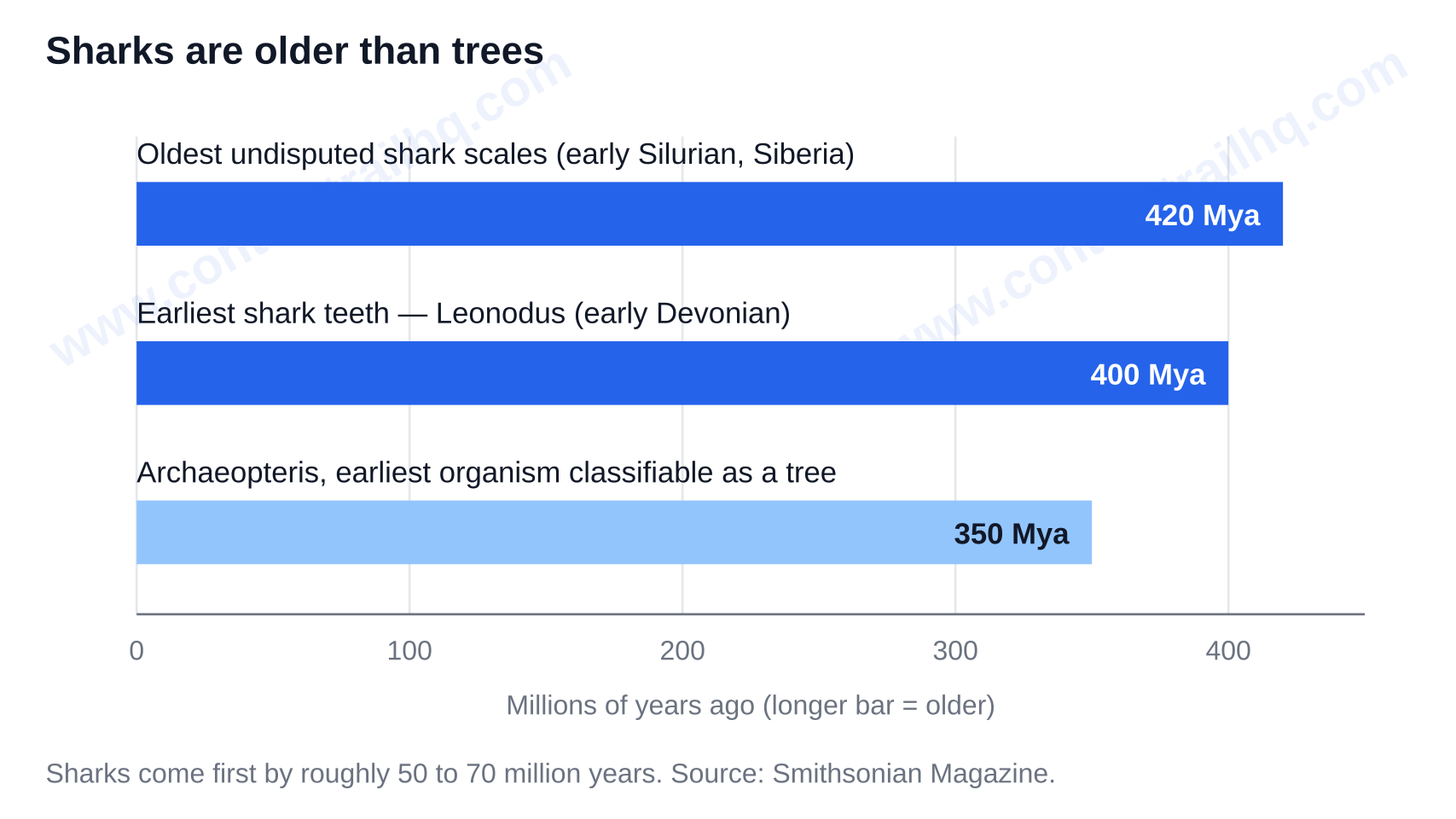
- Sharks are older than trees. Smithsonian Magazine dates the earliest shark teeth to the early Devonian period, around 400 million years ago, from a shark called Leonodus. Undisputed shark scales date to the early Silurian period, roughly 420 million years ago, in Siberia. Archaeopteris, the earliest organism classifiable as a tree, dates to around 350 million years ago, which is around 50 to 70 million years after sharks first swam the ocean.
Body, food, Earth and history (ages 8–12)
- Human body: your tongue has thousands of taste buds that are replaced throughout your life, and a sneeze leaves your nose fast enough you can’t do it with your eyes open. This is the gross-but-safe tier, and eight-to-twelves love it most.
- Food: a tomato is botanically a fruit and honey is one of the only foods that does not spoil. Sealed jars stay edible more or less indefinitely.
- Earth and weather: it snows in the desert, lightning heats the air around it faster than it can get out of the way, and most of the ocean floor has never been mapped in detail.
- History and dinosaurs: the pyramids were already ancient when the Romans visited them as tourists, and Brontosaurus is a real genus again (the best dinosaur fact going).
Which fun facts for kids suit your child’s age?
Match the fact to the child’s obsession first (sharks, space, football, dinosaurs). Interest beats novelty. Then use the band below.
| Age band | What kind of fact lands | Example from this list | Best way to use it |
|---|---|---|---|
| 3–5 (preschool) | One short clause, one clear image, no numbers | A group of flamingos is a flamboyance | Read-aloud or bedtime fact |
| 5–7 (early elementary) | Animal and body facts with a comparison they can picture | A blue whale’s heart is the size of a small car | Fact of the day, show-and-tell line |
| 8–12 | Records, superlatives, gross-but-safe body facts | Ganymede is bigger than Mercury; the Equator weight trick | Trivia night, Two Truths and a Lie, school icebreaker |
How to make a fact actually stick
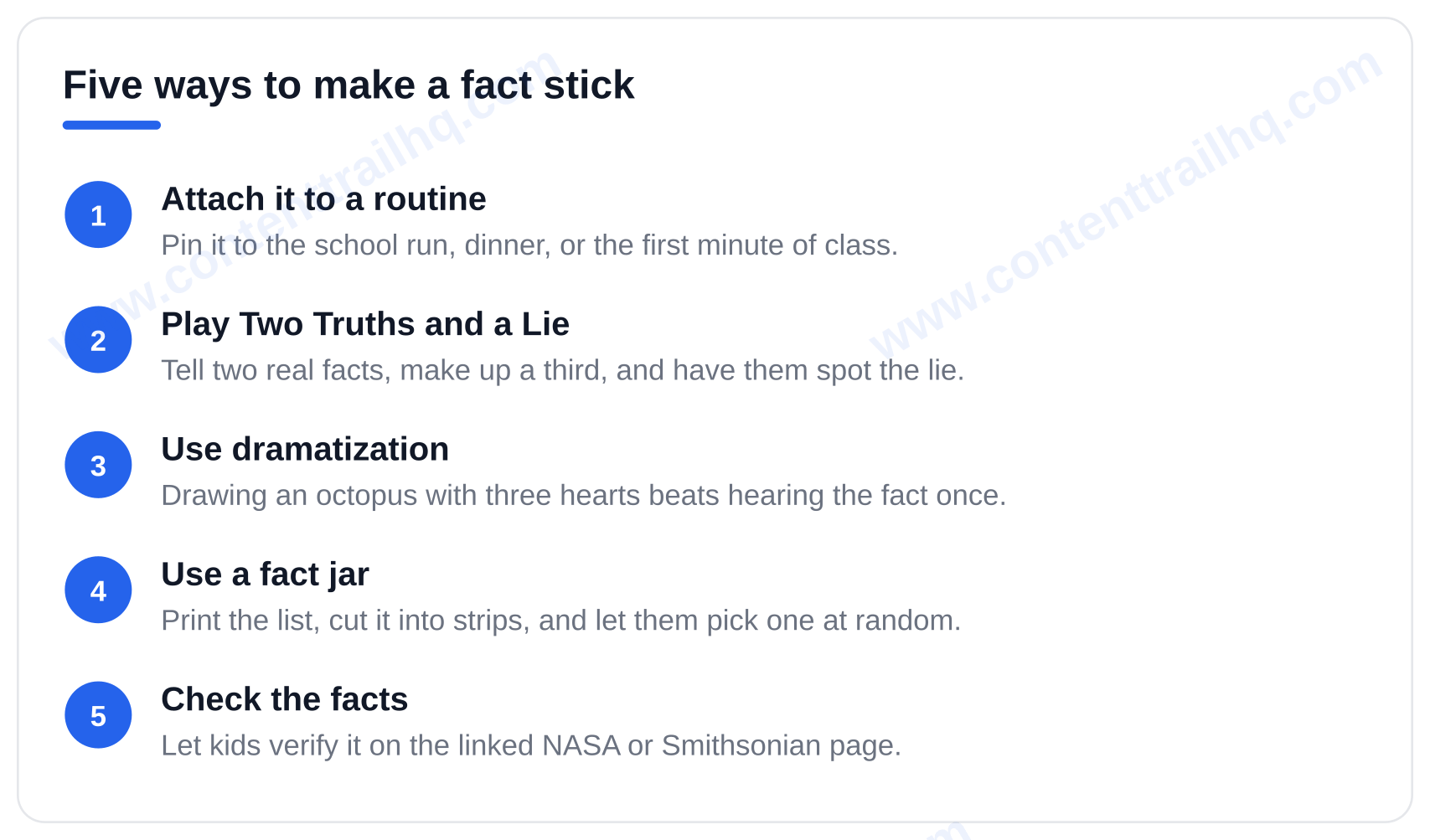
- Attach it to a routine. It’s easier to remember a fact attached to something you already do. Driving your kids to school? Tell them a fact, then do the next. Dinner time? Tell a fact as you clear the plates. First minute of class? Tell a fact.
- Play Two Truths and a Lie. You tell two real facts from above, make up a third, and have them guess the lie. Reasoning it out is stronger than memory.
- Use dramatization. Have them draw or act out the fact — sketching an octopus with three hearts encodes it far better than hearing it once.
- Use a fact jar. Print this, cut it up, have them pick a fact at random.
- Check the facts. Have the kids pull the facts and verify them using the linked NASA or Smithsonian page. The fact becomes their discovery, not something they were told — and that is the version they repeat a week later.
Check out the shark fact. If you only take one, take this one. It sounds made up, it passes the “is that really true?” test, and the Smithsonian site has the dates to back it up. Pick three facts from your kid’s age band, check one using the linked site, and start the fact jar this week.
Quick Answers
What is a good fun fact for a kid to share at school?
Something odd enough to get a reaction, short enough to share in one breath. “An octopus has three hearts” works for younger kids; “Jupiter’s moon Ganymede is bigger than the planet Mercury” works for ages 8 to 12. If it’s for an icebreaker or a “fun fact about me” prompt, tie it to something the child actually does — a sport, a pet, a place they’ve been — because they’ll deliver it with more confidence.
What is the weirdest fun fact that is actually true?
A single season on Uranus lasts about 21 Earth years. The planet takes 84 years to go around the Sun and is tipped almost entirely on its side, so one childhood there wouldn’t cover a whole winter. One of the best runners-up: sharks were swimming around tens of millions of years before the first tree existed.
Are sharks really older than trees?
Yes. According to Smithsonian Magazine, around 400 million years ago an ancient shark named Leonodus swam the seas — that’s the date of the earliest shark teeth, from early Devonian deposits — and the oldest undisputed shark scales have been dated to roughly 420 million years ago in early Silurian deposits in Siberia. Archaeopteris, the earliest organism classifiable as a tree, lived around 350 million years ago, so sharks come first by roughly 50 to 70 million years.
Is there a printable version of these fun facts for kids?
Print this page straight from your browser and cut it into strips — each bullet is written as a standalone one-liner, so it works as a lunchbox note, a worksheet line, or a slip for a fact-of-the-day jar. If you’re printing for a class, keep the mythbusting section intact, as the citations are what let a doubting student check a fact for themselves.
How do I find facts that match what my child is already into?
Start with the obsession, not the list. Search the thing they love plus the institution that would know — “sharks Smithsonian”, “volcanoes USGS”, “Mars NASA” — and find your facts on the agency or museum page, not a roundup. Interest beats novelty, so one good fact about your kid’s favourite animal will outlast twenty random ones.