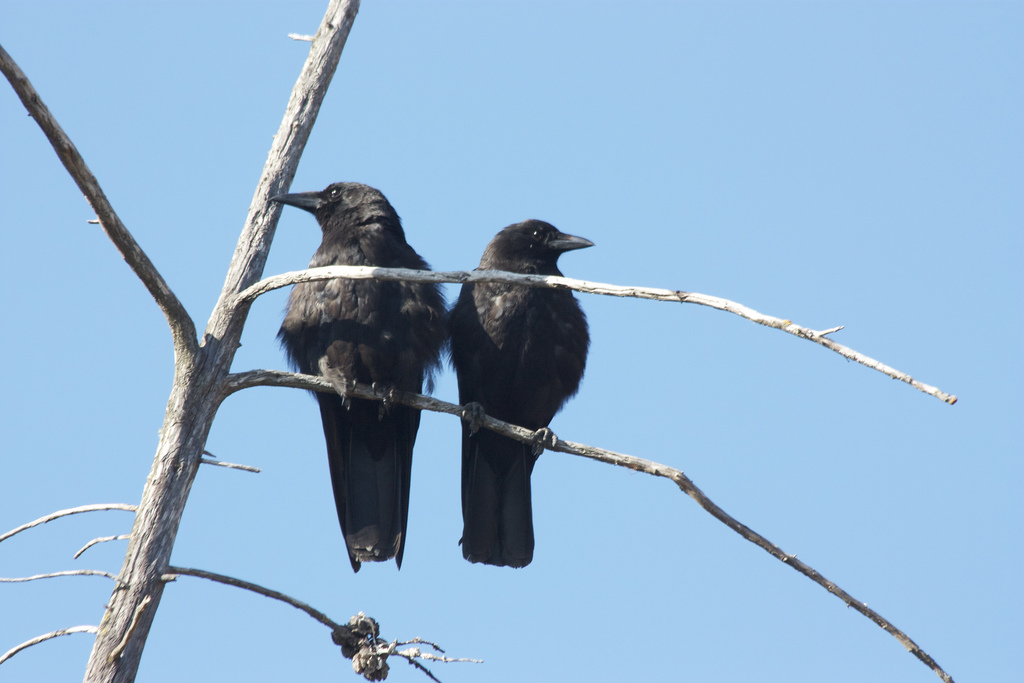
What most people think of when they consider the meaning of two crows is joy, partnership, and good fortune. This belief is essentially the reverse of the idea that a single crow brings sorrow. The idea of a pair of crows bringing good fortune stems from a folkloric rhyme first recorded around 1780 that deals with magpies and counting. This idea was not present in ancient crow lore. More contemporary ideas dealing with the spiritual dimension of a pair of crows brings in the concepts of duality, balance, messages, and change.
Here is the concrete version. You are walking to your car in late February and two crows sit together on a wire, quiet, close, away from any flock. The rhyme says mirth. An 1828 naturalist said fair weather. Crow researchers say it might be a bonded pair — or a parent and last year’s chick. All three are worth knowing, and only one of them is a prediction.
What does it mean when you see 2 crows together?
A pair reads as joy, partnership, balance and good news. One bird reads as sorrow. That is the whole folk answer, and it is genuinely that simple.
What makes it confusing is that people are usually blending at least three layers and don’t notice it:
- Folk rhyme — luck and mirth, counted off on sight. English, eighteenth century, and originally about magpies.
- Mythology — black birds as messengers. Odin’s ravens, Celtic prophecy, Shinto guidance.
- Modern spiritual reading — soulmates, twin flames, angel number 2, transformation. The 20th and 21st centuries, dealing with myths and folklore.
Most things that are shared online are in that third layer. Symbolic, not ornithological. Useful for reflection, not forecast. With honest frames, the bird you saw was a crow, but a lot of the lore that stuck to it was first stuck to magpies and ravens.
We count corvids because of ornithomancy; the ancient art of divining the future by interpreting the behaviors of birds. As RTÉ Brainstorm notes, this superstition moved through nursery books and oral traditions and became widespread across Britain and Ireland, where children unconsciously recited a rhyme upon spotting a magpie. The belief faded, but the counting reflex remained.
Where does “two for joy” actually come from?
It comes from a printed rhyme with a date on it. The original wording is not “joy.”
The original c. 1780 wording, line by line
The earliest recorded version dates to around 1780, in Samuel Johnson and George Steevens’ supplement to The Plays of William Shakespeare. Per Wikipedia’s entry on the rhyme, we find the rhyme, “One for sorrow, Two for mirth, Three for a wedding, Four for death.”
Four lines. No girl, no boy, no silver, no gold, no secret never to be told. Those all came later, as well as the change from “mirth” to “joy.” Because of that changing nature of the rhyme, competing sites can say “two crows mean joy” and have no source because the phrase they are quoting is a later, popularized version of the earlier saying.
It is also a magpie rhyme. Wikipedia is explicit that jackdaws, crows, and other Corvidae are only sometimes substituted, “particularly in America where magpies are less common,” and that in eastern India the common myna takes the place of the magpie. That short statement accounts for the whole of the American search activity on the subject; in areas where magpies are uncommon, the symbolism transferred to the nearest available black bird.
Why one bird meant sorrow and two meant mirth
Sir Humphry Davy, writing in 1828, provided a mechanism you can actually check. A lone bird means poor, inclement weather, as its mate is likely on the nest incubating the eggs. Two birds means mild, settled weather, and in Davy’s terms, fair weather for fishing.
“Two for mirth” therefore meant a fair weather observation, and was not a prophecy. Two visible birds were evidence of good conditions, which is more interesting than the mysticism that took its place. That no page addressing this question bothers to mention this is a shame.
Knowing the rhyme has changed does not diminish your sighting. It changes the site of the meaning, from the bird to the person counting.

Are two crows a sign of love, or just a family group?
Often, yes, a family group. This is the limit on the romance reading, and no one states it.
Do crows mate for life?
Many sources get this far correct: crows are monogamous, and once a pair of bonds, they stay together for life. In the spring and summer, families of two to eight crows can be seen together, while large flocks can be seen in the autumn and winter. Crows help build the nest and raise their young together. So, a pair that is off on their own is usually a bonded pair.
However, there is more to the story. The American crow (Corvus brachyrhynchos) is a cooperative breeder. In research published in 2024, it was documented that helpers at the nest were offspring from previous years that had stayed on the territory to help with nest building, incubation and defence, as well as forage for food.
How to tell a mated pair from parent and offspring
A spring or summer sighting near a nest is at least as likely to be a parent and a grown chick, or two siblings, as a mated couple. The tells:
- Family group — breeding season, close to a nest, coordinated feeding or food-carrying, sometimes a third bird nearby helping them forage and/or feeding young.
- Bonded pair — quiet, closely associating, off on their own outside a flock, late winter before nesting starts.
If you happen to run into an angel number 2 or a twin flame reading, don’t get too caught up in it — those readings grow from the pair-bond idea. Number two represents a partnership regardless of which two birds you happened to see.

What do two crows mean in different traditions?
Each tradition says something different, and each one was originally about a specific bird. Collapsing that is how magpie luck ends up presented as ancient crow wisdom.
| Bird | Tradition | Date or era | What a pair of means |
|---|---|---|---|
| Magpie | English folk rhyme | c. 1780 | Mirth; later popularised as joy and good luck |
| Raven | Norse mythology | Medieval | Odin’s Huginn and Muninn — thought and memory |
| Crow | Japanese Shinto | Ancient | Fortune, guidance, protection |
| Crow and raven | Celtic; Native North American | Pre-modern | Messengers, prophecy, second sight; intermediaries between seen and unseen |
| Raven | Christian scripture | Biblical | Instruments of provision, not omens |
| Crow | Modern spiritual synthesis | Contemporary | Duality, partnership, transition, transformation. |
Two crows in the Bible: ravens, not crows
Material in the Bible concerns ravens. The ravens that gave food to Elijah show up as God’s provision, and as Digital Bible notes, the scriptural framing helps to direct readers away from omen-reading and toward providence. If you are coming from a Christian perspective, this is more of a directive than an interpretation.
Duality, balance, and the union of opposites
The more contemporary interpretation leans on two-ness, i.e. day and night, life and death, the union of opposites. The Norse pair is usually the mythological reference since Huginn and Muninn are named, authentic, paired black birds carrying meaning. The broader body of crow and raven folklore collected by Learn Religions is deep enough across cultures to explain the attraction to pairs.
Does the context of your sighting change the meaning?
Symbolically yes, since context is usually what is being responded to. Here is the more literal interpretation of the various circumstances people ask about.
Two crows outside your window or on your house
- Repeat visits to your roof or window — it is usually prosaic first: a food source, a territory, a nest in your yard. Check that out before jumping to conclusions.
- Cawing versus silent — usually, if they are making a lot of noise near a nest, it is alarm or territorial. Cawing is usually not a message.
- During grief — the sighting lands hard because you are looking. That is real, and it is about you, not the bird.
- Crossing your path mid-decision — it’s a nudge to notice the thoughts you already have.
- Urban versus rural — in cities, crows are in your face and habituated, which lowers the odds any one sighting is unusual.
Are two crows a sign of death?
No, and not even in traditional folklore. The rhyme puts death on the fourth bird, never the second. Corvids scavenged battlefields and gallows, so they were there after the fact, and perhaps “mixed” with the thought of death, so people thought there was a correlation: a historical correlation, not a prediction.
One identification note, since so much of the mythological and all the biblical material is about ravens: ravens are bigger with a wedge-shaped tail, have a deeper croaking call, and prefer wilder country. Crows are smaller, fan-tailed, and caw rather than croak, and are more friendly and social with humans.
The one thing to remember
Two crows signify joy and partnership, because an eighteenth-century English magpie rhyme said “two for mirth”, which then drifted across the Atlantic and was applied to the nearest black bird (crows) — and because two birds out together genuinely did signal fair weather. Hold the symbolism as a prompt rather than a prediction.
Next step: Write down where you saw them, when, and the season. What were you deciding at the time? The pattern in your own notes will tell you more than any omen list. For more like this, check out Content Trail HQ.