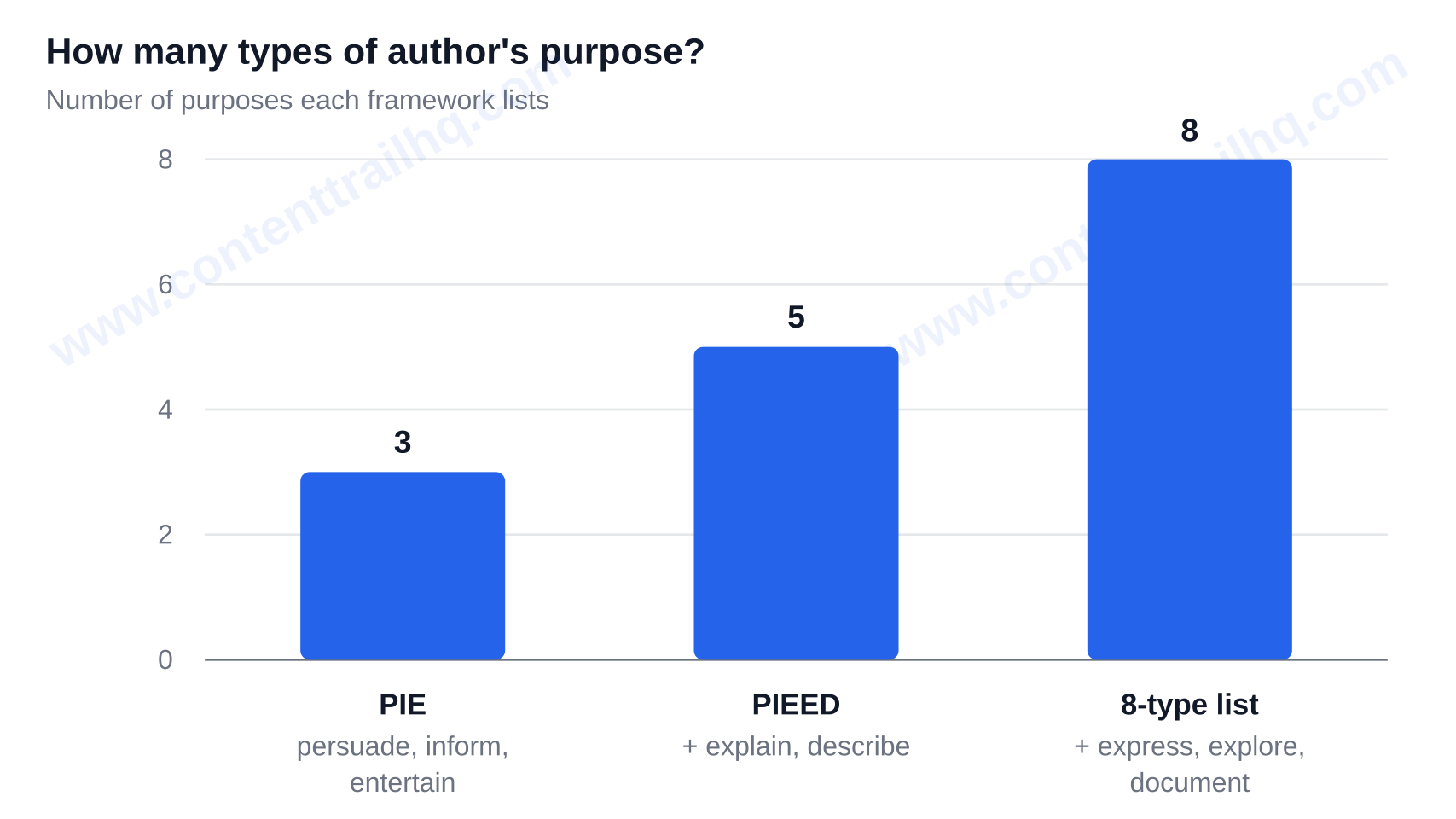
Purpose is the reason an author wrote a text — what they wanted you to know, feel, or do. Most classrooms categorize author’s purpose using the acronym PIE: to persuade, to inform, or to entertain. Frameworks that expand PIE add explain and describe (PIEED), bringing the total to five, and some sources list as many as eight purposes.
You have two answers. One is to pick a word. The other is to write a sentence about the purpose of the text. For third to fifth grade, picking the word is the right answer. For sixth grade and beyond, the sentence, and the text that supports it, gets the points. You can find a rule to help determine when to pick a word vs. when to give a sentence here.
An example before anything else. The topic “sea turtles” is a topic. The author’s purpose to “inform readers how sea turtles navigate” is an example of purpose. Topics are what text is about. Purposes are why the text was written.
What is author’s purpose, and what question does it actually answer?
Writer’s intent is author’s purpose — the why behind the writing, and what they hoped to achieve. As ereadingworksheets.com puts it, that intent can sit behind a whole book, a single paragraph, or one line. A long text can change its purpose, or reason, for being written, mid-chapter, so the question “why was this written?” should refer to the part of the text in front of you, not the title on the cover.
Purpose versus topic — they are not the same thing
A topic is something that can be named. A purpose is something that is inferred. Saying the topic is like identifying a common noun. The purpose is something that the writer is trying to achieve or something that is implied — you are working out something the writer never stated outright. Pointing out the purpose is more difficult. Most incorrect answers on a reading assessment are topics that are wearing a purpose mask.
What the writer wanted you to know, feel, or do
Those three verbs cover the entire question. What the writer wants the reader to know, feel or do can also be called the reasoning behind the text. Khan Academy frames it that way. Knowing the reasoning behind a text tells you what the writer wants you to know, feel, or do during and after reading, and it helps one to judge tone, content, and style, critically, instead of simply reading and agreeing with the text. It’s a method for comprehension, and hence a tool, not a vocabulary word.
There is one thing to be aware of, because it affects everything else. The purpose lists in circulation do contradict each other. You need a decision rule, not another acronym.
What does PIE stand for, and how many types of author’s purpose are there?
PIE stands for Persuade, Inform and Entertain, and it comes from the writer’s point of view. Smekens Education defines the terms as follows: writer wants to convince the reader to think or act in a certain way — persuade; writer wants to give the reader information — inform; and writer wants to provide the reader with a story that the reader will enjoy — entertain. PIEED keeps those three and adds explain, which covers procedural instructions and how things work, and describe, which uses detail so you can picture a person, place, or thing (yourthriftycoteacher.com).
| Purpose | What the writer wants | Text types that usually carry it | Frameworks that include it |
|---|---|---|---|
| Persuade | You to think or act a certain way | Editorials, advertisements, campaign posters, speeches | PIE, PIEED, 8-type |
| Inform | You to have information you did not have | Textbooks, news articles, encyclopedia entries, research papers | PIE, PIEED, 8-type |
| Entertain | You to enjoy the reading | Stories, poems, dramas, comedy scripts | PIE, PIEED, 8-type |
| Explain | You to understand a process or how something works | Recipes, user manuals, how-to guides | PIEED, 8-type |
| Describe | You to picture something clearly | Travel guidebooks, painting analyses | PIEED, 8-type |
Why you keep seeing three different “right” answers
Because, as described above, the number depends on the source, and no page in the top results says so. Here is the split:
- Three (PIE): persuade, inform, entertain — used by ereadingworksheets.com and Smekens Education.
- Five (PIEED): add explain and describe — used by yourthriftycoteacher.com, readingvine.com and thethinkacademy.com.
- Eight: literacyideas.com lists the five primary purposes plus three more — to express, to explore, and to document.
Though the texts remained the same, the framing changed. So, the honest answer to “how many types are there?” is: as many as the list your class or your test uses. Check which one you are being assessed against before you commit to a number.
How do you identify the purpose in a text?
Identify the ending and beginning. According to Chalkbox.org, purpose is signaled most strongly at the opening and closing. Read those two before you read the middle — the opening sets up why the writer is here and the closing tells you what they want from you.
Tone is the fastest single identifier. Opinion-loaded words like “outrageous” or “wonderful” lean persuasive. Measurements and statistics signal a purpose to inform. After tone, scan adjectives and verbs, then look at text features and structure — numbered steps, headings, captions, data tables — for a second signal that confirms the first.
Clue words, purpose by purpose:
- Persuade: should, must, best, worst, unfair, outrageous — and any call to action.
- Inform: dates, statistics, measurements, definitions, flat neutral tone.
- Entertain: look for narratives, dialogue, figurative language, and other signs of description and imagery.
- Explain: numbered steps, materials lists, sequence words.
- Describe: sensory detail and spatial language.
To determine purpose when signals of purpose conflict — and in real texts they often do — ask yourself one question: what did the writer want me to get from this writing? Answer that in a sentence and you have the purpose, whatever label you end up attaching to it.
Why “just use PIE” breaks down — and the decision rule to use instead
PIE requires identifying a single purpose for each text. Plenty of texts do not cooperate. ereadingworksheets.com says it plainly: writers frequently have more than one purpose, a novelist can entertain while informing and nudging you toward a new point of view, and identifying intent is “not so much a science as it is an art.”
The sharpest version of that critique is a November 2024 piece from Coach from the Couch, which argues PIE is too surface-level for the picture books teachers actually teach. In picture books, writers can and do entertain and persuade at the same time: I Wanna Iguana and Click Clack Moo are persuasive and entertaining at once, and The Great Kapok Tree blends purposes outright. The same article states that South Carolina, Indiana and Texas state standards call the author’s purpose what the writer wants to answer, explain or describe, not picking a label off an acronym.
There is also an expiry date on the acronym that nobody states out loud. Current grade-band expectations in circulation (thethinkacademy.com) state PIE-style selection is done in grades 3–5. Grades 6–8 explain how purpose shapes structure and word choice. In grades 9–10, students analyse purpose through tone, argument and audience. Grades 11–12 handle mixed purposes in a single text. So we are talking about a significant grade level shift when a grade 9 student answers a question with a one-word PIE label — they are answering a grade 5 question.
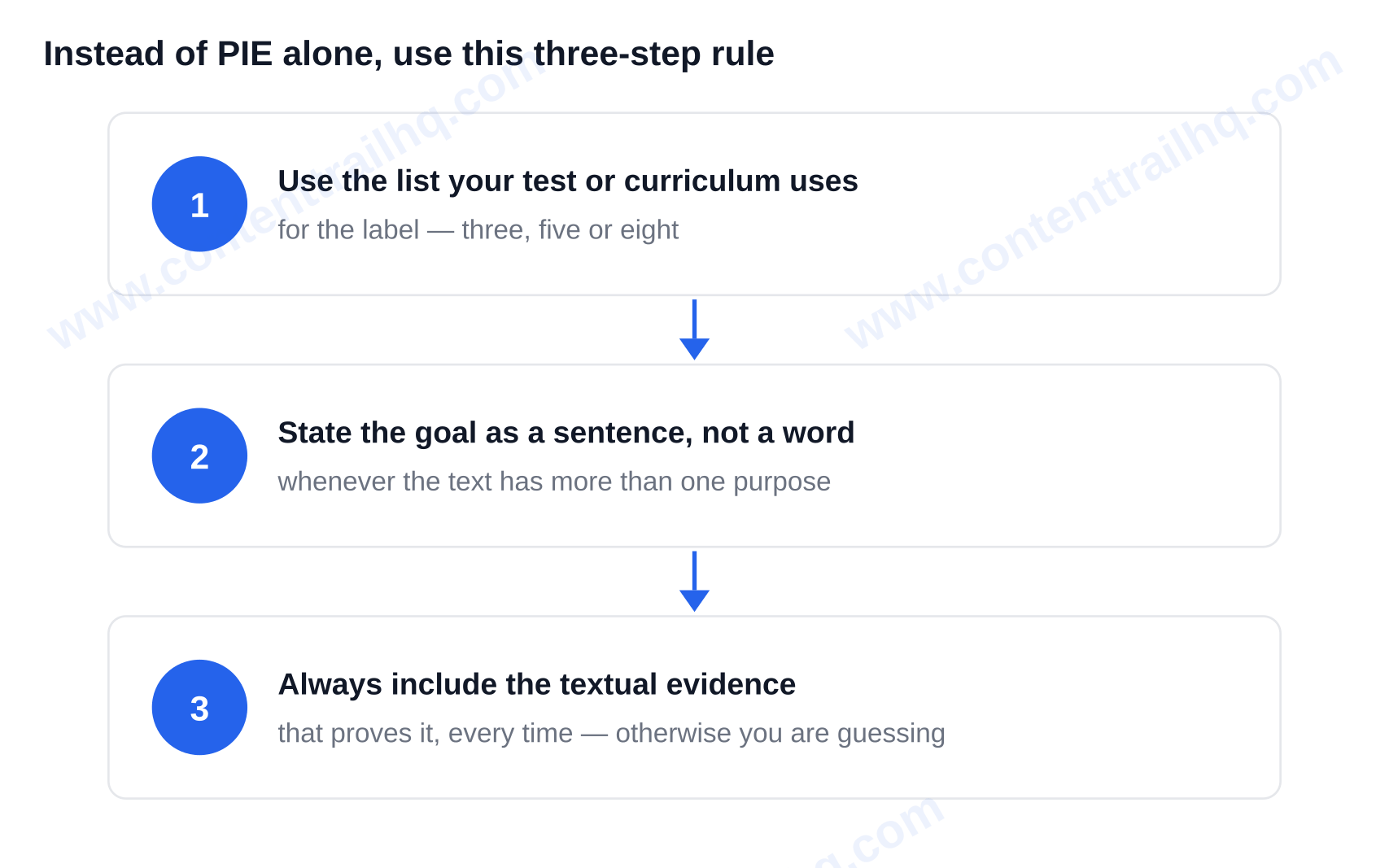
So use this instead of the acronym alone:
- Use the list your test or curriculum uses for the label — three, five or eight.
- State the goal as a sentence, not a word, whenever the text has more than one purpose. A funny cookbook entertains and informs. A pollution documentary informs and persuades. One word loses half the answer.
- Always include the textual evidence that proves it, every time. Otherwise you are guessing.
Author’s purpose vs. point of view, perspective, and tone
These are terms that are confusing and get switched around a lot, and Smekens Education says so directly — the terms are frequently confused and interchanged across curriculum and assessments. The tests ask these questions using varying terminology and that’s why test questions on this skill feel inconsistent. They are inconsistent.
| Term | What it answers | What you cite as evidence |
|---|---|---|
| Purpose | WHY the text was written | First and last paragraphs, structure, calls to action |
| Point of view | WHO is delivering the details | Narrator, pronouns, whose eyes you see through |
| Perspective | HOW that person thinks and feels | Their beliefs, background, reactions to events |
| Tone | The attitude you hear in the writing | Word choice and connotation |
Two trusted sources, two incompatible definitions
Smekens Education says point of view is “the who” — which character is rolling out the details, in a text like Wonder, which has multiple narrators. Study.com and Varsity Tutors say author’s point of view is the writer’s attitude or opinion on the subject. Both definitions are indexed, both are taught, and they do not agree.
The rule that resolves it: in fiction, point of view means the narrator. In informational text, assessments generally use it to mean the writer’s stance. So check which text types the question is about before you answer. If the passage is nonfiction and the question asks for “author’s point of view,” it almost certainly wants stance — and the evidence you cite should be word choice and selected details.
How do you answer an author’s-purpose question for full credit?
The standard usually contains the answer structure. CCSS.ELA-LITERACY.RI.6.6 does not ask you to name a purpose. It asks you to determine the writer’s point of view or purpose and explain how it is conveyed in the text, with word choice, selected details, examples, and tone. RI.8.6 pushes even further: analyse how the writer acknowledges and responds to conflicting evidence or viewpoints.
The clause that says “explain how it is conveyed” is where the marks are, and it is exactly the half the definition pages leave out. So basically, you need to name the reason, and then cite the clue that proves it.
Pull the clue from one of five evidence categories (thethinkacademy.com): quoted words, data and facts, text structure, story elements, and text features.
- Grade 6–8 model: “The writer’s purpose is to inform. The passage uses facts and a neutral tone to teach the reader about sea turtle behaviour.”
- Grade 8+ model: “The writer’s purpose is to persuade. They admit that nets are cheaper, then counter it with stranding data — acknowledging the opposing view in order to undercut it.”
How to practise it
Create an anchor chart based on a goal stated as a sentence rather than a PIE label, so it holds up with mixed-purpose texts. Collect real samples — ads, manuals, op-eds, recipes — sort them by purpose, and spend most of your time on those samples that resist a single category. Then reverse the skill: write a short piece for an assigned purpose, trade with a partner, and have them identify the purpose of your writing and state the piece of evidence that supported their conclusion. That drills the evidence portion of the skill, which is the portion that scores. For fluency, use practice passages with answer keys from ereadingworksheets.com, ReadingVine, or Lumos Learning, and Khan Academy’s 8th-grade unit for the techniques-based treatment. The skill is also on TEAS reading practice and similar standardised sections, where the same two-part answer applies.
Three misconceptions to address early on are that this is a guessing game, that every text has exactly one reason behind it, and that the topic and the purpose are the same thing.
What to do next
Author’s purpose is the writer’s reason for writing — and the answer that earns credit names that reason and proves it from the text. For any passage in front of you, read the first and last paragraphs, write one sentence naming what the writer wanted you to know, feel, or do, then underline the words that prove it.