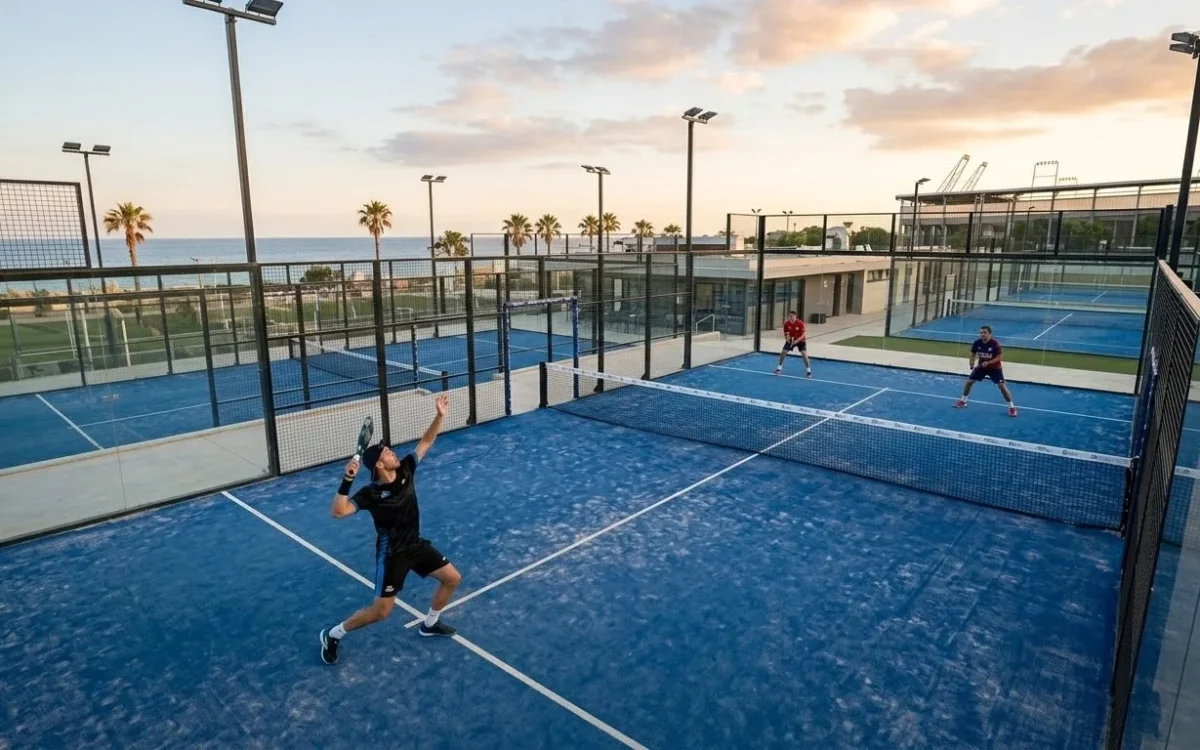
This guide teaches the ins and outs of this budding sport. It includes the basics such as the history, the rules, how to score, the upcoming rule changes, why courts are being converted to pickleball courts, what pickleball gear is needed, the cost to get involved, the risks associated, and how to find a game. Pickleball is a paddle sport where players combine skills from tennis, badminton, and table tennis, to hit a perforated plastic ball over a net, across a small 20-by-44-foot court. The sport can be played as singles or doubles. You serve underhand crosscourt, let the serve and return bounce, and never volley inside the seven-foot non-volley zone.
A single number describes the growth of pickleball. In 2025, 24.3 million Americans played pickleball, according to the Sports & Fitness Industry Association — an increase of 22.8% over 2024. That number explains the interest in converting tennis courts to pickleball courts, the new equipment on the market, and the rulebook changes. It also explains the two things this guide takes seriously that other overviews skip, the 2026 rule changes that players will actually be officiated on, and the rising number of injuries pickleball players over the age of 50 are experiencing that require ER visits.
What is pickleball, and who is it for?
It is a paddle sport that borrows from tennis, badminton, table tennis and even volleyball, played as singles or doubles on the same small court either way. You hit a perforated plastic ball with a solid paddle over a low net. That is the whole sport. The sport is enjoyed by people of all ages and skill levels. Pickleball is a great starting sport for people looking to get more active and involved in the sporting community. The sport’s rules are easy and quick to learn. Anyone can join this growing community!
Watch for just a moment as a newcomer, and the rhythm is immediately odd. One player serves the ball diagonally and underhand. The ball bounces deep and is returned deeply. Both teams creep forward to a line 7 feet from the net and trade tame floats until someone finally breaks the patience contest. The contest of patience is the sport.
The sport lends itself to being easy to learn because there is not a lot of space to cover on the court and the ball is slow, giving you time to read it. Also, the serve is underhand so you do not have to serve like a tennis player to start a point. A lesson can give you the tools to play a real pickleball game in a matter of minutes — not a good one, but a real one with scoring and winners.
Although some rules are subject to change, USA Pickleball, the sport’s National Governing Body in the US, provides the Official Rulebook and resources for the sport of pickleball. It is accredited to approve paddles and balls and has the authority to sanction tournaments and change the rules of pickleball. When a rule changes, it changes there first.
Why “easy to learn, hard to master” is the accurate description
The accuracy in the phrase gets repeated because it is a soft sport. Day one, you can learn to make shots that bounce. Year three, you can maybe start learning how to make consistent low shots instead of the pop ups that everyone can easily smash. The skill ceiling sits in touch, patience and shot selection at the non-volley line, and none of that is reachable by hitting harder.
Who plays it: ages, ability levels and the adaptive divisions
The game has something for everyone, and that’s what has catapulted it to exponential growth. Older adults, especially those over 50, make up a large chunk of the player base, alongside kids and competitive 20-somethings. As of 2026, USA Pickleball also formalized an Adaptive Standing Division, with eligible players permitted a second bounce. So, there are still chances to compete if you are an older beginner. The honest expectation to carry into the rest of this guide: easy to learn, hard to master, and not risk-free if you are an older beginner. The numbers on that last point come later, and they are worth reading before your first session.
Where did pickleball come from, and why is it called that?
It is said that in 1965, on Bainbridge Island, Washington, Joel Pritchard, Bill Bell and Barney McCallum came up with the game of pickleball using equipment found in their backyard shed. The story is unglamorous: bored kids, a summer afternoon, and whatever gear was around. They found ping-pong paddles, a perforated plastic ball and a badminton court, lowered the net toward the ground, and created their own rules as they went. USA Pickleball still credits the game to those early improvisations.
That improvisation is baked into the modern sport. The low net exists because they dropped a badminton net. The small court exists because a badminton court is small. The slow ball exists because a perforated plastic ball is what they had. Nothing about the game was designed for elite athletes, which is exactly why it scaled — and the improvisations of the early creators also attribute to why pickleball is a game that can be played by people of all skill levels and ages.
The pickle-boat origin versus the dog named Pickles
It is an urban myth that the game is named after a dog. The dates also confirm this.
- 1965: Pickleball is created. Joan Pritchard names the sport after a type of boat in crew rowing, the pickle boat, which is composed of rowers leftover from the other boats. Fitting, since the equipment used is makeshift.
- 1968: Pickles, the Pritchard family dog, is born. Three years earlier, Pickleball was created. The dog was named after the game, not the other way around.
- 1969: Joel Pritchard tells a reporter the real pickle boat story, then says the dog story is more charming and amusing. The reporter publishes the dog story. The myth has outlived everyone involved.
From there, the sport spread like wildfire through the country, and is the most-cited growth story in American recreation. More info on participation later in the guide.
What does a pickleball court look like, and what gear do you need?
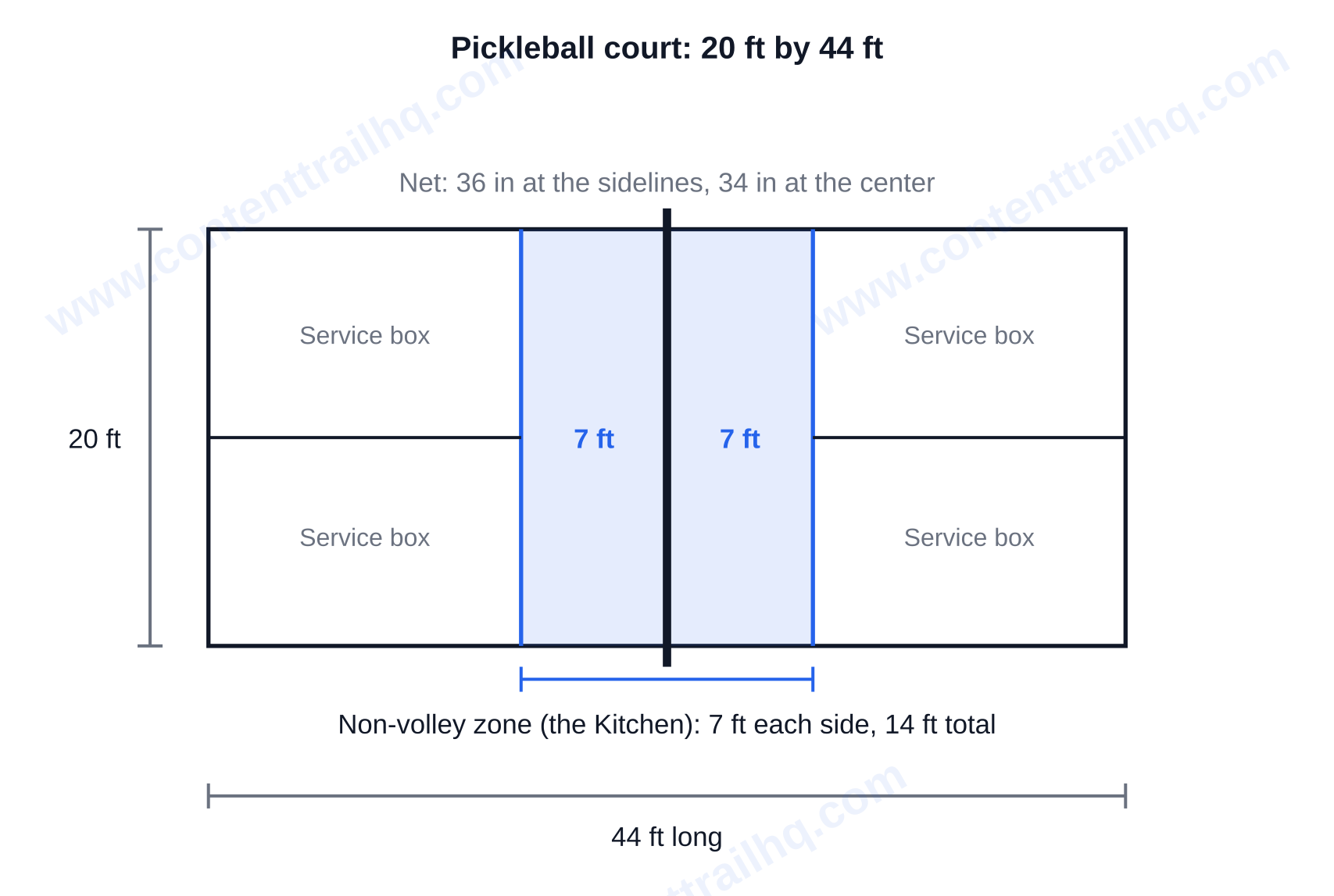
A court is 20 feet wide by 44 feet long. For singles or doubles, the court is the same. This is different from other racquet sports. You have a baseline, two sidelines, a centerline, and two service boxes per side.
The court, line by line
The net is 36 inches high at the sidelines, and 34 inches in the center. This two-inch sag in the middle is not by chance. Balls hit over the middle clear the net easier. Good players hit there when they are under pressure.
The “Kitchen” is the Non-Volley Zone extending 7 feet from the net on each side for a total of 14 feet. The line marking it is included in the zone, so touching it while volleying is a fault. That is the one detail most beginners will ever need to remember, and it will keep you clear of the most common beginner error.
One practical warning: thousands of courts are converted or taped-over tennis courts. Public park lines are sometimes approximate and net heights are sometimes wrong. Be flexible when playing other people’s courts. Don’t make assumptions about the dimensions being exact.
Paddles, balls and the shoes that actually matter
USA Pickleball has approved standards which say balls should be made of perforated plastic with 26 to 40 circular holes, and paddles from a rigid, non-compressible material.
Indoor and outdoor pickleballs are different. The outdoor balls are harder and have smaller holes to counteract wind. Indoor balls are softer with larger holes. Using the wrong ball on the wrong surface fundamentally alters how the game is played. Indoor balls outdoors are nearly unplayable with just a slight breeze.
Court shoes are the most misunderstood piece of equipment by beginners. Running shoes should not be used as this sport primarily moves side to side and running shoes are built for forward movements.
There are several injuries commonly associated with this game. Lateral support is key to preventing these. Most beginner injuries can be attributed to a lack of appropriate court shoes and support. That is not a comfort preference, as the injury section will make clear.
How do you play a game of pickleball from the first serve?
Organize your own game however you want, but pick sides before you begin. Whoever serves first will start behind the right baseline and serve underhand, diagonally crosscourt, into the service box of the opposing player past the non-volley-zone line. Call the score out loud. The serve must land in the service box. The recipient of the serve returns it in the same manner until one player or team reaches 11 points by two points.
The serve and the two-bounce rule
The standard volley serve requires an upward arc, contact below the waist, and the paddle head below the wrist. A pickleball serve can also be executed by dropping the ball and letting it bounce before hitting it — the drop serve. No arc requirement, no wrist geometry to police. While a tennis serve can cross court, a pickleball serve must be diagonally crosscourt. USA Pickleball’s own instruction treats both types of pickleball serves as legal.
The two-bounce rule or double-bounce rule dictates the flow of the game. The serve must bounce. The return of serve must bounce. Only after those two bounces may either side hit the ball out of the air. This rule eliminates serve and volley attacks, which is why rallies in pickleball always start deep and then collapse toward the net.
The Kitchen: what you can and cannot do in the non-volley zone
The non-volley zone or kitchen rule states that while the ball is in play, no player may volley while standing in the non-volley zone or touching its line. If after a volley the player’s momentum moves them into the non-volley zone, then that player is at fault even if the ball is contacted cleanly while outside. But you can step in freely to play a ball that has already bounced, then step back out. The zone restricts volleys, not your feet.
Faults that end a rally
- Volleying from inside the Kitchen or on its line
- Serving into the wrong service box
- Failing to clear the net, or landing the serve short of the non-volley-zone line
- Hitting the ball out of bounds
- Volleying before the two-bounce requirement is satisfied
Rules govern positioning. Both players begin positioned behind the baseline to return the first serve, because the return has to bounce anyway. Since the return bounce is required, the players move up to the Non Volley Zone line, where they remain for the duration of the rally. The team positioning at the net controls the rally, every time.
Singles versus doubles
The same court, the same 7 foot zone, and the same 2 bounce rule apply. One player has to cover the entire court, which turns the game into a running sport. Serving position is indicated by the server’s own score. Even scores indicate that the server has to serve from the right, and odd scores indicate that the server has to serve from the left.
How does scoring work, and why does the game start at 0-0-2?
Only the serving team can score. This is called side-out scoring and is the first thing to internalize about the game. The receiving team has to win the rally in order to take over serving and scoring privileges — winning a rally does not get you a point, it gets you the serve, which is how you get to points.
Side-out scoring and games to 11
Traditionally, a game is won by reaching 11 points and being 2 points ahead of the opposing team. Medal matches and tournament matches may run to 15 or 21, also won by being 2 points ahead.
Calling the score in doubles
Three numbers, always in this order: serving team’s score, receiving team’s score, then the server number (1 or 2). So “4-3-2” means the serving team has 4, the receiving team has 3, and the second server is up. Both partners serve before a side-out, and the serving team’s players swap sides after every point they win — which is why a server’s position quietly tells you the score.
The treatment of “0-0-2” for the first service turn of a game is confusing for first time players. For this turn only, the starting team’s server that is serving for the first time is treated as “server 2”. That team gets one server, then an immediate side-out. Therefore, it is a deliberate fairness correction for the advantage the first team to serve has.
| Situation | What you call | What happens next |
|---|---|---|
| Very first serve of the game | “0-0-2” | Starting team gets one server only, then side-out |
| Serving team leads 4-3, second server | “4-3-2” | Lose the rally and the serve goes to the other team |
| Serving team leads 4-3, first server | “4-3-1” | Lose the rally and your partner serves next |
| Serving team wins a rally | Score goes up by 1 | Partners swap sides; same server continues |
| Receiving team wins a rally | No point scored | Serve passes to the next server or the other team |
| Score reaches 11-9 | “11-9” | Game over — 11 points, won by 2 |
One 2026 wrinkle applies to rally-scoring events: the “freeze” rule at game point is gone. Thus, either team can score the winning point now, rather than needing to be serving to close it out.
What changed in the 2026 rulebook, and what it means for new players
This is the gap you need to know about. Almost all overviews ranking this sport were written based on the old rule book, the pre-2026 rule book. The serve description that new players are reading is not the description that is officiated.
The volley serve now has to be “clearly” legal
The rule book from 2026 puts one word in all three volley-serve requirements: contact clearly below the waist, paddle head clearly below the wrist, and a clearly upward arc. One word, big deal. Before, a borderline serve would get a shrug and a pass. Now, if it is not clear that a serve is legal, then it is a fault — the referee no longer has to find it illegal, you have to make it obviously legal.
This means that for a beginner player, if your serve is on the border, it is best to switch to a drop serve. This sidesteps all three judgment calls. Nobody can question your arc if there is no arc to question.
Rally scoring, net posts and out calls
Three more rule changes, per The Dink’s rundown of the 2026 updates. The change to the rally-scoring freeze is mentioned above. The case of the net-post has been switched: if a ball legally crosses the net, lands on the opponent’s court, and then spins or blows into the net post, it is a dead ball won by the hitter, and it is not a fault charged against them. Out-call timing has been shortened.
The last point is more relevant to open play than you may realize. Line calls in open play are self-refereed, and the only reliable way to start a dispute on a public court is to call the shot late as “out” after the opponent has already played the next shot. The new rule protects players who make prompt line calls.
The new Adaptive Standing Division
The Adaptive Standing Division has officially been created, and players in that division are now permitted to allow the ball to bounce twice. We should take a moment to reflect on this. “All abilities” has been a slogan in this sport for years, and this year, we have a second bounce rule written into the rule book — the slogan turning into an actual rule.
Which of these will you feel in your first month? Probably the serve standard, and only the serve standard. Remember, this only applies to you if you choose to volley serve. The net-post reversal happens even less, perhaps once a season. The new rally scoring for sanctioned events will not affect you for a while. The new rule on out call timing is social, not technical, and should be practiced immediately.
What does it really cost to start, and what are the injury risks nobody mentions?
The standard response is it’s cheap, with no numbers given. Now, we have the real costs.
What to buy first, and what to skip
New players can expect to spend between $50 and $150 for the essentials: a mid-range paddle, a pack of balls and court shoes. A quality beginner paddle will cost between $30 and $80. For $80 to $100, you can purchase a carbon fiber 16mm control paddle from an established brand, which is where most players land after their first upgrade — so if you already know you will stick with it, start there and skip a step. Two-paddle starter sets with balls and a bag sell for about $30 to $60.
You can always save money by borrowing a loaner paddle at a local open-play session. Most groups keep spares. You can find out if you like the sport without spending any money.
Court shoes are a good first buy. A $40 pair of court shoes will prevent more lost playing time due to an injury than a $200 paddle gains you. Paddle upgrades are marginal; ankle sprains are weeks.
Why most emergency-room visits are players over 50
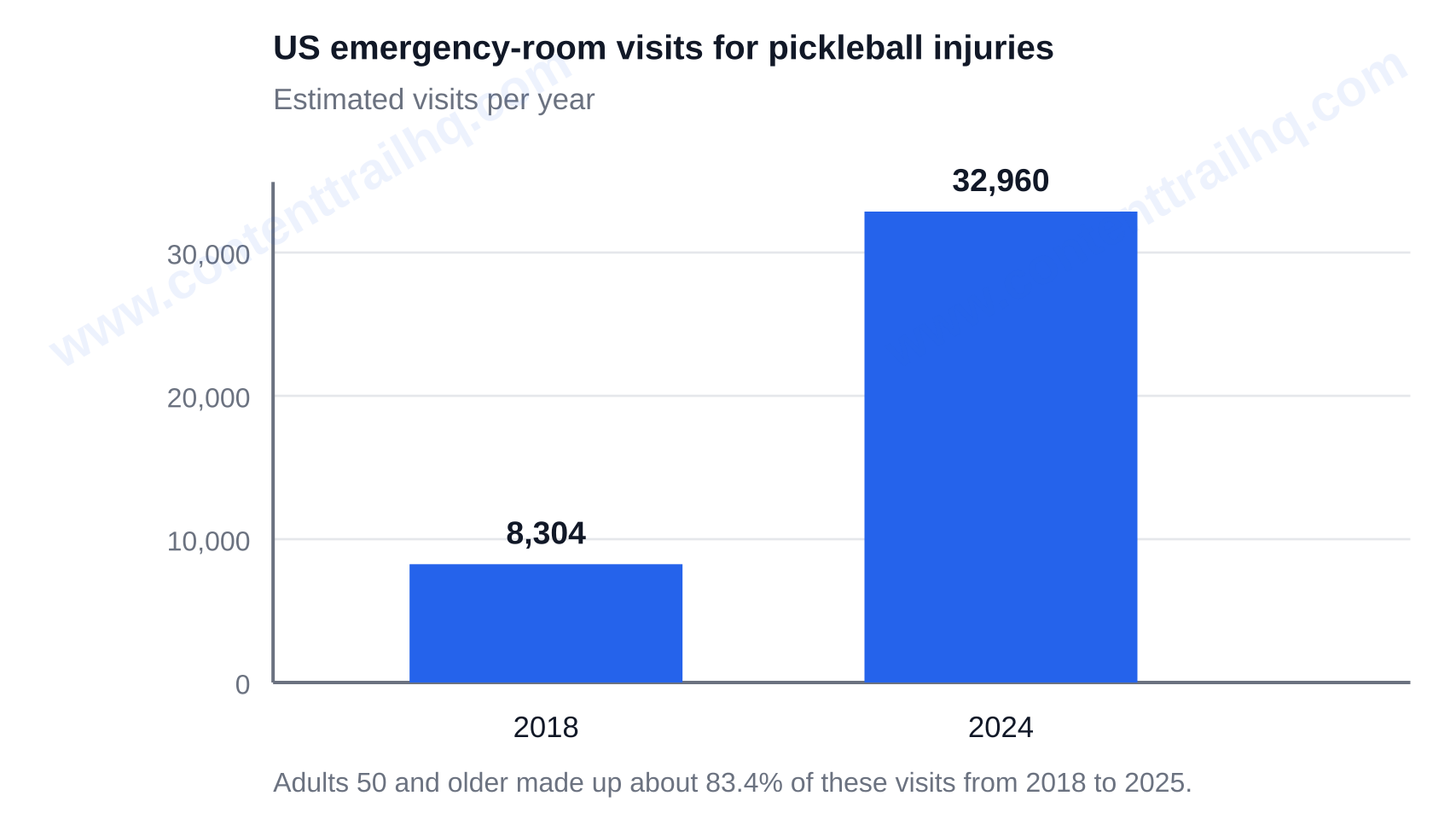
The phrasing “great for all ages” makes pickleball sound risk free and it isn’t. US emergency-room visits for pickleball injuries rose from an estimated 8,304 in 2018 to 32,960 in 2024. Between 2018 and 2025, approximately 125,287 pickleball related injuries requiring an ER visit were reported among adults 50 and older — approximately 83.4% of the total. The 65 and older age group alone made up approximately 55.6% of total visits.
The mechanism matters more than the count. Peer-reviewed research on pickleball injuries in US emergency departments found falls accounted for 36.5% of the injuries, with fractures (roughly 30%) being the most common diagnosis. Approximately one in five cases required admission to a hospital, and the cardiac admissions outnumbered the orthopedic admissions.
Read that together and the sport’s real hazard becomes clear. The injuries associated with pickleball are more attributable to falls, and to the heart. It is not overused.
A safer first session for 50-plus beginners
- Court shoes, not running shoes. Running shoes roll forward; This game moves sideways.
- Warm up before the first serve. The pickleball community stresses the importance of warming up before you play your first game. Warming up after two games, when you are already chasing a lob, will do more harm than good.
- Never backpedal for an overhead. Turn and shuffle instead. Backpedaling is how falls become fractures.
- Hydrate. The short nature of the points in pickleball and the social breaks mean players tend to forget to hydrate. One way to help with this is to hydrate when your opponents are serving.
- Clear the cardiac side with a physician before ramping up the volume. The admissions data suggests this is the least optional item on the list.
Where can you find a court and get into your first game?
You can use the pickleball courts sponsored by your City or County Parks and Recreation department to find free public courts and open play times. Most municipalities have a similar set up as LA City Recreation and Parks.
Public courts and open play
Open play works on a queue. Paddles get stacked or lined up in a rack, and the next four players rotate on when a game ends — usually games to 11. Because of the nature of open play pickleball, new players tend to be folded into mixed level play (which is also the nature of the sport). This means pickleball tends to be very new player friendly; this is not a sport with a gatekeeping culture.
Being new to the game is simple. Say you are new. Call your faults so you aren’t catching heat for bad calls, including the ones nobody saw. Let the score be known before each serve. You do the clean up and ball retrieval when balls go flying onto the next court. This is the social contract. Breaking this contract won’t get you kicked out, but it will ensure you aren’t invited back.
Court-finder tools, clubs and leagues
Court-finder tools will locate courts near you, filter indoor versus outdoor, and tell you whether nets are provided or you bring your own. Once you are looking for some structure, there are clubs, dedicated indoor facilities and gyms that provide memberships. There are beginner clinics, and/or organized leagues to give you structure. Converted tennis courts and portable nets allow you to play on nearly any flat surface with taped lines.
Shot vocabulary you’ll hear on your first day
There is a specific way to learn the game. First is the serve and return of serve, both deep. Next is the dink, which is a soft shot played at the non-volley line and defines the sport. The third-shot drop is played from the baseline, and is used to take the serving team to the net. Next is the volley. After that is the lob. You will also hear “stacking,” which means a doubles team lines up on the same side of the court before each point to put a stronger forehand or a lefty in a better position.
How popular is it, and is it harder than tennis or headed to the Olympics?
This is the data supporting the claim “fastest-growing sport in America.” As noted by the Sports & Fitness Industry Association, in 2025, an estimated 24.3 million Americans played pickleball, a 22.8% increase from 2024, a 171.8% increase over three years, and a 479% increase across the five years from 2020 to 2025.
The participation numbers behind the growth claim
The difference in commitment levels is the interesting part. As noted by SFIA, for 2025, there were an estimated 16.8 million casual players (one to seven sessions in the year), up 23.9%, and 7.48 million core players (eight or more sessions in the year), up 20.4%. That core number is the one worth watching. Casual players mean the sport is accessible, and core players means they stick around.
Pickleball versus tennis, and the Olympic question
Easier to start than tennis? Yes, without question. The court is smaller, the ball is slower, and the serve can be underhand, which is reachable on day one, as opposed to tennis where the serve takes months before rallies even start. Harder than it looks at the top, though, and in a different way: the soft game at the non-volley line rewards patience and touch, and power players plateau there fast.
The sport will not be at the Los Angeles 2028 Olympics. It is not an Olympic sport and the Global Pickleball Federation has applied for IOC recognition and is still awaiting it. Brisbane 2032 (whose organizing committee is expected to make sport selections in 2026) is the earliest realistic chance.
The three things to take with you
First: one underhand serve, two bounces, and a seven-foot zone where you can’t volley is pretty much all you need to play your first game. Second: the 2026 serve standard now requires “clearly” legal on all three counts, so use the drop serve if yours is on the fence and buy court shoes before you buy a nicer paddle, especially if you’re over 50 and have read the fall numbers. Third: the fastest way to get a court this week is to look up your city’s parks department open play schedule. Show up to open play with a borrowed paddle and tell the group you’re new. In most places that’s all you need to do to get a game. For more like this, explore Content Trail HQ.