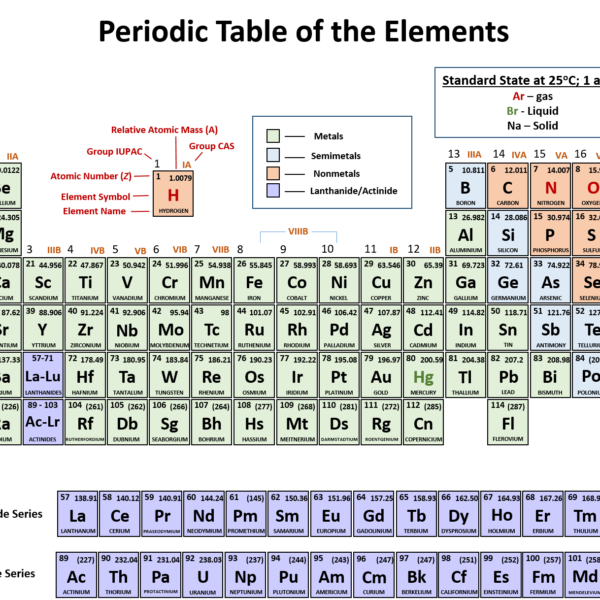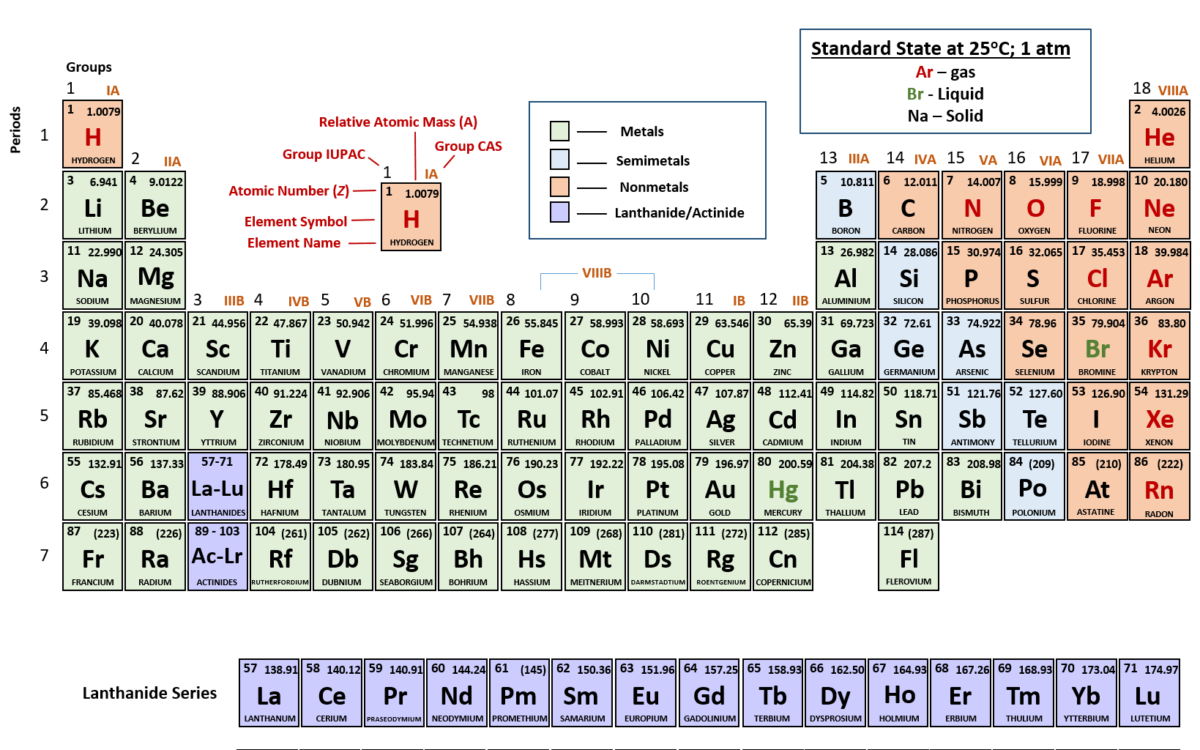
Most people assume all atoms of the same element share the same mass. In fact, the thing all atoms of the same element have in common is the number of protons in their nuclei. Beyond that, nothing is the same. The number of protons in a nucleus is the atomic number (Z), and it uniquely identifies each element. Every carbon atom has 6 protons, and every gold atom has 79. The number of neutrons can vary, and so can the number of electrons and the mass.
What do all atoms of the same element have in common?
Same number of protons. If you are filling in a blank on your worksheet, it wants the word atomic number. Another name for atomic number is proton count.
All atoms of the same element have the same atomic number (Z)
The IUPAC Gold Book defines atomic number as the number of protons (also referred to as the proton number) in the atomic nucleus. Those two terms are interchangeable because no two elements share the same number of protons. Two protons means helium, and it cannot mean anything else. Therefore, Chemistry LibreTexts is correct when it says the atomic number is unique to the atoms of a given element. That one-to-one relationship is the entire basis for the proton count serving as an element identity test.
Where the atomic number sits on the periodic table
It is the whole number printed above or beside the symbol, and the table is arranged by it — that is what the sequence of boxes is counting. Check a few: hydrogen has 1, helium has 2, beryllium has 4, carbon has 6, gold has 79. Those are proton counts, not masses, and they are constant.
Why is it the proton count — and not mass or electrons — that defines an element?
Because the proton count is the only one of the three particle counts that is constant. The nucleus holds both protons and neutrons. The electrons occupy the space outside of it. Two of the three can change without affecting the identity of the element being referred to.
Add a proton to carbon’s 6 and you get a completely different element, nitrogen. Change the neutron count and you still have the same element, but a different isotope. Change the electron count and you still have the same element, but an ion.
In a neutral atom, electrons equal protons. That is the reason why “electrons” feels like the right answer, and is not. That equality holds only for a neutral atom, so it is a coincidence of the neutral state rather than a definition. Mass is further removed. It is a measured effect of what is in the nucleus, and so it is the wrong thing to use for identifying an element.
Ruling out the three wrong answers on the quiz
The multiple-choice version of this question provides students with a list of possible answers which include the mass number, the number of isotopes, the atomic number, and the number of neutrons. In practice, that list is where students lose the mark — the answer is easy, but three of the four options sound plausible if you have not pinned down which property is actually fixed. Here is each one, settled in a line.
Why “mass number” is the most common wrong pick
Mass number, by definition, includes both protons plus neutrons. Since neutrons can vary, mass number is wrong. Carbon-12 and carbon-14 are both carbon, with mass numbers of 12 and 14. The pick is tempting because mass is the property students have spent the most time calculating, so it feels like the important number. It is also the one that varies most visibly.
Neutron count is wrong, of the four options, in the most interesting way: varying neutron numbers are the definition of isotopes. Choosing this answer means choosing the one property which is certain to differ between some atoms of an element.
Why “number of isotopes” is a category error
Number of isotopes is wrong at a different level — it is not a per-atom property at all. Asking how many isotopes an atom has is like asking how many siblings a family has. Isotopes describe an element, and therefore, an atom is always a single isotope.
That only leaves atomic number, which is correct because it is the proton count renamed. The one-line check that settles the whole thing: count the protons and ignore the rest.
What is not the same across atoms of one element?
Neutrons, mass number, atomic mass and electrons. Here is the complete information in one location.
Isotopes: same protons, different neutrons
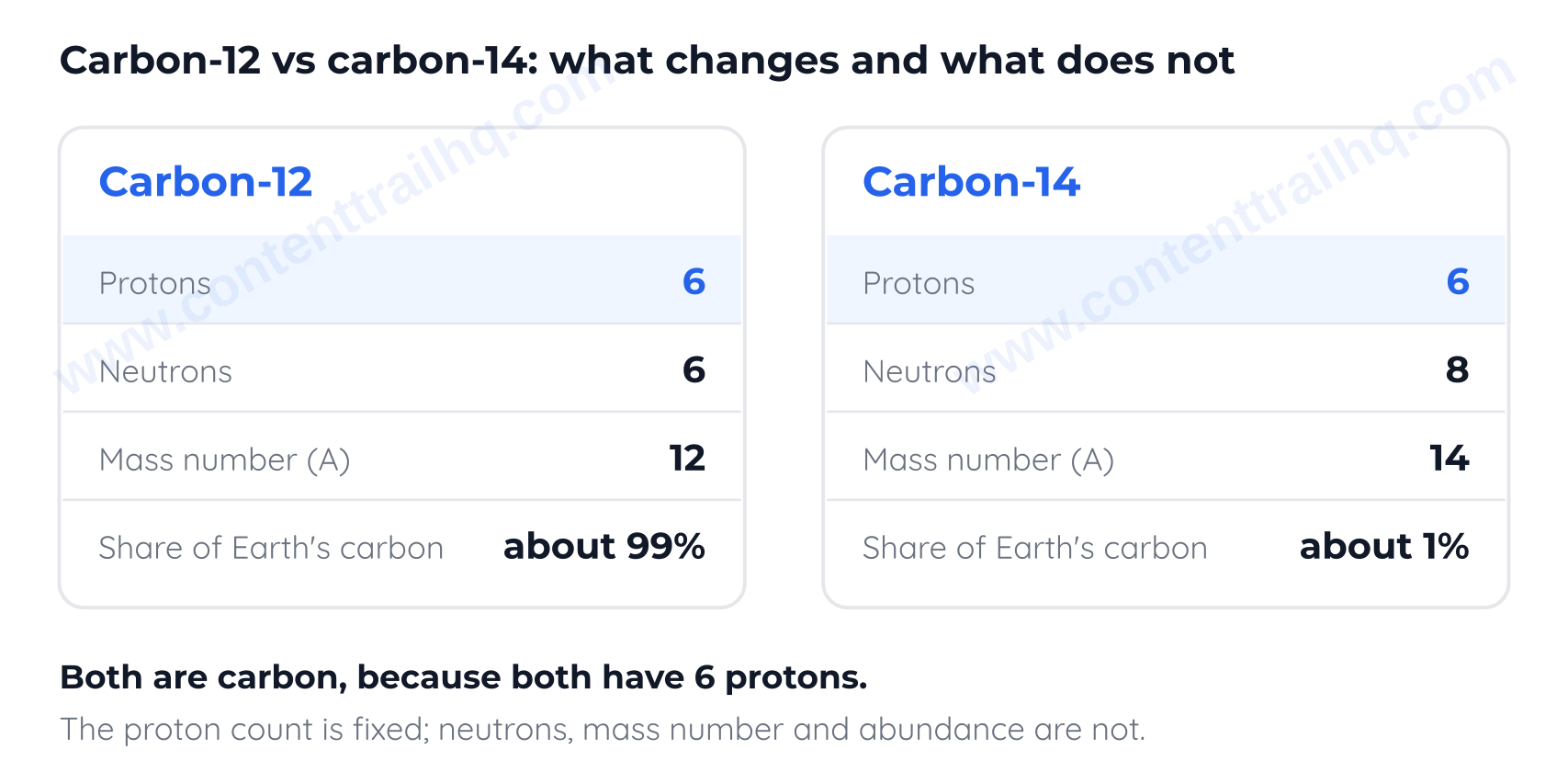
The U.S. Department of Energy Isotope Program says that isotopes are atoms of the same element that have an identical proton count, but a different neutron count and therefore, different mass numbers. Mass number (A) is the total of the protons and neutrons. Carbon-12 has 6 protons and 6 neutrons, and carbon-14 has 6 protons and 8 neutrons.
Atomic mass differs too, and the single figure printed on the periodic table is a weighted average across an element’s isotopes rather than any one atom’s mass. For scale, Chemistry LibreTexts gives one atomic mass unit as roughly 1.67 × 10⁻²⁷ kilograms, and notes that most helium atoms carry 2 neutrons for a mass of about 4 amus. If you are working from those averaged figures in a calculation, it is worth knowing you are using an average — the same subtlety shows up when you calculate molar mass from the table.
The notation makes it difficult to illustrate, but the abundance numbers answer the question. From Maricopa’s chemistry text, roughly 99% of Earth’s carbon atoms have 6 neutrons, and roughly 1% have 7. The case of strontium is even more clear: approximately 82.58% of all strontium atoms have 50 neutrons and others carry anywhere from 44 to 52. All of them are strontium because they all have 38 protons. A 44-to-52 range without a change of element is a good demonstration that neutrons do not impact which element you have.
Ions: same protons, different electrons
The gain or loss of electrons always changes the charge, but it never changes the identity. Sodium ions always have 11 protons and are always sodium. Isotope notation carries the same logic: the number after the name is the mass number, so carbon-12 and carbon-14 differ by two neutrons. Deuterium always has one neutron instead of none, and is always hydrogen.
Are atoms of the same element ever genuinely identical?
Yes — for a sizeable minority of elements. The caveat “but atoms of an element can have different masses” is true as a general warning and false as a universal rule, and textbooks rarely give a case where this is not true.
According to Wikipedia’s list of monoisotopic elements, 26 elements are monoisotopic: each has one and only one stable isotope. For those, essentially every atom you will ever meet does have the same mass as well as the same proton count. Two oddities within that set are worth checking yourself: all but one of the 26 have an odd atomic number, and all but one have an even number of neutrons — with beryllium the sole exception to both rules.
Seven of the 26 — vanadium, rubidium, indium, lanthanum, europium, lutetium and rhenium — are still not counted as mononuclidic, since a long-lived primordial radioisotope is present in a significant fraction. So the honest version of the caveat is narrower than the blanket phrasing most courses use.
Do atoms of the same element behave the same chemically?
Yes, usually. The chemistry is driven by protons and electrons, not neutrons. Since isotopes have the same protons and electrons as other atoms of the same element, they generally react in the same way and sit in the same periodic-table slot. While it is usually acceptable to ignore the effect of isotopes in introductory courses, it is a simplification, not a law.
The deuterium exception
Deuterium is the documented exception. Its nucleus contains an additional neutron, bringing its mass to roughly twice that of ordinary hydrogen’s, and that is enough to register in measurement: per Wikipedia’s heavy water article, the hydrogen bond in H₂O is slightly weaker than the corresponding bond in D₂O, and ordinary water dissociates to a greater extent than heavy water. Same element, same proton count, measurably different behaviour.
Allotropes: same atoms, different arrangement
Same atoms arranged differently are not a different element, either. Diamond and graphite are both pure carbon. Each carbon in diamond forms four covalent bonds to four neighbours; in graphite each forms three bonds within sheets that slide past one another. That is why one is the hardest mineral and the other among the softest — identical atoms, different structure, same element throughout.
Which part of Dalton’s atomic theory got this wrong?
He said atoms of an element had identical mass. Dalton postulated that the atoms of a given element are all of the same size and mass and have the same chemical properties, and students typically meet that claim in the same chapter as the fill-in-the-blank, with no reconciliation offered.
While the early-20th-century discovery of isotopes disproved the “identical in mass” half, the identity claim itself was left standing. As explained by Chemistry LibreTexts, that is the reason that when an element’s atomic mass is reported, an average is taken; there is more than one isotope to average over. That is also the reason why the modern sentence specifies the same number of protons rather than the same mass.
There is a current illustration of the difference. IUPAC’s Commission on Isotopic Abundances and Atomic Weights, which met in The Hague in August 2023 under Prof. Johanna Irrgeher, revised the standard atomic weights of gadolinium to 157.249 ± 0.002, lutetium to 174.966 69 ± 0.000 05 and zirconium to 91.222 ± 0.003 after re-evaluating their terrestrial isotopic abundances. IUPAC notes that each element’s recommended atomic weight is formally revised, on average, about once every two decades. Atomic weights get re-measured and re-published; atomic numbers never do.
Get it right: the corrected version
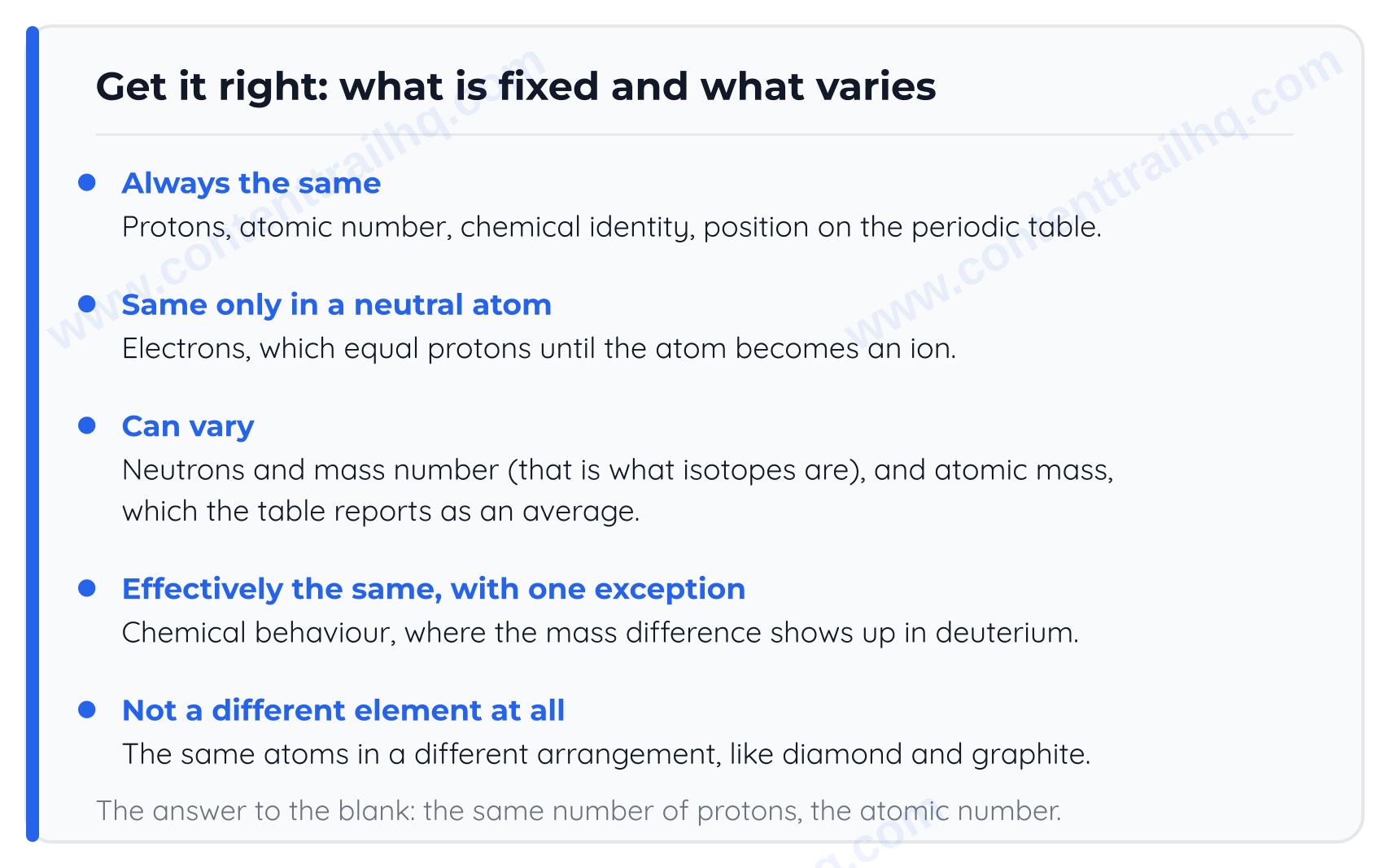
- Always the same: protons, atomic number, chemical identity, position on the periodic table.
- Same only in a neutral atom: electrons, they equal protons until the atom becomes an ion.
- Can vary: neutrons and mass number (that is what isotopes are) and atomic mass, which the table reports as an average.
- Effectively the same, with one exception: chemical behaviour, which is where the mass difference is shown, i.e. the case of deuterium.
- Not a different element at all: the same atoms in a different arrangement, like diamond and graphite.
The correct answer to this blank is the number of protons, which is the same atomic number. Only the number of protons needs to be the same for the element to remain the same. Open a periodic table, name five elements and write the atomic number, then work out the neutron count for one named isotope of each of the elements using mass number minus protons. With this done the distractors lose their appeal, and you should remember to watch the atomic weight column: IUPAC keeps revising those figures, which makes it clear which number is measured and which number is fixed.
Common Questions
All atoms of the same element have the same number of what?
They have the same number of protons. The proton count in the nucleus is the element’s atomic number (Z), and IUPAC defines atomic number as exactly that — the number of protons, also called the proton number. If the question is multiple choice, “atomic number” and “number of protons” are the same answer. Mass number, number of neutrons and number of isotopes are all wrong.
Is an atom still the same element if it gains or loses electrons?
Yes. Gaining or losing electrons just changes the atomic charge and makes it an ion, but it does not touch the nucleus. A sodium atom that gained or lost electrons is still sodium, because it still has 11 protons. Electrons only equal protons while the atom is neutral, which is why an atom’s electron count cannot be used to determine which element it is.
Do all atoms of the same element have the same mass?
Usually not, but sometimes yes. Atoms of an element with different neutron counts are called isotopes and have different mass numbers — about 99% of the carbon atoms on Earth have 6 neutrons while roughly 1% have 7. The exception is the 26 monoisotopic elements, which have only one stable isotope each, so nearly every atom of those elements you encounter does share the same mass.
True or false: all atoms of the same element have the same atomic number?
True, and it is true without exception. The atomic number is the proton number, no two elements share an atomic number, and nothing an atom can do — gaining neutrons, losing electrons, bonding differently — changes it. Atomic weights get re-measured and revised by IUPAC; atomic numbers never change.