


A common noun is the general name for a person, place, thing, or idea, and names a class rather than a specific member of that class. Dog, city and teacher are examples of common nouns. Rufus, Boston, Ms. Reyes, and Spain are proper nouns. Common nouns are usually in lowercase, but can be capitalized if they begin a sentence or are in a title.
What is a common noun, and what are some examples?
The definition doesn’t rest on whether the word is capitalized. A common noun names a class of entities (continent, planet, person, corporation), while a proper noun names a specific entity (Africa, Jupiter, Sarah, Microsoft). This definition is the one linguists draw between proper and common nouns, and it is the most accurate.
A quick sanity check: if the word can describe many entities of the same kind, it belongs in this category.
Common noun examples by category: people, places, animals, things, and ideas
Instead of a hand-picked list, here is an evidence-based one. According to Oxford Dictionaries’ analysis of the Oxford English Corpus, time is the most-used noun in English, ranking 55th across all parts of speech, followed by person, year, way, and day. The rest of the top 25 runs: thing, man, world, life, hand, part, child, eye, woman, place, work, week, case, point, government, company, number, group, problem, fact.
Every word on that list is a common noun. That is the evidence behind the often-repeated claim that this is the most-used noun category in English. Specific nouns are comparatively rare because everyday speech relies on generic terms.
A quick summary by category:
- People: teacher, neighbour, driver, child, stranger
- Places: city, harbour, kitchen, country, school
- Animals: dog, heron, salmon, horse, beetle
- Things: sandpaper, bread, phone, ladder, envelope
- Ideas: freedom, courage, grief, democracy, truth
How common nouns work in a sentence
Grammatically, there are three jobs these words do in a sentence. They take determiners (a, an, the) and pluralize. They head a noun phrase, which can then serve as the subject or the object of a clause. Take this example: the teacher graded a stack of essays. Here, teacher, stack and essays are all common nouns, each carrying a determiner or a plural ending. That determiner test matters again below.
How is a common noun different from a proper noun?
There is one major difference between the two, and it is specificity, not word type. In the case of country vs. Spain, country is a common noun because it generally names a place and Spain is a proper noun because it specifically names that country. Merriam-Webster puts it this way. The first is the general case and the second is the specific case.
Common noun vs. proper noun: side-by-side examples
| Category | Common noun | Proper noun |
|---|---|---|
| People | woman, senator, cousin | Amara, Churchill, Ms. Reyes |
| Animals | dog, parrot, mare | Rufus, Polly, Seabiscuit |
| Places | country, river, city | Spain, Danube, Boston |
| Organizations | corporation, university, charity | Microsoft, Yale, Oxfam |
| Days and months | day, weekend, month | Tuesday, October |
| Brands | trainers, soft drink, car | Nike, Pepsi, Volvo |
| Languages | language, dialect | Portuguese, Welsh |
The capitalization rule is narrow. A common noun is lowercase unless it begins a sentence or appears in a title. A proper noun is always capitalized.
Is a common noun ever capitalized?
Yes. They are capitalized in three scenarios: at the start of a sentence, in a title, and when used directly as a name. That last case trips people up the most, and the next section gives you the rule for it.
Why a capitalized word inside a name can still be a common noun
Most grammar guides collapse the next distinction. Proper nouns are single words, possibly with the. Proper names are broader: they include proper nouns plus noun phrases like the United Kingdom and North Carolina.
That resolves the follow-up question most explanations leave hanging. The word “Kingdom” is a common noun sitting inside a larger proper name, and its capitalization is inherited from the name as a whole. A capital letter doesn’t make a common noun a proper noun.
This is also where the capitalization-based definition of a proper name fails outright, especially for people whose first language capitalizes differently. German capitalizes every noun mid-sentence — Apfel as readily as Berlin — plus any word turned into a noun (das Gute, beim Essen). Wikipedia notes that the link between proper names and capitalization usually holds in linguistics, but that the details are complex and vary from language to language, with French, Spanish, and English each handling it differently. In English we have layered an orthographic convention on top of the classification, where a lowercase letter is read as meaning generic. The definition based on reference (class vs. single entity) is the one that travels.
The two-question test for words that sit on the line
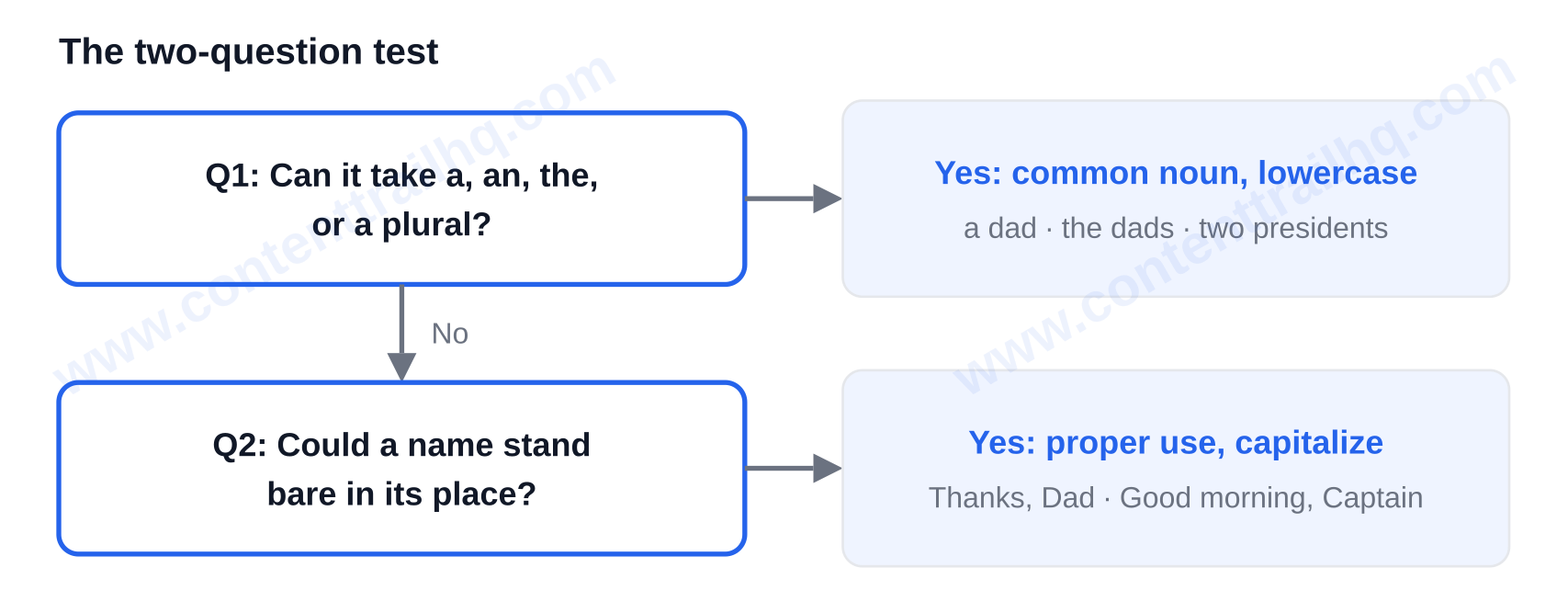
Nobody gets stuck on dog versus Rufus. The words that trip people up are Dad, President, and South. With those, the standard guidance is to look up each exception one at a time. Treating them as one mechanism instead of three separate rules removes the guesswork. Here is that mechanism, in the form of two questions.
Question 1: Can it take ‘a’, ‘an’, ‘the’, or a plural?
If you can stick a determiner in front of it or make it plural and it still makes sense, the word is still being used generically and stays lower case. A dad. The dads. Two presidents. The south side.
Question 2: Could a name stand in its place?
If, on the other hand, the word makes sense only if there is no determiner, standing bare exactly where a name would go, then it’s being used as a proper noun right now, and it gets a capital. Thanks, Dad. Good morning, Captain.
Scribbr is correct to say that words become proper if they are used directly as a name, without an article or other determiner. The test is not in the word itself. It is in the other words surrounding it.
The rule applied: family titles, job titles, and directions vs. regions
| Case | Common noun (lowercase) | Proper use (capitalized) | Which question settles it |
|---|---|---|---|
| Family titles | my dad drove me home | Thanks, Dad | Q1 passes on the left (my); Q2 passes on the right (bare name) |
| Job titles | the president spoke on Friday | President Lincoln spoke | Q1 passes on the left (the); the title fuses to a name on the right |
| Directions vs. regions | drive south for two miles | she grew up in the South | Left is a direction, not a thing; right names one recognized region |
If you can insert a or the into a sentence without rewriting it, then the word can be kept lowercase. With this quick check, you can resolve most of what you’d otherwise have to look up.
What are the types of common nouns?
There are five types of common nouns, and they overlap rather than sort words into separate bins.
Concrete, abstract, and collective common nouns
- Concrete: anything that can be perceived by the senses, for example, bread, thunder, or sandpaper.
- Abstract: an idea or a quality that has no physical existence, like beauty, courage, truth, or democracy.
- Collective: a term used to refer to a group of people or things but usually treated as grammatically singular, for example, a family, team, crew, or committee.
Countable vs. uncountable common nouns
There is also a distinction between countable and uncountable nouns. This is a separate axis, not a fourth category, and the two axes don’t line up one-to-one. As EnglishClub’s breakdown of noun types points out, not all concrete nouns are countable (water, furniture) and not all abstract nouns are uncountable (an idea, three theories). The test is simple: if you can put a number in front of the noun and it still reads normally, it is countable.
Compound common nouns
The fifth and final type is the compound: two or more words used together to create a single noun, like a toothbrush, mother-in-law, or swimming pool. Compounds can be common (post office) or sit inside proper names, like the Oxford Street Post Office.
One word can carry more than one of these labels. The word team, for example, is concrete, collective, and countable at the same time.
Can a proper noun become a common noun?
Yes. Grammar pages tend to cover only one direction, showing how dad gets a capital letter. Names also collapse into generic words, which is the same boundary moving the other way.
According to Wikipedia’s account of generic trademarks, the documented cases are very specific and dated:
- Aspirin: US court rulings in 1918 and 1921 found the term genericized. The 1921 court attributed it to Bayer AG’s failure to reinforce the brand’s connection with its product.
- Heroin: introduced in 1898, also originally a Bayer trademark, and likewise ruled generic by 1921.
- Escalator: Otis Elevator lost the trademark after a petition by Haughton Elevator. The USPTO examiner cited Otis’s own advertising, which used escalator right next to the generic word elevator with no trademark significance.
A longer list includes linoleum, thermos, and bubble wrap. The writing takeaway is simple: once a name has gone generic, it takes a lower case letter like any other generic word.
The boundary between common and proper nouns can move in both directions, so this isn’t a set-in-stone list to memorize. It depends on how the word is being used right now.
Practice: can you spot the common nouns?
Exercise sentences
- The librarian found three books about volcanoes.
- I called Mom from the station.
- I called my Mom from the station.
- The senator met the prime minister in Ottawa.
- Senator Harris introduced the bill.
- Walk north until you reach the bridge.
- Her accent gives away that she’s from the North.
- The United Kingdom raised its export tariffs.
- He took an aspirin and went back to bed.
- Her courage surprised the whole committee.
Answers and explanations
- Common nouns: librarian, books, volcanoes. Q1: each can take a determiner or plural.
- station is common, and Mom is properly capitalized. Q2: it stands bare where a name would go.
- Should be my mom. Q1: the determiner my is present, so this is a common noun. Lowercase.
- senator, prime minister. Lowercase. Q1: both follow the. Ottawa is proper.
- Senator is capitalized here. The title fuses to a name with no determiner. Q2.
- north. Lowercase. A compass direction, not a place, and Q2 fails.
- the North. Capitalized. It names one recognized region.
- Kingdom is a generic word sitting inside a proper name. The capital comes from the name the United Kingdom, not from the word.
- aspirin. Lowercase. A genericized trademark is a common noun now.
- courage (abstract), committee (collective). Both common.
Quick-reference summary
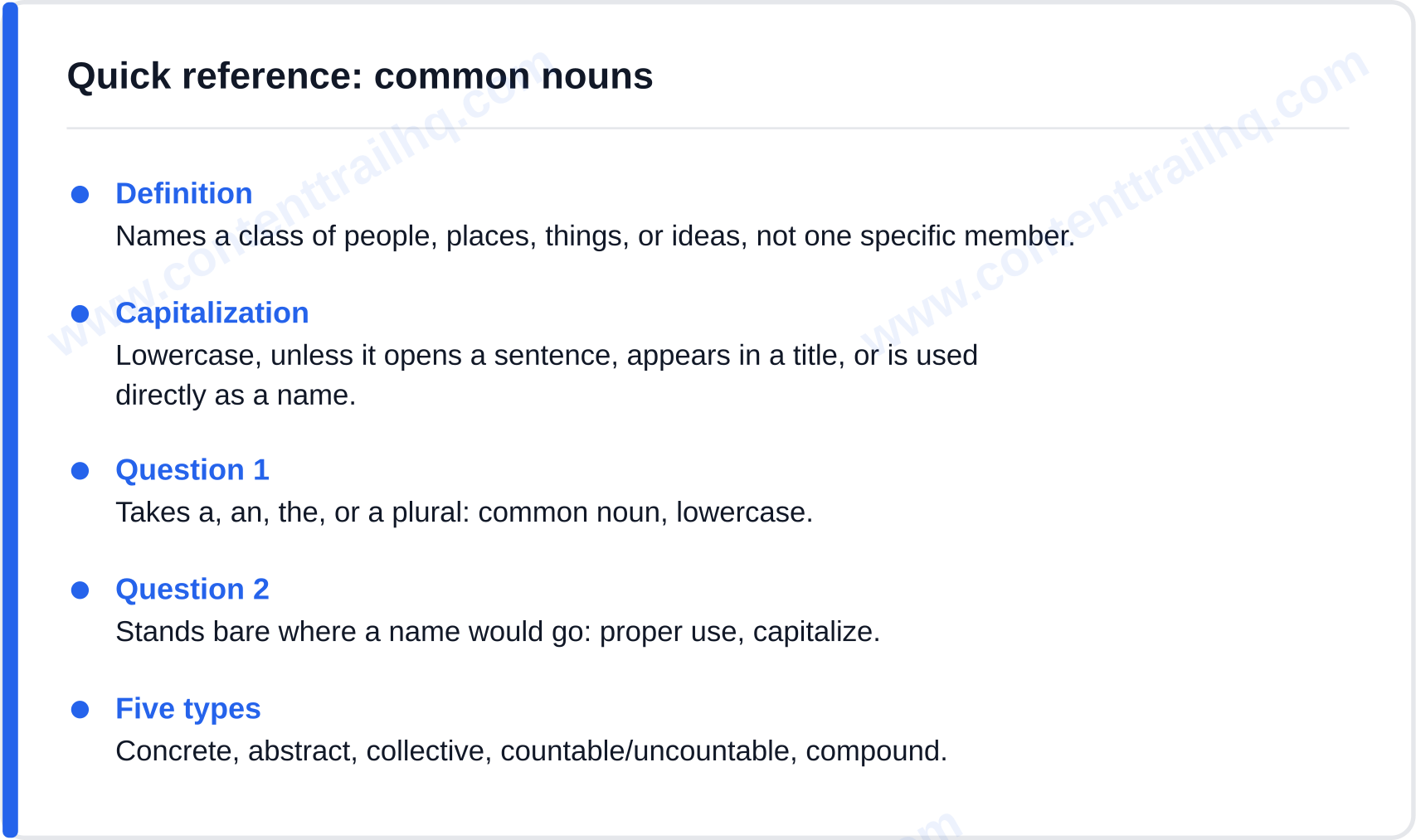
- Definition: names a class of people, places, things, or ideas, not one specific member.
- Capitalization: lowercase, unless it opens a sentence, appears in a title, or is used directly as a name.
- Question 1: takes a, an, the, or a plural → common, lowercase.
- Question 2: stands bare where a name would go → proper use, capitalize.
- Five types: concrete, abstract, collective, countable/uncountable, compound.
The distinction that holds up is this: common nouns name classes; proper nouns name single entities. Capitalization is an English convention layered on top of that distinction, not the distinction itself, which is why the reference test survives contact with German, French, and Spanish but the capital letter test doesn’t. For worked examples, see our more complete guide on what counts as a common noun, which runs through additional cases.
What comes next? Take the last thing you wrote, find every noun that could take a, an, or the, and make sure it is lower case. Anything that fails that test and stands in for a name should be capitalized.









1 comment