Most people think of ocean producers as plants. Perhaps you can picture some sort of underwater grass or plants. However, very few producers are plants. Producers in the ocean are organisms that make their own food instead of eating other organisms, and phytoplankton is probably the most abundant producer in the ocean — microscopic drifting algae and cyanobacteria. Cyanobacteria and algae produce food by the process of photosynthesis. Seaweed, kelp, seagrass, and the algae inside coral add the rest. The deep sea has various kinds of bacteria that produce food by chemosynthesis, without light.
An example to make it more understandable is Prochlorococcus. This cyanobacterium is small enough that 100,000 cells or more can exist in a single millilitre of surface seawater, making it more abundant than any other photosynthesizing organism on earth. It is responsible for approximately 20% of the earth’s atmospheric oxygen. You cannot see it. It still outranks every kelp forest on the planet.
What is a producer in the ocean?
A producer is an organism capable of creating its own food from simple inorganic ingredients. They are called primary producers or autotrophs. Carbon dioxide, water, nutrients, an energy source. Nothing else in a food web is able to do this.
Everything else is called a heterotroph. A fish, a crab, a whale — anything that is not a producer must eat something that was already alive. This is what separates organisms at the bottom of the food chain from everything else.
There are two ways to create food in seawater. The first is photosynthesis, which uses sunlight. The second is chemosynthesis, the use of chemical energy from vent fluid. Both of these count as primary production, which is why the deep sea is considered to have producers despite having no light at all.
Producer, autotroph, primary producer: are they the same thing?
Not much difference. Autotroph is the biological term, primary producer is the ecological term, and producer is the term used in the classroom. All three describe organisms at trophic level 1.
The copy-ready answer: producers in the ocean are organisms that make their own food through photosynthesis or chemosynthesis, and they occupy trophic level 1 at the base of the marine food web. When a worksheet asks for a term, “primary producer” is what the teacher is looking for. They probably don’t want “ocean plant.”
What are the main producers in the ocean?
Five major groups cover almost all of them:
- Phytoplankton — drifting single celled algae and cyanobacteria in open surface water. Diatoms, dinoflagellates, coccolithophores, Prochlorococcus, Synechococcus.
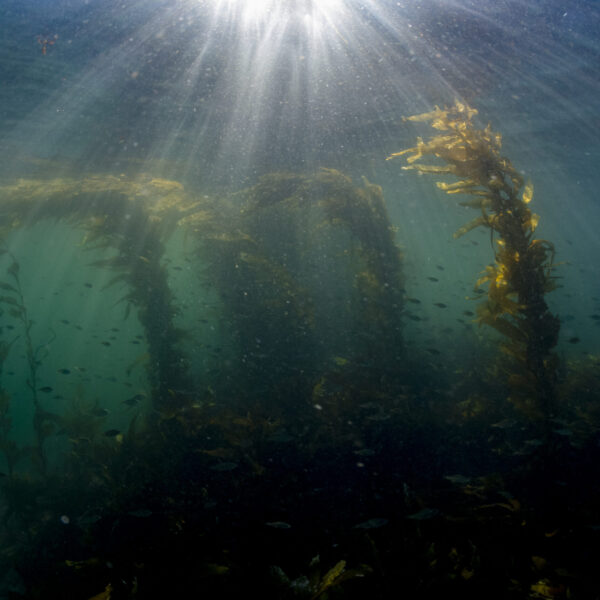
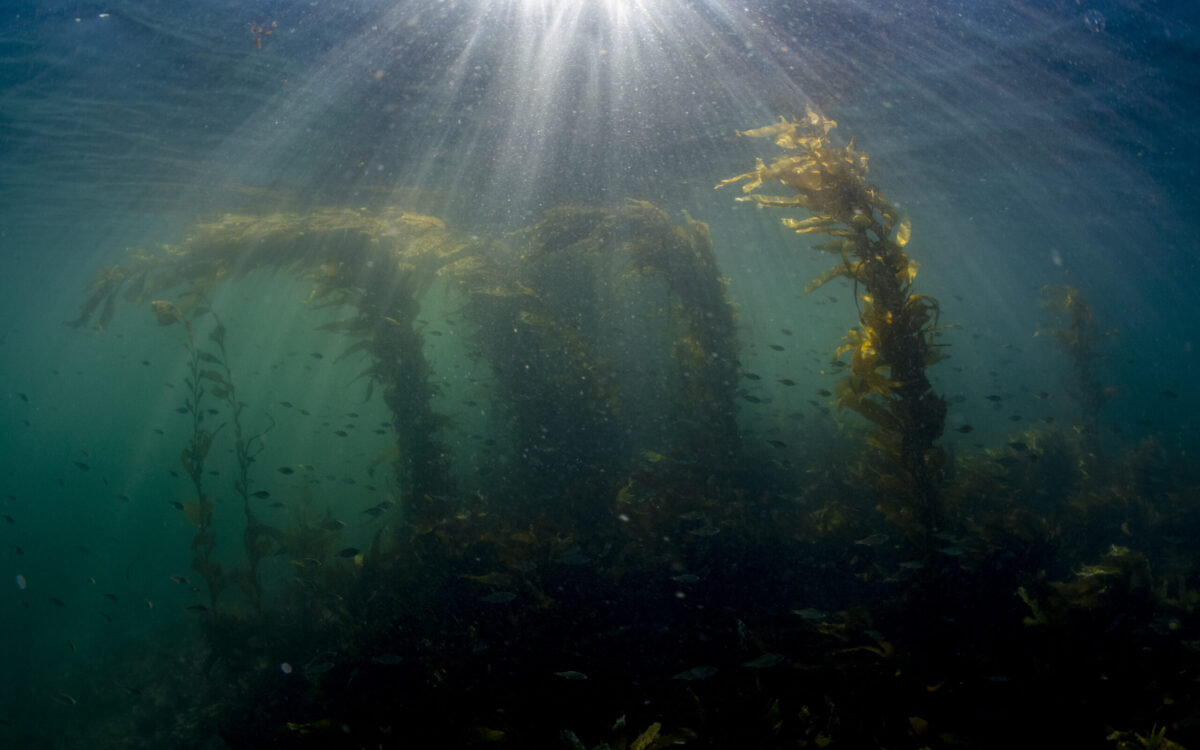
- Macroalgae — larger algae like kelp and seaweed, anchored to rock along coasts. Giant kelp is the familiar one.
- Seagrasses — true flowering plants rooted in shallow soft sediment. Eelgrass is the common temperate species.
- Zooxanthellae — algae that are contained in the tissue of reef-building coral.
- Chemosynthetic bacteria and archaea — found at hydrothermal vents and cold seeps on the deep seafloor.
Mangroves sit at the edge of the list: true flowering trees at the coastal margin that feed marine food webs through their leaf litter rather than being eaten whole.
Which group dominates depends entirely on scale. Globally, phytoplankton are the most dominant primary producers on the planet. However, when looking at smaller geographic areas — where you happen to be standing on a shoreline — phytoplankton may not be as dominant.
Why are phytoplankton the ocean’s most important producers?
Only a handful of people are honest about the split: about 95% of all ocean primary productivity is attributed to phytoplankton, with the rest to seaweeds and seagrasses. This is what is behind the vague statement that they are “most important.”
Now, let’s talk about the ratios. Marine net productivity is between 35–50 billion metric tons of carbon per year, which is produced from only about 1–2 billion metric tons of producer biomass. On land, you would need 600–1,000 billion tons of plant biomass to generate a comparable annual output. The ocean produces a similar amount with only a small standing biomass.
There are three reasons why small drifters are better than large plants in open water. First, they do not need roots, stems or support tissue. Second, small drifters have an enormous surface-area-to-volume ratio, allowing them to take up nutrients efficiently. Third, their generation times are measured in days.
Turnover is the mechanism. A phytoplankton population can be grazed down and then regrown many times in a single season. That is how a tiny standing crop can deliver a colossal annual total. Phytoplankton also does not have the ability to swim against currents — that is why they are called “plankton” — so their distribution is set by ocean physics rather than behaviour.
Which types of phytoplankton produce the most?
From satellite-derived, class-specific estimates, the groups are ranked rather than lumped together: diatoms are the most productive, followed by cyanobacteria and chlorophytes, and lastly coccolithophores with a smaller slice.
Diatoms, dinoflagellates, coccolithophores and cyanobacteria compared
| Group | Share of production | Distinguishing feature |
|---|---|---|
| Diatoms | Largest contributor; earlier global estimates gave 20–40% of total primary production (9–26 Gt C per year) | Silica glass shells; bloom fast in cold, nutrient-rich water |
| Cyanobacteria (picoplankton) | Second, with chlorophytes | Prochlorococcus and Synechococcus; the most abundant photosynthesisers on Earth, credited with ~20% of atmospheric oxygen |
| Chlorophytes | Second, with cyanobacteria | Green algae; small cells across varied water types |
| Coccolithophores | Smaller share | Chalk plates; milky blooms visible from orbit; carbon burial |
| Dinoflagellates | Not ranked in class-specific satellite estimates | Many swim using flagella; some are mixotrophic; several cause harmful algal blooms and red tides |
The Woods Hole Oceanographic Institution’s guide to phytoplankton covers the same four major categories if you want the group-by-group biology.
Are seaweed, kelp and seagrass producers too?
Yes — and per square metre they comfortably outproduce the phytoplankton drifting above them. Seaweed forests average about 656 gC m⁻² yr⁻¹ subtidally and 1,711 gC m⁻² yr⁻¹ intertidally, up to ten times the per-area production of coastal phytoplankton in temperate and polar seas.
Kelp forests are habitat as much as food. Urchins and snails graze the fronds directly, and drifting detritus feeds animals well beyond the forest edge. Seagrass meadows, the ocean’s only true flowering plants, root into the sediment and serve as nursery habitat and long-term carbon store.
So why don’t they dominate? Because they need light and something to anchor to, which confines them to the shallow coastal fringe and rules out about 90% of the ocean’s area.
On a food chain diagram, label them exactly as you label phytoplankton: trophic level 1.
When the textbook answer is wrong: where visible producers outproduce phytoplankton
The standard line — “phytoplankton are the ocean’s producers” — is a global average. A global average hides the location you are looking at.
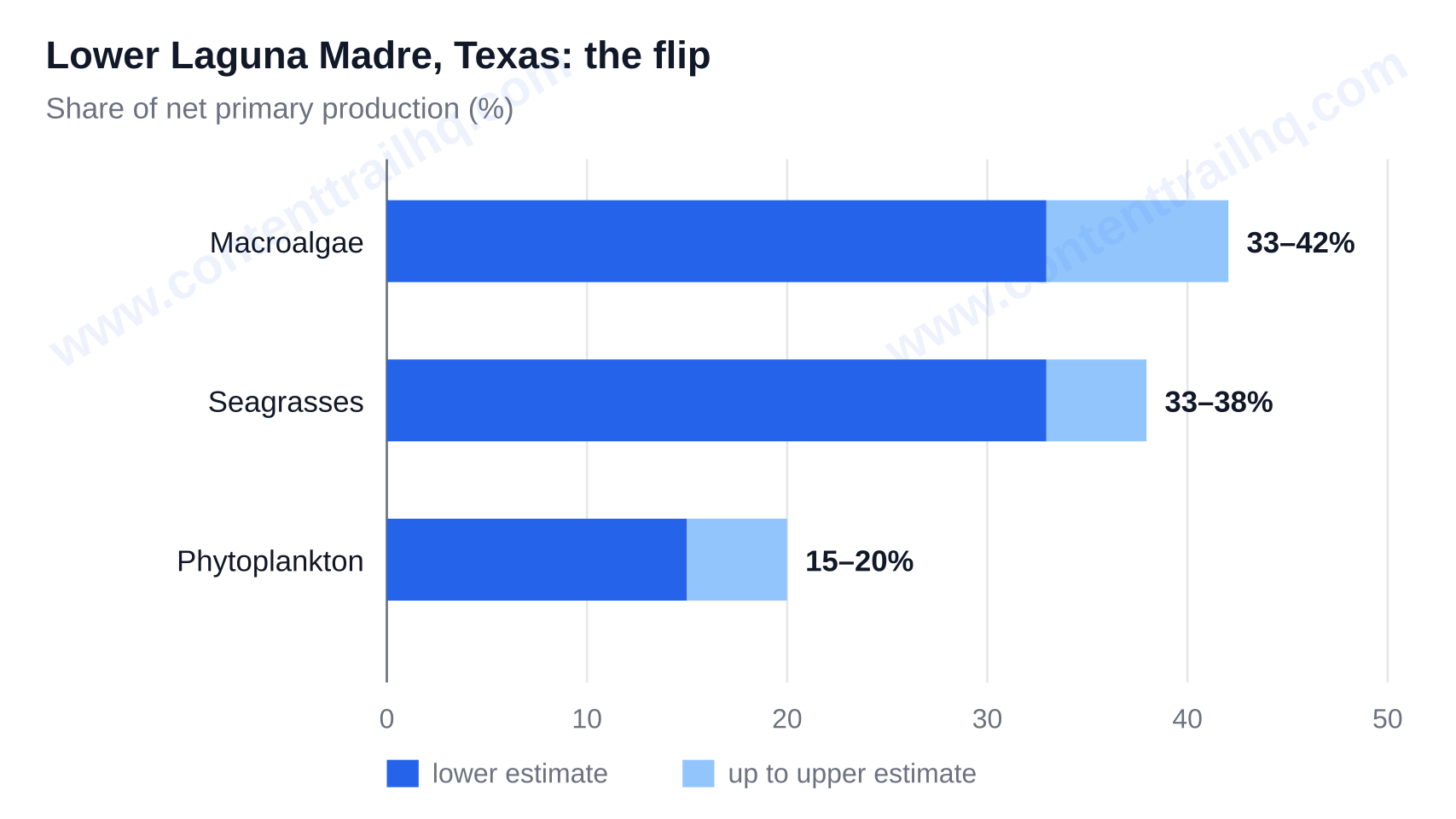
The Lower Laguna Madre in Texas is the clearest documented case of the flip. In that location, macroalgae accounted for 33–42% of net primary production, and seagrasses accounted for 33–38%, with phytoplankton accounting for about 15–20% of net primary production. The textbook order is reversed.
The reason is light. In shallow, clear, nutrient-poor water, sunlight can reach the seabed. Attached or rooted producers can intercept the light before drifting cells get a share. The visible producers win in three habitats: a kelp forest, a seagrass meadow or a shallow subtropical lagoon.
Why global percentages and local measurements disagree
There are two halves to the honest student answer, in a single sentence. On the global scale, phytoplankton are the dominant producers in the oceans; whichever producer you can see usually dominates the coastline you are standing on.
That distinction is not academic. Knowing the dominant local producer is often the difference between conservation and neglect. The predominant producer also determines blue carbon accounting and fisheries management.
How do coral reefs have producers inside the animals?
Corals house single celled algae — dinoflagellates — called zooxanthellae, living inside coral tissue. The algae photosynthesise and manufacture sugars which are then passed straight on to their host.
That makes a coral polyp two things at once. It catches plankton with its tentacles like any consumer, and it eats what its lodgers manufacture. The partnership is why reefs can thrive in clear tropical water so nutrient-poor it would otherwise be a marine desert.
Coral bleaching is the loss of the producer, not the loss of a pigment in the animal. Heat stress makes the coral expel its algae, and without them it slowly starves. Giant clams and some sea slugs and sponges run the same arrangement.
How can there be producers in the deep ocean with no sunlight?
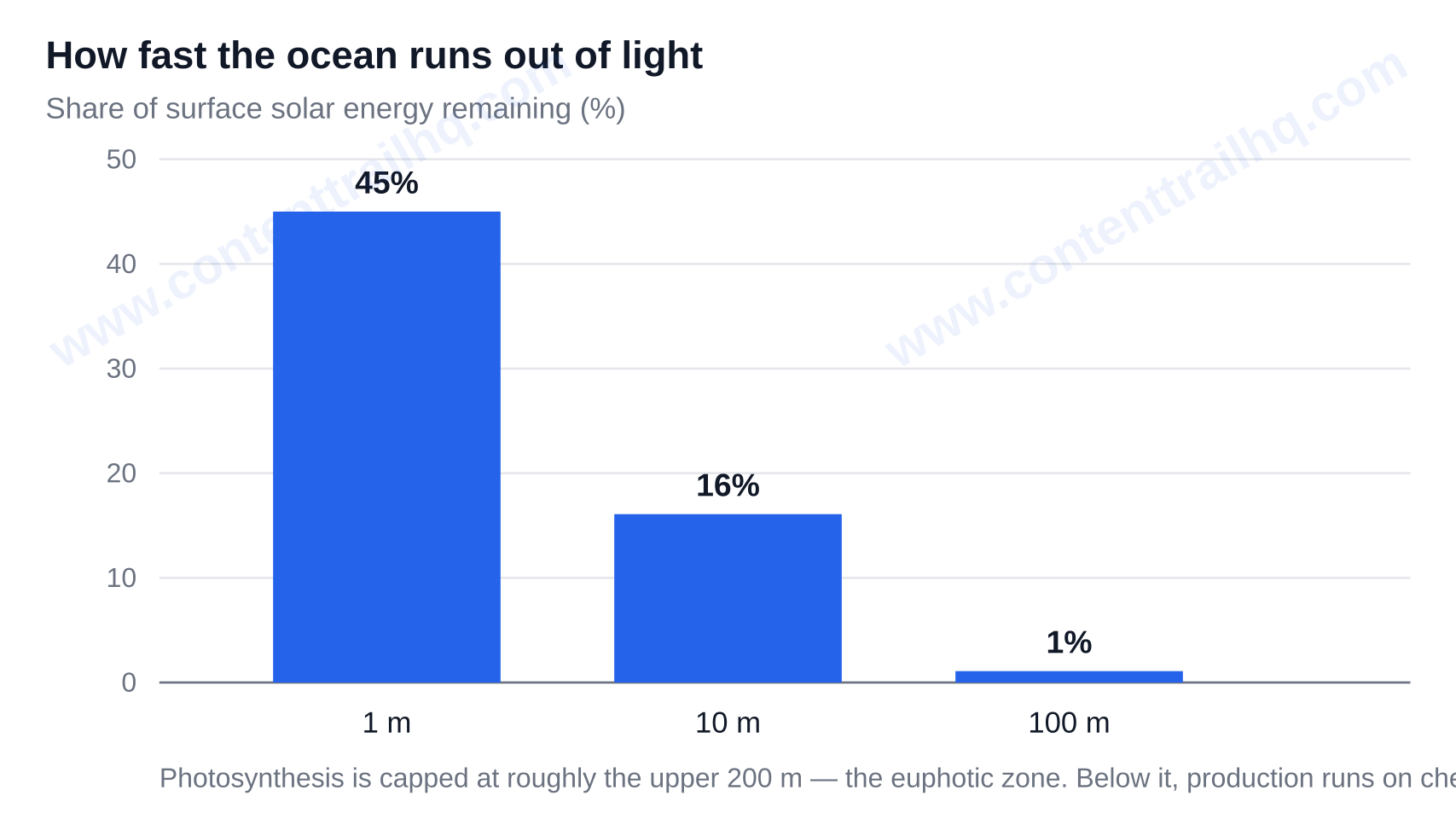
Start with the depth limit, because it explains the need. Light, or rather the absence of it, actually provides one of the better indicators of where producers can be found. Seawater absorbs light fast: about 45% of surface solar energy remains at 1 m, 16% at 10 m, and only about 1% at 100 m. That caps photosynthesis at roughly the upper 200 m — the euphotic zone — where about two-thirds of all photosynthesis on Earth takes place. Below it, light-driven production is simply not available.
Chemosynthesis vs photosynthesis at a glance
There are other ways to produce food. Chemosynthesis takes over. Bacteria and archaea found near hydrothermal vents on the seafloor harvest energy from hydrogen sulfide and other vent chemicals to fix inorganic carbon, no light required. Vents and cold seeps become production hotspots on an otherwise food-poor seafloor.
The symbioses are stranger than the chemistry. Giant tubeworms have no mouth and no digestive tract at all; they house dense bacterial populations internally and absorb hydrogen sulfide through their tentacles to feed them, as MarineBio’s overview of chemosynthetic vent ecosystems describes. Vent clams and shrimp run comparable partnerships.
Recent work also concludes that geothermal radiation cannot supply enough light for oxygenic photosynthesis at vent depths, so chemosynthesis is the only production pathway down there. Marine snow feeds the deep sea too — but that is production sinking from above, not production in place.
Producers, consumers and decomposers in the ocean
This three-way comparison is typically the kind of thing an exam question is really trying to test.
| Role | What it does | Ocean examples |
|---|---|---|
| Producers (trophic level 1) | Make their own food from inorganic ingredients | Phytoplankton, kelp, seagrass, vent bacteria |
| Consumers | Eat other organisms | Zooplankton, krill and grazing urchins (primary); forage fish (secondary); tuna, seals, sharks, whales (top) |
| Decomposers | Break down dead organisms and waste, recycling nutrients | Marine bacteria and fungi returning nitrogen and phosphorus to the water |
Draw it as a cycle, not a ladder. The nutrients in the dead organic material are released back into the environment by decomposers, they feed the producers, and the cycle starts again.
What eats the producers, and how does the energy move up?
An example of a classic marine food chain would be phytoplankton being eaten by zooplankton and krill, which are in turn eaten by forage fish such as sardines, anchovies and herring, which are then eaten by larger predators including tuna, seabirds, seals and sharks. NOAA’s aquatic food webs collection sets out the same trophic structure, with bacteria, phytoplankton and algae forming the lowest level.
The big producers have their own specialist grazers. Sea urchins and some fish work over kelp; turtles, manatees and dugongs graze seagrass.
In a marine food web, the energy that makes it up the food chain is lost at each step: roughly 10% of energy transfers at each step upward. That loss is the whole reason there has to be vastly more producer than predator. Baleen whales take the shortcut — the largest animals on Earth eat krill, only one step above the producers.
And it is a web, not a chain. Most consumers feed at more than one level, and detritus-feeders skip the sequence entirely.
What limits how much ocean producers can grow?
Light and nutrients, together. Light is required for photosynthesis and nutrients are required for growth. Producers need both in the same water, and the ocean rarely delivers them to the same place.
Nitrogen, phosphorus and iron are the usual limiting nutrients — iron especially in the Southern Ocean and other high-nutrient, low-chlorophyll regions. Stratification is the structural problem: nutrients sink, sunlight remains at the top of the ocean, and when the sun heats the warm surface layer it stops the two from mixing.
Upwelling is the fix. Wind-driven deep water upwells off Peru, California, Namibia and northwest Africa, and those zones host the world’s largest fisheries. Seasonal pulse events, such as spring mixing and the long days of a polar summer, also result in productivity blooms — the ones visible in satellite chlorophyll images.
It is due to these mechanisms that much of the open ocean is a biological desert despite its size, and why coasts, shelves and upwelling zones produce the most biomass.
Why do ocean producers matter beyond the food web?
Oxygen, stated precisely: NOAA Ocean Exploration states that over half of Earth’s photosynthesis, and therefore subsequent atmospheric oxygen production, is attributed to seasonal phytoplankton blooms.
Do ocean producers really make half the world’s oxygen?
Almost no page adds a caveat. Roughly as much oxygen as is produced by the ocean is consumed again by marine life, making the ocean’s net contribution to the atmosphere in any given year close to zero. The “half our oxygen” statement describes production, not net supply. Both are true at once.
The long view is more impressive than the annual balance. Algae and phytoplankton have been performing photosynthesis long before there were land-based plants, and Earth’s atmosphere held under five percent oxygen before roughly 600 million years ago, versus about 21 percent today.
We also have the biological carbon pump. Producers fix CO₂ at the surface, and sinking cells, shells and faecal pellets transport that carbon into the deep, where it can remain for centuries. All of our commercial fisheries are derived from the same primary production.
Risks: warming and stronger stratification, ocean acidification on shell-builders like coccolithophores, and nutrient pollution which causes harmful algal blooms and dead zones.
The one thing to remember
In most instances, the answer to ocean producers comes down to one short phrase with one footnote. Phytoplankton account for roughly 95% of the ocean’s food globally — but in a kelp forest, a seagrass meadow or a shallow lagoon, the producer doing most of the work is the one you can see, and in the deep sea it runs on chemicals instead of light.
Next step: draw a marine food chain, focusing on phytoplankton as the base, label them trophic level 1, and work your way up through zooplankton, forage fish and a top predator. Then draw it twice more — once for a kelp forest, once for a hydrothermal vent — and watch the base of the web change with the habitat. Browse more explainers on Content Trail HQ for related reads.
Quick Answers
Are phytoplankton producers or consumers?
Phytoplankton are producers. As primary producers, they are at trophic level 1, since they make their own food from carbon dioxide, water and nutrients using sunlight. A few groups, notably some dinoflagellates, are mixotrophic and can also eat other cells — but they are still classified as primary producers.
Is coral a producer, a consumer, or both?
Coral is a producer and a consumer, in effect. The coral polyp is an animal and a consumer: it catches plankton with its tentacles. However, coral tissue is home to single celled algae, called zooxanthellae. These algae produce sugars via photosynthesis and give them to the polyp. Coral bleaching is what happens when heat stress expels that internal producer and the coral begins to starve.
What is the single most important producer in the ocean?
Phytoplankton as a whole, as they account for roughly 95% of all marine primary productivity. Within that, satellite-derived class-specific estimates rank diatoms as the largest single contributor, ahead of cyanobacteria and chlorophytes. Of the cyanobacteria, Prochlorococcus is thought to be more abundant than any other photosynthesiser on Earth, and is credited with about 20% of the Earth’s atmospheric oxygen.
Are producers in the ocean plants?
Mostly no. Phytoplankton are algae and cyanobacteria, and seaweed and kelp are macroalgae; none of these are true plants. The only genuine flowering plants in the sea are seagrasses, plus mangroves at the coastal margin. That is exactly why textbooks say “producer” rather than “ocean plant.”
What trophic level are ocean producers on?
Ocean producers are on level one of the food web — the base of it. This applies equally to drifting phytoplankton, attached kelp, rooted seagrass and chemosynthetic vent bacteria. Zooplankton and krill sit at level 2, forage fish above them, and large predators such as tuna, seals and sharks at the top.
Can producers survive in the deep ocean without sunlight?
Yes, through chemosynthesis. Light drops to about 1% of surface energy by 100 m, capping photosynthesis at roughly the upper 200 m. Below that, bacteria and archaea at hydrothermal vents and cold seeps oxidise hydrogen sulfide and other vent chemicals to fix carbon. Giant tubeworms, which have no mouth or digestive tract, house those bacteria internally and feed them sulfide, which they absorb through their tentacles.