Where are Samoans from? Samoans are the indigenous Polynesian people of the Samoan Islands, an archipelago in the Central South Pacific roughly halfway between Hawaii and New Zealand. The islands are politically divided with the westernmost part being the independent country of Samoa and the eastern part being the U.S. territory of American Samoa. Their ancestors are the Lapita seafarers of Island Southeast Asia.
Take a Samoan family that traces its lineage to a village in Savai’i, holds a matai title from that village, and has lived in Auckland for three generations. All of that is true at once, which is why the answer comes in two parts — the place on the map, and the ancestral origin behind it.
Where are Samoans from? The short geographic answer
The Samoan archipelago is a volcanic island chain in the Central South Pacific Ocean. It is approximately 2,600 miles southwest of Hawaii and 1,800 miles northeast of New Zealand. It is in the region of Polynesia, the eastern of the three great island groupings of the Pacific. That makes a Samoan a Pacific Islander, and specifically a Polynesian.
The word Samoan has dual meaning:
- A nationality — a citizen of the independent country of Samoa.
- An ethnicity — tagata Sāmoa, the Samoan ethnicity regardless of where a person is in the world, whether American Samoa, Auckland or Los Angeles.
Samoa, American Samoa or both? What people mean by “Samoan”
Usually both. The Samoan people on either side of the colonial border, drawn in 1899, are the same people — someone from Pago Pago and someone from Apia. The actual answer is that, though the islands may be the origin, they are no longer the home of the majority. There are more ethnic Samoans living abroad than in Samoa itself.
Which islands do Samoans actually come from?
The islands of Samoa (independent nation)
- Upolu — the most populated island, and home to Apia, the capital. Samoa Pocket Guide puts about 77% of Samoa’s residents here.
- Savai’i — the largest island by land area and the most volcanically dramatic, with around 22% of the population.
- Manono and Apolima — small inhabited islands in the Apolima Strait, roughly 0.5% of the population.
The islands of American Samoa (U.S. territory)
- Tutuila — the main island and home of Pago Pago, where the large majority of American Samoans live.
- The Manu’a group — Ta’ū, Ofu and Olosega, plus Aunu’u, Rose Atoll and Swains Island.
Samoa’s resident population is in the low 220,000s. The Samoa Bureau of Statistics reports a population of 218,697. United Nations-based estimates put Samoa’s population near 221,000, with a 2026 census under way. At the time of the 2011 census, it was reported 96% of Samoa’s population was Samoan, 2% Samoan–New Zealander, and 1.9% of other ethnicities. That makes Samoa one of the world’s most ethnically homogeneous nations.
Where did Samoans originally come from?
The Lapita and the Austronesian expansion
Samoans descend from the Lapita people who were a seafaring culture known for their distinctive dentate-stamped pottery. The Lapita people were part of the Austronesian expansion which originated in Island Southeast Asia — the Taiwan and Philippines region — and spread east through Island Melanesia before reaching West Polynesia. Published accounts of that expansion place the eastward spread at about 3,500 to 3,000 years ago.
Language supports the same picture. The Samoan language, Gagana Sāmoa, is related to Tongan, Māori, and Hawaiian languages, and is part of the wider Austronesian family, in its Polynesian branch.
Mulifanua: the one site Samoa’s settlement date rests on
This is the detail that many pages skip. The only known Lapita site in Samoa is the partly submerged village at Mulifanua, in the Upolu lagoon, and the pottery from that site dates to roughly 2,700–2,900 years ago. After three decades of searching, this is the only Lapita site ever found anywhere in the Samoan archipelago.
This single-site fragility is the reason that published dates vary. Popular sources repeat “about 3,500 years ago” for the arrival of migrants from Maritime Southeast Asia; however, the direct archaeological constraint from Mulifanua is narrower and later. Both of these numbers are in print because they respond to slightly different questions and the whole settlement date for Samoa rests on one waterlogged site.
What genetics says about Samoan ancestry
A study published in PNAS in April 2020, led by Associate Professor Ethan Cochrane, analyzed the genes of more than 1,100 contemporary Samoans. One finding was that modern Samoans carry about 24% Papuan-related ancestry against around 35% in other Polynesian groups. The study also calculated the founding population to have stayed small — between about 800 and 3,300 people — until roughly 1,000 years ago, when it rose to as many as 10,000.
The part most pages miss: Samoa is where other Polynesians came from
Almost every page asking “Where are Samoans from?” depicts Samoa as the end of a migration. Add the genomic evidence to the archaeology, though, and the migratory arrow turns around. Samoa was a departure point.
The route and the dates, step by step
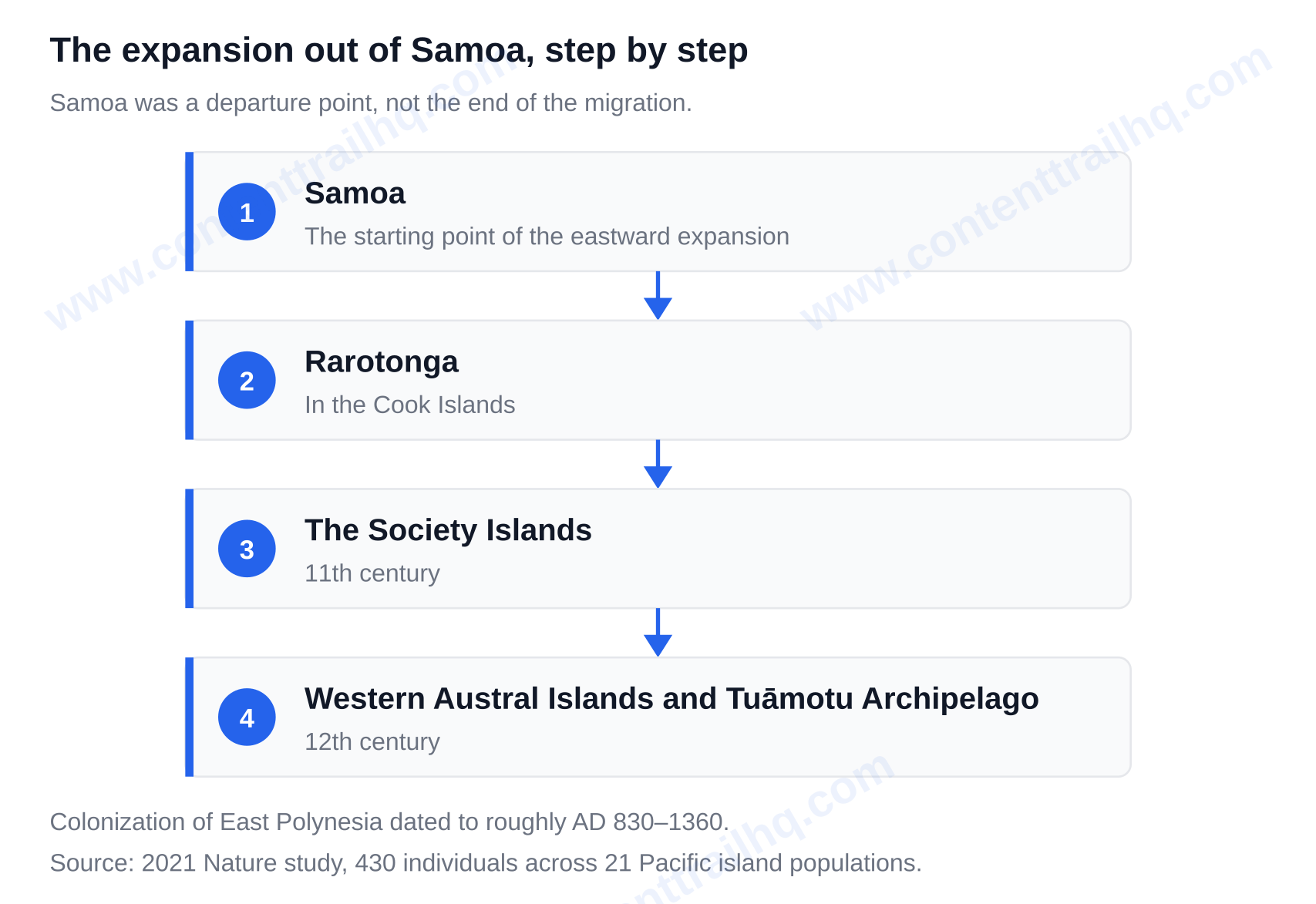
A 2021 Nature study built genomic networks from 430 modern individuals across 21 Pacific island populations and reconstructed a serial founder expansion beginning in Samoa:
- Samoa
- Rarotonga, in the Cook Islands
- The Society Islands, in the 11th century
- The western Austral Islands and the Tuāmotu Archipelago, in the 12th century
They date the colonization of East Polynesia at roughly AD 830–1360: a late, fast, deliberate expansion rather than a slow drift.
Why Samoa, and why so late?
It reframes the original question. Samoa isn’t just one of the many Polynesian peoples — in this family tree, Samoa occupies a position relatively closer to the root of the eastern Polynesian family tree, which is a large part of why Samoan, Tahitian, Māori and Hawaiian resemble each other so strongly. It also answers the long pause: people were in Samoa for well over a thousand years before anyone pushed further east.
One limitation is worth stating plainly. Reading migration history off modern DNA reconstructs the most likely path, not a logbook. There is a degree of uncertainty associated with the dates, and the route describes populations and not individual voyages.
What do Samoans themselves say about where they come from?
Ask “Where are Samoans from?” in Samoa itself and the answer does not begin with migration at all. The Samoan tradition says that Samoans are indigenous to their islands, which means they are not arrivals from anywhere else. The account describes Samoans being birthed from a tear in the heavens, Lagi, with Tagaloa as creator in Samoan cosmology.
Savai’i is widely identified with Hawaiki, the ancestral homeland named in oral traditions right across Polynesia. That sits strikingly well beside the genomic finding that the eastward expansion began here.
Both records are worth holding at once. The archaeological and genetic record describes arrival. The oral tradition describes belonging. Correcting the oral tradition using the archaeological and genetic records, or vice versa, gives a false impression about what each record is for.
Origin also lives in present-day structures, not only in stories — fa’a Samoa, the Samoan way; the matai chiefly system, in which the matai heads the family and extended family and manages village affairs and family land; and the aiga, the extended family that is the unit a Samoan actually belongs to.
What is the difference between Samoa and American Samoa?
One archipelago, two political entities. The two sides share a common heritage and history; the split is colonial, not cultural or ethnic. The Tripartite Convention of 1899 divided the chain, assigning the eastern islands to the United States and the western islands to Germany. After World War I, New Zealand took over the administration of the western half. It became independent in 1962 and dropped “Western” from its name in 1997. American Samoa has been an unincorporated U.S. territory since 1900.
Samoa vs. American Samoa at a glance
| Samoa | American Samoa | |
|---|---|---|
| Capital | Apia | Pago Pago |
| Main island | Upolu | Tutuila |
| Political status | Independent state; independent of New Zealand administration in 1962 | Unincorporated U.S. territory since 1900 |
| People born there | Samoan citizens | U.S. nationals, not U.S. citizens |
Are American Samoans U.S. citizens?
No. American Samoans do not possess U.S. citizenship, and American Samoa is the only permanently inhabited U.S. territory whose people do not have birthright citizenship. The Court of Appeals for the Tenth Circuit, in the case of Fitisemanu v. United States (2021), held that only an act of Congress can bestow birthright citizenship there. The Supreme Court declined to take the case in October 2022 and, thus, upheld the decision of the Court of Appeals.
Are Samoans Asian, Hawaiian or Pacific Islander?
Samoans are Pacific Islanders, specifically Polynesians. Samoans are not Asian, not Native Hawaiian, nor Black. Native Hawaiian and Samoan are separate Polynesian peoples with separate islands, languages and histories; the relationship is cousin, not same.
In the U.S. official statistics, Samoans are classified as Native Hawaiian or Other Pacific Islander, the category covering people with origins in the original peoples of Hawaii, Guam, Samoa or other Pacific Islands.
Why the “Asian” confusion exists in U.S. data
Because for decades the forms said so. For a long time, U.S. guidance grouped Pacific Islanders and Asians together in a single combined “Asian or Pacific Islander” race category, until a revision that first took effect for the 2000 Census split it into “Asian” and “Native Hawaiian or Other Pacific Islander.” So, anyone reading pre-2000 U.S. records, forms or statistics will legitimately find Samoans counted as Asian — and older counts cannot be compared straight across to current NHPI figures.
While it is true that deep ancestry does trace back to Island Southeast Asia, it does not make a Samoan person Asian in any modern ethnic or census sense. On a form, the accurate choice is Pacific Islander or Native Hawaiian or Other Pacific Islander; in a day-to-day conversation, Samoan, Pacific Islander or Polynesian is okay.
Where do most Samoans live today?
New Zealand, the United States and Australia by the numbers
- New Zealand — roughly 180,000 people identified as Samoan in the 2023 census, the country’s largest Pacific ethnic group, built largely on post-war labour migration.
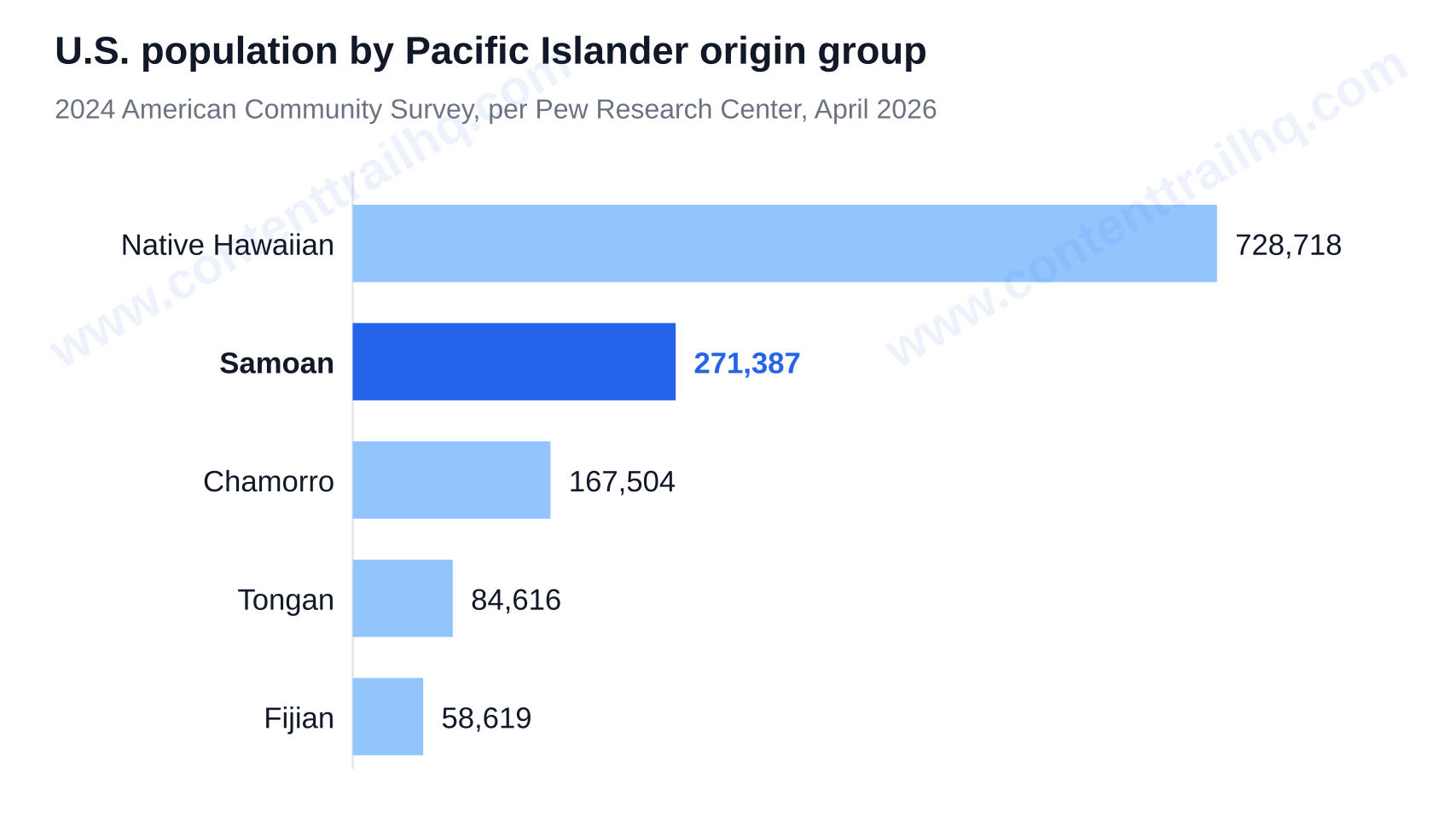
- United States — 271,387 people of Samoan origin as of the 2024 American Community Survey, per Pew Research Center in April 2026. That is the second largest NHPI origin group behind Native Hawaiians (728,718) and in front of Chamorro (167,504), Tongan (84,616) and Fijian (58,619). Circulating numbers near 204,600 or 243,682 are out of date.
- Australia — 98,022 people reported Samoan ancestry in the 2021 Census and 28,107 residents were born in Samoa, concentrated in New South Wales (36.1%), Queensland (32.3%) and Victoria (27.5%).
How Samoans got there: Navy transfers, Hawaii and California
The U.S. route went through Hawaii first. Mormon converts were brought to Laie from the 1920s, and by 1929, 125 American Samoans lived there. In 1951, almost 1,000 American Samoans connected with the military moved to bases around Honolulu at the U.S. Navy’s invitation. Many moved on to California from 1952, and by 1972, California had replaced Tutuila as the main Samoan-populated region.
Which brings the question of where Samoans are from full circle. The Samoan person you meet is statistically more likely to have been born in Auckland, Honolulu, Carson or Brisbane than in Apia — and be completely Samoan.
The one line to remember
So, where are Samoans from? From the Samoan Islands, and before that from Lapita seafarers out of Island Southeast Asia — so if you remember only one thing, remember that Samoa is not where Polynesian migration ended, it is where the eastward half of it began. And if your question came from meeting someone, ask which island their family is from. The distinction between Upolu, Savai’i and Tutuila is the one that actually means something. Browse more explainers on Content Trail HQ for related reads.
Common Questions
How long have people lived in Samoa?
The oldest known case of human occupation in Samoa is the partially submerged Lapita village in the Upolu lagoon, at Mulifanua, whose pottery is dated to roughly 2,700–2,900 years ago. Elsewhere, wider accounts of the Austronesian expansion date the arrival of migrants from Maritime Southeast Asia to approximately 3,500 years ago. The gap between those two numbers is real: Mulifanua is the only Lapita site that has been found in the archipelago despite three decades of searching, therefore the archaeological constraint rests on a single site.
What language do Samoans speak, and is it related to Hawaiian or Māori?
Samoans speak Gagana Sāmoa, the Samoan language. It is a member of the Austronesian language family, more specifically in its Polynesian branch. Therefore, yes — it is directly related to Hawaiian, Māori and Tongan. The similarity isn’t a coincidence. A 2021 Nature study of genomic networks across 21 Pacific island populations reconstructed an eastward expansion that began in Samoa and ran through the Cook Islands, Society Islands, western Australs and Tuāmotus, which places Samoa near the root of the eastern Polynesian family tree.
Is Samoa part of the United States?
No. The western half of the Samoan archipelago, known as Samoa, is an independent country with its capital at Apia; it was administered by New Zealand after World War I and became independent in 1962. The eastern half, American Samoa, is a separate, unincorporated United States territory, administered since 1900, with its capital at Pago Pago. The Tripartite Convention of 1899 drew that line. There is no ethnic or cultural divide along that border — it is a colonial one.
Are Samoans related to Tongans and Māori?
Yes, closely. All three are Polynesian peoples descended from the Lapita culture of the Austronesian expansion, and their languages are in the same Polynesian branch. The 2021 Nature genomic study dates the settlement of East Polynesia to roughly AD 830 to 1360, spreading out of Samoa. In a separate study, published April 2020 in PNAS and led by Associate Professor Ethan Cochrane, researchers reported modern Samoans to carry about 24% Papuan-related ancestry, compared with around 35% in other Polynesian groups.
Can a Samoan from American Samoa move freely to the U.S. mainland?
Yes — people born in American Samoa are U.S. nationals and have the right to live and work in the United States. What they do not have is birthright U.S. citizenship, which affects things like voting in federal elections and some jobs. This makes American Samoa the only permanently inhabited U.S. territory in that position. In Fitisemanu v. United States, the Tenth Circuit ruled in 2021 that extending birthright citizenship to American Samoa would require an act of Congress. In October 2022, the U.S. Supreme Court declined to review this case.