What is an author’s purpose? This is the reason why a writer creates a given text. At Dictionary.com, this reason is given as the main intent of the writer, which falls into three major categories: to inform, to persuade and to entertain. The author’s purpose definition always takes the shape of a verb phrase starting with “to”: to persuade, to inform, to entertain, to explain or to describe.
Here is the author’s purpose at work. One example is a persuasive editorial at the end of which is the statement, “your city should ban gas leaf blowers.” In this case, the purpose of the editorial is to persuade the reader to favor the ban on gas-powered leaf blowers. The topic is leaf blowers. The purpose is the clause beginning with “to.” Now, what if these same facts are structured and organized for inclusion in an encyclopedia? In this example, the purpose shifts to that of providing or informing the reader about the subject matter, and the writer, in this case, is no longer trying to persuade the reader — the subject matter never changed.
What is the author’s purpose definition in simple words?
It is the reason that the text exists. Not what it encompasses. Not whether it is good or bad. The fuller version taught in classrooms, from Literacy Ideas, adds the writer’s motivation and their intent to persuade, inform, entertain, explain or describe something to a specific audience.
That last part is not decoration. Purpose and audience are closely related. Informing a 6 year old and a heart surgeon call for two different texts, so the intended audience is part of the purpose rather than a separate question to answer afterwards.
Why author’s purpose is always a verb phrase starting with “to”
Because the verb phrase is what makes the answer checkable. “To persuade readers to recycle” is an example of purpose. “Recycling” is the topic. Notice that what you have written down is often a common noun that is found in the passage, and if that is the case, you have named the subject and stopped one step short.
What does PIE stand for, and what are the five types?
PIE: persuade, inform, entertain
PIE is Persuade, Inform, Entertain. It is the version taught in most schools and is the reason it dominates multiple-choice reading sections.
PIE’ED: adding explain and describe
Literacy Ideas adds PIE to PIE’ED (sometimes written PIEED) by including Explain and Describe. The inclusion of these is necessary because a user’s manual and a travel essay, for example, do not adequately fall into “inform” nor “entertain.” The same source notes three further categories in circulation — Express, Explore and Document — that you should recognize when you see them.
- Persuade — political speeches, advertisements, editorials, opinion columns
- Inform — textbooks, news reports, encyclopedia entries
- Entertain — novels, poems, comedy
- Explain — user manuals, how-to guides, recipes
- Describe — travel writing, descriptive essays
This still doesn’t answer the list’s greatest failing: the number of purposes is completely dependent on which page you happened to open.
Three types, five, or twenty-one — which list should you actually use?
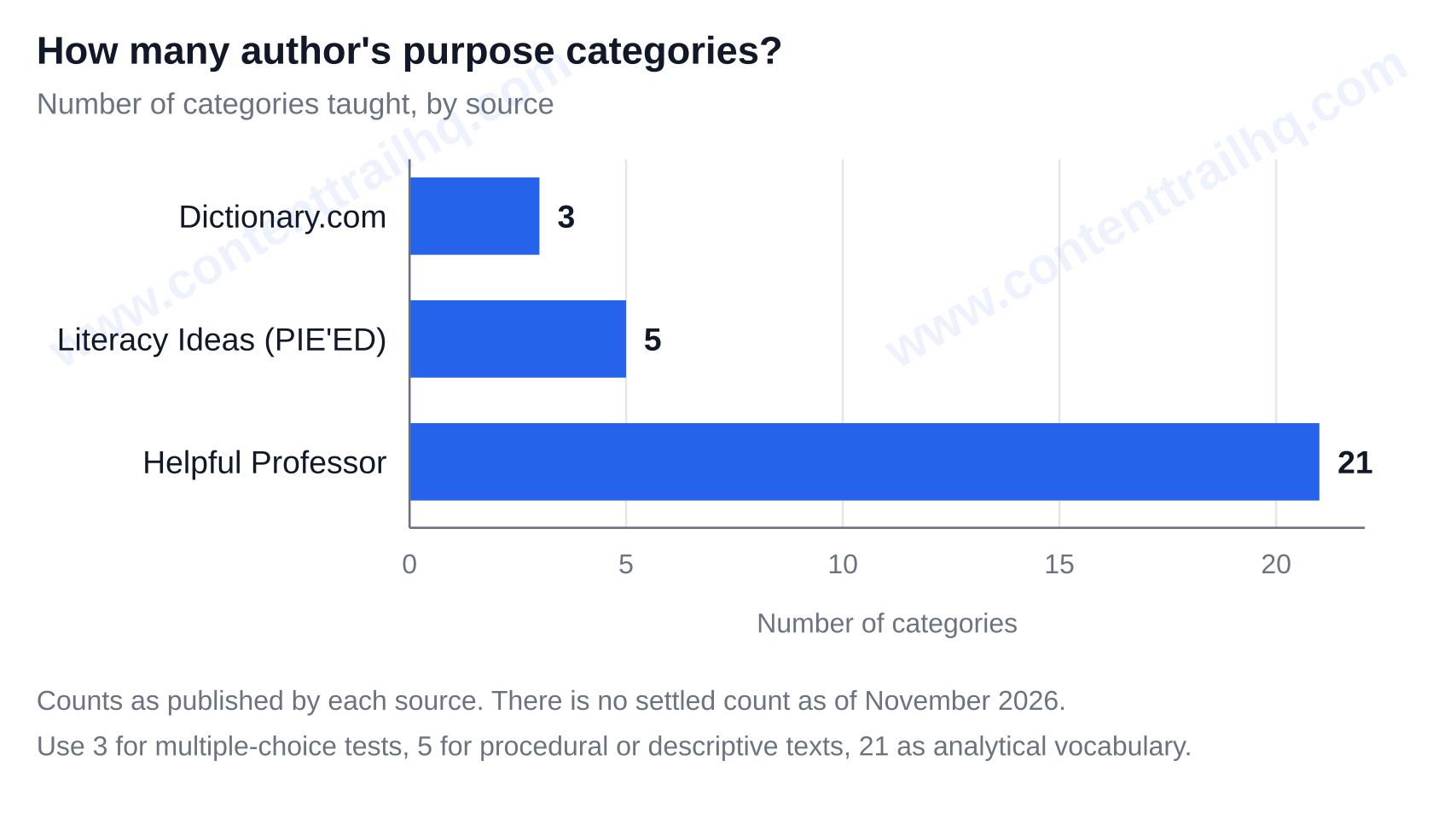
All three counts are live, and the pages carrying them do not recognize the others. Purpose is defined by Dictionary.com as having exactly three categories. Literacy Ideas teaches five under PIE’ED. Helpful Professor identifies 21 categories: to inform, entertain, persuade, describe, explain, analyze, teach, argue, inspire, reflect, share, record, provoke thought, criticize, predict, express emotion, explore, satirize, commemorate, plead and celebrate. There is no consensus as to how many types there are as of November 2026.
So, with respect, stop asking which list is correct, and ask which list addresses the task at hand:
- Use three when labeling a passage on a multiple choice reading test. Distractors are typically built around persuade, inform, and/or entertain, and a fourth or fifth category is unlikely.
- Use five when the text is a manual, a recipe or a descriptive piece, which does not belong in either of the three categories, and forcing it there is clearly wrong.
- Treat the twenty-one as vocabulary for essay writing and analysis, and describe the text with them as precise analysis — words like satirize, commemorate and plead. They are not, and should not be, the answer choices.
How to identify it — and the standard that actually tests it
Union Test Prep’s method is short enough to run in your head: read the text, ask why the author wrote it, and then collect evidence. Opinion and signal words like should or best lead to persuade. Tone can be urgent, neutral or playful. Be sure to check the text type and the title as well as the headings, and the audience being addressed.
Collecting the evidence is always necessary because of how the standard is worded. CCSS.ELA-LITERACY.RI.6.6 is a Grade 6 Reading: Informational Text standard that is part of the Craft and Structure strand and is worded as follows: “Determine an author’s point of view or purpose in a text and explain how it is conveyed in the text.”
There are two things that follow from that sentence. First, in the same standard, point of view is bundled with purpose, which is exactly why students confuse the two. And second, “explain how it is conveyed” means a bare label earns nothing unless the answer names the words in the passage that convey it. Purpose and tone also show up on the ACT, SSAT, TACHS, Praxis Core Reading and the TEAS, where the same rule applies.
Purpose, point of view and tone are three different things
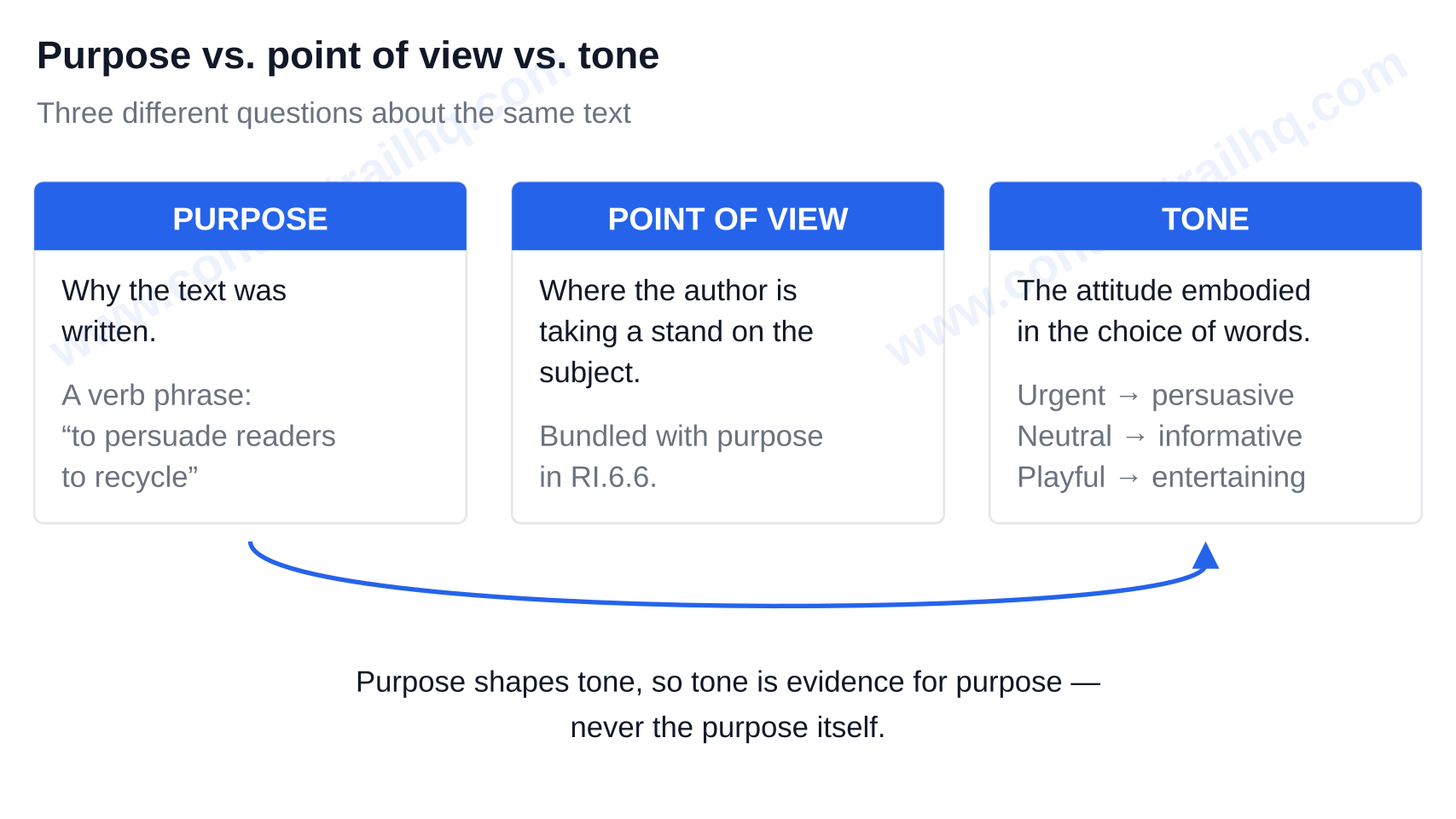
Smekens Education website separates the three and the separation is worth remembering. Purpose is why the text was written. Point of view is where the author is taking a stand on the subject of the passage. Tone is the attitude embodied in the choice of words.
They connect in one direction: purpose shapes tone. An urgent tone is evidence of a piece being persuasive, while a neutral tone is evidence of an informative piece. That makes tone evidence for purpose, never the purpose itself. Ignoring this causes the two classic errors. The first is thinking the topic is the same as the purpose. A passage on vaccines may be informative, persuasive, or even entertaining depending on how it is written. The second error is thinking the writer’s tone is the same as your reaction.
Where PIE breaks down, and how to break the tie
PIE fails to recognize three text types you see often. Satire entertains on the surface while persuading underneath. Informative and entertaining passages can also be combined, like biography or narrative nonfiction, by design. Lastly, a procedure, a recipe, or a user manual is neither entertaining nor really informing in the textbook sense; it exists to explain.
Plenty of pages concede that writers “frequently have more than one purpose” and then leave you there, which is the moment a test item goes wrong. The tie-breaker: ask which purpose does the text fail at if we take it away. The argument survives if the jokes are taken out of a satire column, therefore the purpose is to persuade. Taking the argument away leaves only the jokes, which means a different writing piece. Run that test instead of forcing a letter.
What school leaves out: authorial intent and the 1946 intentional fallacy
The definition of author’s purpose in Grade 6, and the idea of authorial intent in the realm of literary criticism are not the same thing, and a reader moving from reading class to a literature seminar will be taught almost the direct opposite of what PIE alludes to.
In 1946, Wimsatt and Beardsley published “The Intentional Fallacy” and argued that “the design or intention of the author is neither available nor desirable as a standard for judging the success of a work of literary art.” Two camps arose from this debate. Intentionalism holds that intent determines meaning — E. D. Hirsch argued in 1967 that a text means what its author meant, separating fixed meaning from changeable significance. Anti-intentionalism locates meaning in linguistic convention and in the reader; Roland Barthes’ “The Death of the Author,” also 1967, held that a published work comes loose from its author’s intentions entirely.
Notice that RI.6.6 quietly takes a side. It asks how purpose is “conveyed in the text,” not what was in the writer’s head. The school version is a claim about the evidence on the page, which is why it survives contact with the theory, and why our wider guide to author’s purpose stays tethered to the passage, and not to the author’s biography.
The gap is what to watch. The definition is stable, but the label count is not. Dictionary.com still says three, but 2026-dated teaching pages list twenty-one, and the pressure on “intent” keeps growing, as more text arrives without a single identifiable author behind it. Remember the one durable part — purpose is a verb phrase you can prove from the words on the page.
People Also Ask
What is the author’s purpose definition in one sentence?
The author’s purpose is the principal reason that a writer creates a particular text. It can be expressed in a verb phrase that starts with “to,” such as, to persuade, to inform, to entertain, to explain, or to describe. Dictionary.com’s live entry groups it into three intents: to persuade, inform or entertain an audience.
What does PIE stand for in author’s purpose?
PIE stands for Persuade, Inform, and Entertain. Literacy Ideas extends it to PIE’ED (sometimes PIEED) by adding Explain and Describe, because manuals, recipes and travel writing fit neither inform nor entertain cleanly. The same source notes three other categories in use: Express, Explore, and Document.
How many types of author’s purpose are there?
This can vary by source, and there is no settled count as of November 2026. Dictionary.com defines three. Literacy Ideas teaches five under PIE’ED. The Helpful Professor lists twenty-one, including analyze, satirize, commemorate and plead. Use three on multiple choice reading tests, five when a text is procedural or descriptive, and the long list as analytical vocabulary.
What grade level is author’s purpose taught and tested at?
It is assessed under the Common Core standard CCSS.ELA-LITERACY.RI.6.6, a Grade 6 Reading: Informational Text standard in the Craft and Structure strand. This standard states, “Determine an author’s point of view or purpose in a text and explain how it is conveyed in the text.” Purpose and tone also appear on the ACT, SSAT, TACHS, Praxis Core Reading, and the TEAS.
What is the difference between author’s purpose, point of view and tone?
Purpose is the reason a text is written, point of view is the author’s stance on the subject, and tone is attitude shown through word choice. Purpose is always the driving force behind tone, so tone is evidence for the purpose rather than the purpose itself. Thus, in a persuasive text, we can expect an urgent tone, and with an informative text, we can expect a neutral tone.
How do you identify the author’s purpose when a text has more than one?
Identify which purpose the text would fail at if you eliminated it. Satire entertains while persuading, biography informs and entertains, and a manual exists to explain — so instead of forcing one PIE letter, strip each candidate purpose out and see which removal breaks the text. Then name the specific words that convey it, because RI.6.6 requires the evidence, not just the label.