


Getting molar mass right is harder than most people expect. It’s not the formula that is the problem (the brackets trip most people up). It is the hydrates and the improper placement of subscripts. Here is how to calculate molar mass in six steps, with the number you should see at the end of every step so you catch the mistake while it is still small. Allow 10 minutes for each compound you do not know well.
Molar mass is the mass of one mole of a substance, M = m/n, reported in grams per mole (g/mol). To calculate it, list every element in the chemical formula, count the atoms of each, multiply each count by that element’s atomic mass from the periodic table, then add the contributions together. Water, H₂O, works out to 18.02 g/mol.
What is molar mass, and what units should your answer be in?
Molar mass is the ratio of a sample’s mass to the amount of substance it contains: M = m/n, where n is measured in moles. The mole is the SI unit of amount of substance, and since the 2019 SI redefinition it is fixed at exactly 6.02214076 × 10²³ elementary entities.
The units confuse people because there are two equally correct answers. As noted in Wikipedia’s article on molar mass, the SI coherent unit is kg/mol, but the historically conventional working unit is g/mol. Put g/mol on your homework.
One more thing worth knowing before you start summing: molar mass is a bulk, averaged property. It describes a mole of particles, not a single one, which is why the value is averaged over the natural isotopic composition of the element. The general formula the rest of this guide executes is M = Σ(n × A) — for every element, atom count times atomic mass, all added up.
Molar mass vs molecular mass vs formula mass vs molecular weight
These terms are not synonyms, and their definitions differ at the particle vs. mole level, though their numbers coincide. Molecular mass and formula mass are particle-level quantities in daltons (u or Da); molar mass is a mole-level quantity in g/mol. Chemistry LibreTexts states clearly that formula mass is applied to formula units (including ionic compounds) and molecular mass is applied to discrete molecules. Water is about 18.0153 Da per molecule and about 18.0153 g/mol per mole. “Molecular weight” is the older term, but the idea is still widely used.
Why your periodic table and your calculator disagree in the last decimal
Because an element’s molar mass in g/mol is numerically equal to its atomic mass in daltons, you can read values straight off the table. The link is the molar mass constant, M_u ≈ 1 g/mol. Here is the nuance no ranking how-to mentions: that equivalence is no longer exact. Since the 2019 redefinition, M(¹²C) = 12 g/mol and M_u = 1 g/mol are experimentally determined, not defined. Wikipedia puts the discrepancy at order 10⁻⁹ — within a part per billion — and the RSC’s analysis records a relative standard uncertainty of 4.5 × 10⁻¹⁰ acquired at the redefinition. The shortcut is safe to nine significant figures. It changes nothing about your answer.
How do you calculate molar mass step by step?
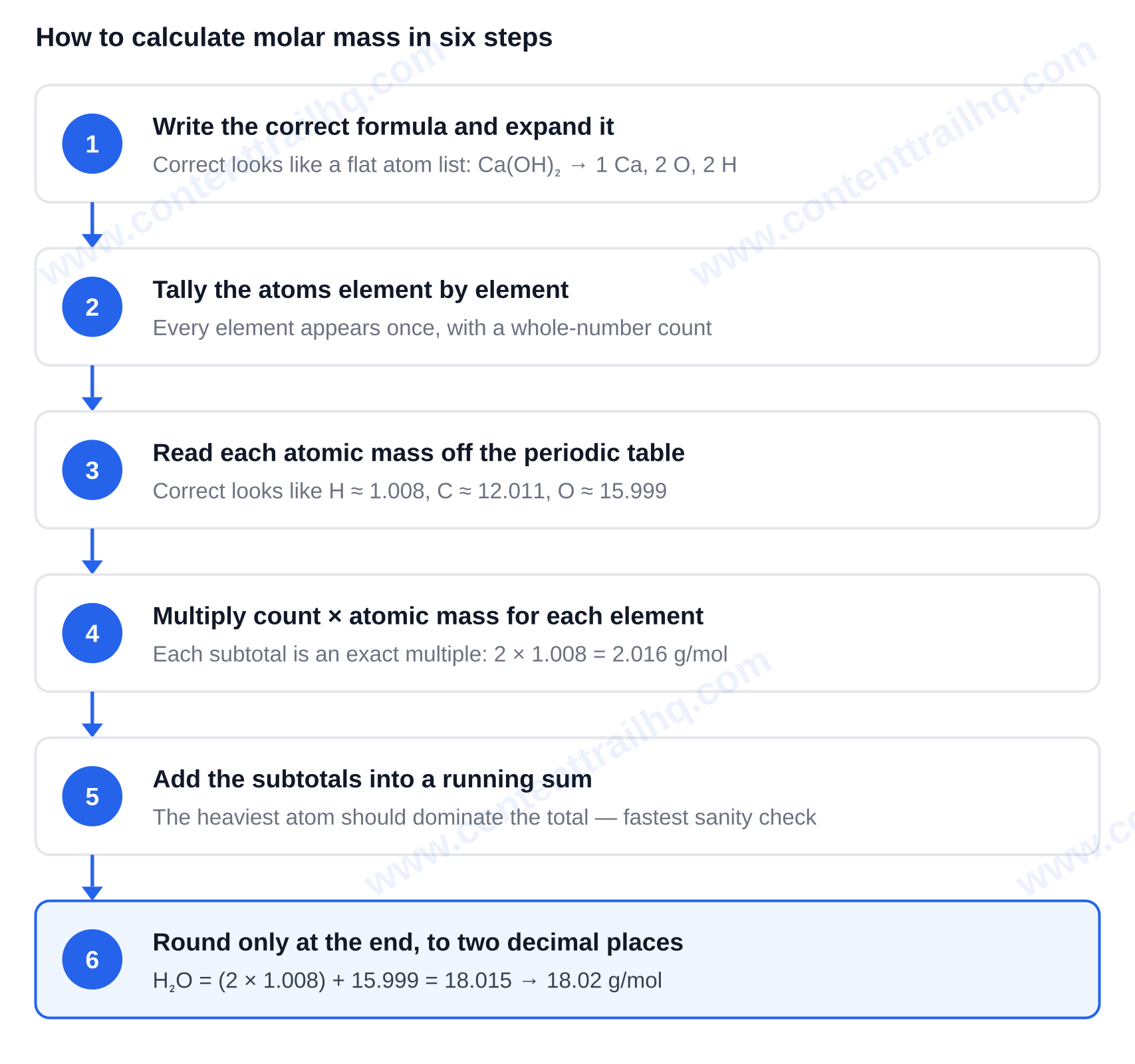
Run these in order. Note that with each step, you will be shown an example of the correct format of the intermediate result. You will never have to carry an incorrect result to the next step.
- Write the correct formula and expand it. Be sure to clear all parentheses and dots before counting anything. A correct format will look like a flat atom list: Ca(OH)₂ → 1 Ca, 2 O, 2 H.
- Tally the atoms’ element by element. Count the atoms’ element by element and write in a column. A correct format will have every element in the formula shown only once and a whole number count.
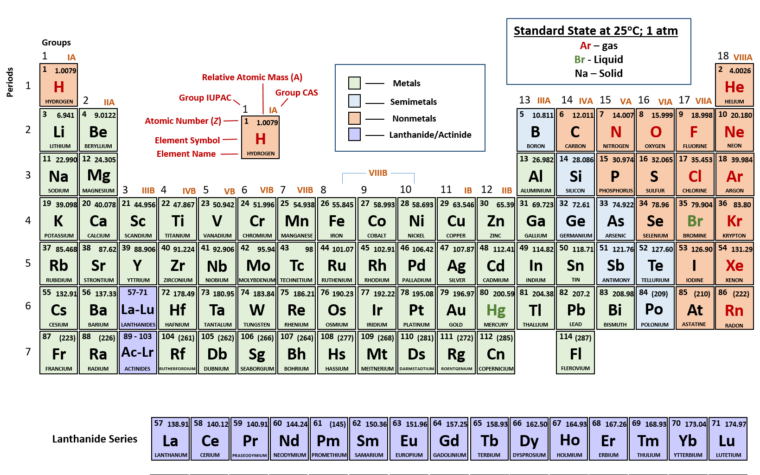
- Read each atomic mass off the periodic table. Take the decimal number under the symbol, not the whole-number atomic number above it. Correct looks like H ≈ 1.008, C ≈ 12.011, O ≈ 15.999.
- Multiply count × atomic mass for each element. Correct looks like a subtotal that is an exact multiple of the atomic mass: 2 × 1.008 = 2.016 g/mol.
- Add the subtotals into a running sum. Add the sub totals to a running total. A correct format will be dominated by the heaviest atom shown in the element formula — your fastest sanity check.
- Round only at the end. You may round only at the end. All values must be multiplied and added using the digits from the periodic table and the final figure must be quoted to two decimal places.
Worked example: molar mass of water (H₂O)
H₂O = (2 × 1.008) + 15.999 = 2.016 + 15.999 = 18.015 → 18.02 g/mol. Wikipedia’s reference value is 18.0153 g/mol, so you have landed exactly where you should.
The step most people get wrong — and exactly what the mistake costs you
In my experience, when a person gets the molar mass problem wrong, it’s mostly because of step 1 and not because of step 4. Most people get the arithmetic correct, but the atom list is wrong before the arithmetic even starts. Almost every page that has a how to find molar mass step-by-step example shows the three-step process to find it and not one of them shows an example of what a correct intermediate value is. So that is what I will be showing you here.
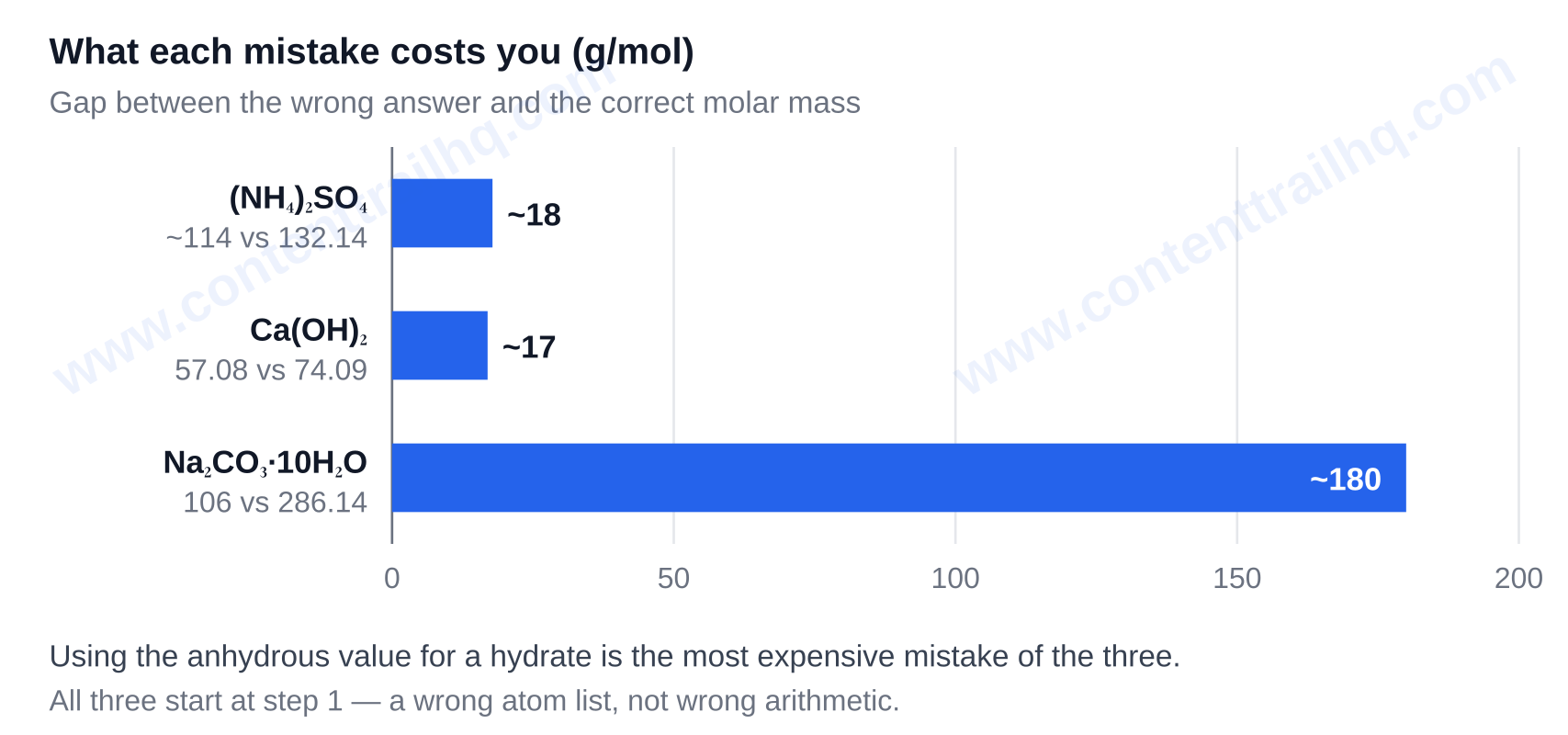
The most common mistake is placing a subscript outside of a closing parenthesis. Readers will either completely ignore it, or apply it to the last element. Learn to recognise these errors by the size of the discrepancy:
| Mistake | Wrong answer | Correct answer | Cost |
|---|---|---|---|
| (NH₄)₂SO₄ — missing the outer 2 on the ammonium group | ~114 g/mol | 132.14 g/mol | ~18 g/mol |
| Ca(OH)₂ — counting one O and one H instead of two of each | 57.08 g/mol | 74.09 g/mol | ~17 g/mol |
| Na₂CO₃·10H₂O — using the anhydrous value | 106 g/mol | 286.14 g/mol | ~180 g/mol |
| Reading the atomic number instead of the atomic mass (O = 16 vs 15.999) | 18.02 looks like 18.00 | 18.02 g/mol | third decimal |
Chemistry AI Tutor has an article describing the parenthesis and hydrate problems, with the (NH₄)₂SO₄ example around 18 g/mol, and the 286.14 g/mol decahydrate figure comes from LivePhysics. The hydrate problem is the more expensive problem, as it will corrupt all downstream mole, molarity, and percent composition calculations.
A per-step correctness check you can run on any formula
- Each element in the formula appears exactly once in your list.
- Each subtotal is a clean multiple of its atomic mass.
- The heaviest element dominates the sum.
- The final answer has two decimal places.
How do you handle parentheses, polyatomic ions, and hydrates?
The rule for parentheses is one line: the subscript outside the closing bracket multiplies every element count inside it, including subscripts that are already present.
Ca(OH)₂ gives 1 Ca + 2 O + 2 H → 40.08 + (2 × 15.999) + (2 × 1.008) = 74.09 g/mol. (NH₄)₂SO₄ gives 2 N + 8 H + 1 S + 4 O → 132.14 g/mol; notice the outer 2 doubles both the N and the whole H₄ inside the ammonium ion.
A handful of polyatomic ions generate most of these brackets — hydroxide OH⁻, sulfate SO₄²⁻, ammonium NH₄⁺, carbonate CO₃²⁻. Learn their formula masses and every later calculation gets faster.
Dot notation means water of crystallization. That water is part of the crystal, and is present when you weigh the salt, so it should be included in the molar mass. The dot means “plus this many whole water molecules”, not multiplication of the salt. CuSO₄·5H₂O carries five of them; the decahydrate Na₂CO₃·10H₂O has a molar mass of 286.14 g/mol, compared to the anhydrous Na₂CO₃ at 106 g/mol.
Two edge cases close this out. For ionic compounds, NaCl = 22.99 + 35.45 = 58.44 g/mol describes a formula unit, not a discrete molecule — “formula mass” is the more precise term there. And for elements, the formula decides the count, not the element: Na = 22.99 g/mol, but O₂ = 2 × 16.00 = 32.00 g/mol.
How do you find molar mass when you have no chemical formula?
The sum-the-atomic-masses recipe fails completely when you have a substance and no formula — an unknown in a lab, or an identify-the-gas exam question. Use this decision rule: have a formula → sum it; have a mass and a mole count → M = m/n; have a gas sample → M = mRT/(PV); have a solution → use a colligative property.
Molar mass of an unknown gas with M = mRT/PV
Because n = m/M, the ideal gas law PV = nRT rearranges to M = mRT/(PV). Take 3.20 g of a gas occupying 1.85 L at 27 °C (300.15 K) and 0.980 atm: n = (0.980 × 1.85)/(0.08206 × 300.15) = 0.0736 mol, so M = 3.20/0.0736 = 43.5 g/mol. That is consistent with CO₂ at 44.01 g/mol or propane at 44.10 g/mol. A measured molar mass rarely lands on the textbook value exactly, so match it to the nearest candidate rather than expecting a perfect hit.
Molar mass from colligative properties
In Purdue’s general chemistry help page, there are three methods for determining the molar mass of an unknown non-volatile dissolved solid: freezing point depression, boiling point elevation, and osmotic pressure. All three of these methods have the same general procedure: measure the colligative property, determine molality or molarity, convert to moles, and then divide the measured mass by the moles. Volatile unknowns and gas identification questions go to the gas law. Non-volatile solutes go to colligative measurements.
How precise should your answer be, and what do you do with it next?
Most pages leave this rule vague. For ordinary laboratory work, molar masses should be quoted to two decimal places, and over 1000 g/mol, to no more than one decimal place, according to Wikipedia’s guide on precision. Follow the workflow above: keep all digits the periodic table gives you throughout the multiplication and addition, round once at the end. That is why 18.02 g/mol for water is defensible, whereas 18 and 18.0158 are not.
There is also a lower limit to precision, and it addresses the query attentive readers typically strike, that being: Why do a couple of periodic tables give diverse atomic masses? CIAAW publishes several standard atomic weights as intervals, as opposed to exact figures, because the range of isotopic composition in normal terrestrial material prevents a more precise value: hydrogen [1.00784, 1.00811], carbon [12.0096, 12.0116], nitrogen [14.00643, 14.00728], oxygen [15.99903, 15.99977], sulfur [32.059, 32.076], chlorine [35.446, 35.457]. Sodium, on the other hand, is a tight single value, 22.98976928(2).
The consequence is concrete: water’s molar mass carries a built-in spread of roughly ±0.001 g/mol from the hydrogen and oxygen intervals alone. Your textbook and your calculator can differ in the third decimal with neither being wrong. The table in force is based on the Atomic Weights 2021 report with 2024 revisions, so a periodic table printed before 2024 can carry superseded values for gadolinium, lutetium and zirconium.
Now carry the number forward. Use n = m/M to convert grams to moles — 36.04 g of water is 2.00 mol — and m = n × M to go the other way: 0.500 mol of NaCl is 0.500 × 58.44 = 29.22 g. From there you are usually heading to one of two places: molarity in mol/L for solution prep, or percent composition from each per-element subtotal divided by the total molar mass. Both inherit any molar mass error directly, which is why the per-step check earns its keep.
Quick-reference molar masses for common compounds
- H₂O — 18.02 g/mol
- CO₂ — 44.01 g/mol
- NaCl — 58.44 g/mol
- O₂ — 32.00 g/mol
- Na₂CO₃ — 106 g/mol
- Na₂CO₃·10H₂O — 286.14 g/mol
- Ca(OH)₂ — 74.09 g/mol
- (NH₄)₂SO₄ — 132.14 g/mol
- Dry air — 28.9647 g/mol
Three things to take away
Molar mass is a calculation you will perform repeatedly all year, and a focus will be on getting the right answer, as opposed to merely remembering how to compute it. Remember these:
- Expand before you count. A flat list of atoms, with the bracket subscripts and hydrate water already applied, prevents the errors that cost 17 to 180 g/mol.
- Audit each intermediate. Check your work element by element. A clean sum of subtotals, dominated by the heaviest element, with each element appearing once.
- Round last, to two decimal places. Carry all the periodic-table digits through, then quote the final figure in g/mol.
Next step: take the compound in front of you right now, run the six steps on paper, and check your total against the quick-reference list above before you carry it into n = m/M. Browse more explainers on Content Trail HQ for related reads.
Frequently Asked Questions
What is the formula for calculating molar mass?
There are 2 ways to look at it. By definition, M = m/n — the sample mass divided by the amount of substance in moles. To determine it from a chemical formula, use M = Σ(n × A): multiply each element’s atom count by its atomic mass from the periodic table and add the results. Report the answer in g/mol.
Is molar mass the same as molecular weight?
They describe the same quantity in practice, and the numbers match, but molar mass is the more correct and recent term. Molar mass is a mole-level property expressed in g/mol; “molecular weight” is the older name for the mass of a molecule and is still used in textbooks and on reagent bottles.
What is the difference between molar mass and formula mass?
Formula mass is the mass of a formula unit in daltons (u or Da). Because it is at the particle level, it is appropriate to use it for ionic compounds like NaCl. Molar mass is at the mole level and is expressed in g/mol. As Chemistry LibreTexts states, the numerical values for the two are the same. Water is about 18.0153 Da per molecule and about 18.0153 g/mol per mole, for example — even though the units and meaning differ.
How many decimal places should you use for atomic masses when calculating molar mass?
You should carry over every digit the periodic table gives you (H = 1.008, O = 15.999) through the multiplication and the sum, and then round once at the end. Wikipedia’s guidance suggests quoting molar masses to 2 decimal places for normal laboratory work, and no more than 1 decimal place if the molar mass is greater than 1000 g/mol.
Why is the molar mass of an element numerically equal to its atomic mass?
Because the molar mass constant, M_u, is approximately 1 g/mol, which links the particle scale to the mole scale. The 2019 SI redefinition fixed the mole at exactly 6.02214076 × 10²³ entities, so that equivalence is experimentally determined rather than exact — the discrepancy is of order 10⁻⁹, so the shortcut holds to nine significant figures.
Does a molar mass calculator give a different answer than hand calculation?
It can vary up to the third decimal place and neither is necessarily wrong. As CIAAW notes, there are intervals for some standard atomic weights — hydrogen [1.00784, 1.00811] and oxygen [15.99903, 15.99977] among them — because terrestrial isotopic variation prevents a single value. That alone gives water’s molar mass a built-in spread of roughly ±0.001 g/mol, which is why 18.02 g/mol is the honest answer.









1 comment