Art Deco furniture refers to the geometric, luxurious style that emerged in France in the early 1920s. This style continued until the early 1940s. This style is characterized by stepped, symmetrical, streamlined forms (geometric) covered in exotic veneers, chrome, lacquer and glass. This style is more architectural, polished and deliberately less ornate than the Art Nouveau that came before it.
Émile-Jacques Ruhlmann’s 1923 Macassar ebony and ivory cylinder desk is an example of this style. This desk was the centrepiece of the most well received pavilion at the 1925 Paris Exposition. Now set it beside a 1930s American waterfall dresser in bird’s-eye maple veneer. Both are genuinely of the period. This desk is a seven figure object, but the waterfall dresser costs less than a new sofa. Telling them apart is the real skill, and most style guides stop before they teach it.
What exactly makes a piece Art Deco?
To identify a piece as Art Deco, look for geometry first. These forms are symmetric and architectural, often with tiers or steps (like a ziggurat) borrowed straight from skyscraper design — Paul T. Frankl built a whole range of Skyscraper furniture on that idea. Where there are curves, they are machine curves: swept-back corners, drum shapes, long uninterrupted sweeps set against hard straight lines. Typically, Deco pieces are sparse and stylised, and can include decorations such as chevrons, sunbursts or fans. Often, decorations are chevron-matched veneers or geometric inlays.
Next look at the legs because they are the fastest tell in the room. Deco legs are tapered and sometimes shrunk to almost nothing or completely missing altogether leaving a plinth or platform base. Victorian furniture has turned, bulbous legs. Thin splayed mid-century modern legs often have daylight between them. A heavy case piece sitting flat to the floor is very often Deco.
Also, it’s good to know that the style is a pastiche rather than a single doctrine. The Victoria and Albert museum notes it as a combination of historic European movements, avant-garde art, the Russian ballets, folk art and machine-age city imagery, hence why two genuine pieces can look surprisingly unalike.
The waterfall front explained
The waterfall front is the single most recognizable Deco profile in American furniture. This style edge has a smooth rounded continuation from the top of a case piece straight down its face with no break, lip or moulding, and no break in the veneer. If you run your hand along the top of a dresser and keep going, and the edge is not there, you are touching the waterfall front. It is streamlining applied to a bedroom suite: simplified shape, curved corner, ornament stripped out.
Deco, Nouveau or Mid-Century? The three-way comparison
| Style | Rough dates | Forms | Materials | Legs | Giveaway |
|---|---|---|---|---|---|
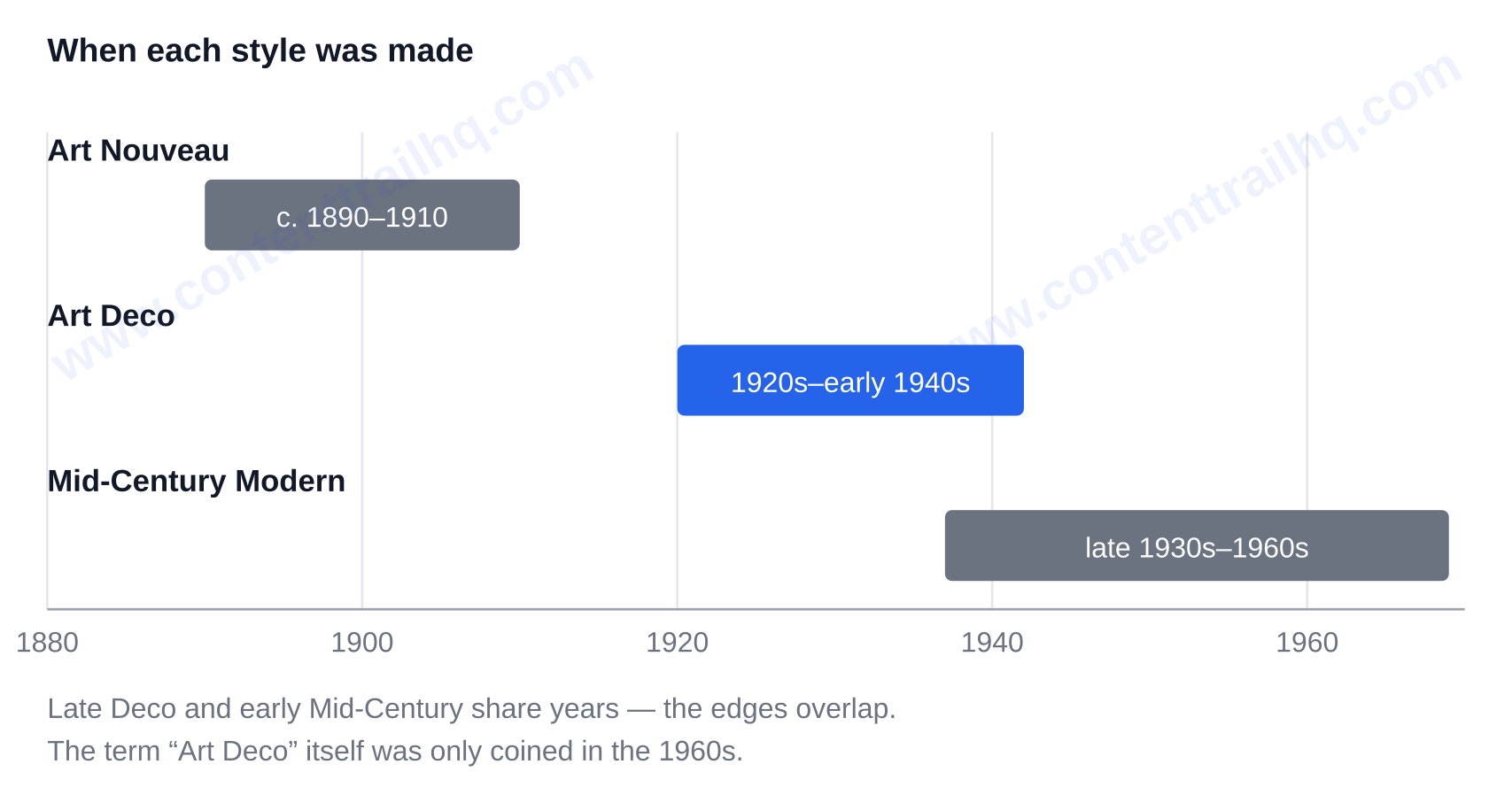
| Art Nouveau | c. 1890–1910 | Organic, asymmetric, nature-derived | Carved hardwood, stained glass, wrought iron | Flowing, often carved into stems | Plants, vines and whiplash curves |
| Art Deco | 1920s–early 1940s | Geometric, symmetrical, stepped, streamlined | Exotic veneer, chrome, lacquer, Bakelite, glass | Tapered, minimal, or a plinth base | Chevron veneer, sunbursts, waterfall fronts |
| Mid-Century Modern | Late 1930s–1960s | Pared back, function-first, light | Teak, walnut, plywood, plastic, plexiglass | Thin, splayed, visible | Almost no ornament at all |
The one-line field test: curves that imitate nature are Nouveau, curves that imitate a machine or a building are Deco, and almost no curve at all on visible tapered legs is Mid-Century. The edges can and do overlap. Late Deco and early Mid-Century share years, and Eileen Gray’s tubular steel belongs to both conversations.
What years was it made, and why wasn’t it called that at the time?
The Art Deco (or Deco, for short) style emerged in France in the early 1920s, reached the United States and the rest of Europe by the early 1930s, and ran to about the early 1940s. The naming event was the Exposition Internationale des Arts Décoratifs et Industriels Modernes, staged in Paris in 1925 by the Société des Artistes Décorateurs; Encyclopaedia Britannica puts the style’s high popularity at roughly the fifteen years that followed. Ruhlmann’s pavilion was the showcase everyone remembered, praised for the modernisation of traditional forms rather than abandoning them. In 1922, Tutankhamun’s tomb was excavated, bringing lotus flowers, scarabs, hieroglyphics, pylons and pyramids into the design lexicon at the same moment.
What the period actually called it — and how to search like it
In the 1920s and 1930s, no one used the word “Art Deco.” The V&A dates the term to the 1960s, noting that for the 1925 exhibition the style was known as Style Moderne. Trade publications used a variety of terms, including moderne, modernistic, jazz modern, and zig-zag. The phrase first appeared with the 1966 exhibition Les Années 25 at the Musée des Arts Décoratifs, and was popularized by Bevis Hillier’s 1968 book Art Deco of the 20s and 30s.
This is not an obscure fact, this is a search strategy. You will never find the words you are searching for in trade catalogues from the period, estate inventories, or old auction listings. Searching terms like “moderne”, “waterfall”, “zig-zag”, and the maker’s own product names will help you find pieces that other buyers never see. For context on how the canon is framed today, the Musée des Arts Décoratifs ran an exhibition titled 1925–2025. One Hundred Years of Art Deco from 22 October 2025 to 26 April 2026, which brought together nearly 1,000 works and centred on Ruhlmann, Eileen Gray and Jean-Michel Frank.
Materials, finishes and the makers worth knowing
There’s a juxtaposition of machine age materials and natural luxuries, with no sense that one is cheaper than the other. Available at the time, chrome, nickel, brass, and stainless were read as the pinnacle of manufactured luxury (so were tubular steel, plate glass, and Bakelite), so they sit beside ebony without apology. The woods to know are Macassar ebony, amboyna burl, zebrawood, rosewood, lemonwood, and bird’s-eye maple. Ivory, mother-of-pearl, and shagreen are inlays and trim.
Surfaces are polished, never matte: high-gloss Japanese lacquer, marquetry, engraving, and lacquer that can be black or colourful. Upholstery is velvet, fur, hide and leather club chairs. Colours go two ways, both are correct for the time — muted creams, taupe and blush with soft metallics, or black and gold with jewel tones and lacquer red. René Lalique’s glass is the representative of how the style treated light and transparency as materials in their own right.
Names you will actually meet on a label, a stamp or an auction listing:
- Émile-Jacques Ruhlmann (France) — the benchmark cabinetmaker; exotic veneers and ivory, the top of the market.
- Eileen Gray (Ireland/France) — lacquer screens and tubular steel; the bridge to modernism.
- Paul T. Frankl (Austria/USA) — Skyscraper furniture; the purest stepped American silhouette.
- Jean-Michel Frank (France) — Deco stripped down to quiet, expensive simplicity.
- Jules Leleu and Charles Dudouyt (France) — the middle market worth hunting.
- Jindřich Halabala (Czechoslovakia) — Central European bentwood and curves, still often underpriced.
- René Lalique (France) — glass, lighting and panels rather than case furniture.
Is it period, Deco-style, or a 1930s factory piece?
This is where the look stops helping and inspection takes over. Work through it in order, on the piece in front of you.
- Pull a drawer. Hand-cut dovetails are irregular and slightly uneven; machine-cut dovetails are identical to each other. Then check the carcase: a solid frame points to period cabinetwork, while veneer over particle board points to a modern reproduction.
- Read the veneer. Printed grains can not fool the figure and depth of real Macassar ebony, amboyna and zebrawood. Follow the chevron on the drawer fronts, was it matched by someone who cared?
- Check the hardware. Period chrome pulls and brass escutcheons? Wear that matches the metal’s age? Original screws? Bakelite? It can be tested with hot water — guides say 15 to 30 seconds, then smell immediately for a sharp formaldehyde odour — or it can be tested with Simichrome on cotton to look for a yellowish residue. Neither test settles it alone: refinished, sanded, lacquered and some black Bakelite fail while being perfectly genuine.
- Check the paperwork. Stencils? Labels? Stamps? They are often found hidden inside drawers, on drawer bottoms and on carcase backs. Anything claiming a signature name needs provenance behind it.
- Read the listing language as a confession. “Art Deco Style”, “Inspired by Art Deco” and “Modern Take” are the seller telling you it is not period.
The exception that trips up good buyers
Strictly applied, the dovetail-and-solid-wood rule will make you reject actual period furniture. The mass-market American waterfall bedroom pieces from the 1930s and early 1940s — from manufacturers including the United Furniture Corporation of Lexington, North Carolina — are genuinely of the period and genuinely Deco in form, but were made as affordable factory goods in walnut, mahogany and bird’s-eye maple veneer, and not as signed cabinetwork. For purposes of judgment, assess this category for form and veneer pattern, not for joinery, and expect a modest price.
So you are sorting into three verdicts, not two. Period signature work: buy for value and rarity. Period factory Deco: buy for the look at a real-world price. Deco-style reproduction: buy only for the look, if you so desire.

What is Art Deco furniture worth, and where should you buy it?
The ceiling is high and well documented. A Ruhlmann “Tardieu” desk in chromed metal and lacquer, for example, sold for $1,876,000 at Christie’s, reported by Antiques and The Arts Weekly as a world auction record both for Ruhlmann and for any piece of Deco furniture at auction. The spread is what is more interesting: auction-guide data for Ruhlmann furniture, tables and chests runs from approximately €100 to €2,500,000 depending on type and rarity. Name value is not a set value.
Most buyers shop on the other end of that curve, on 1930s waterfall dressers and vanities purchased for their form, not for their maker. As for where to look, it depends on what you want: 1stDibs and Chairish are good sources for vetted vintage with provenance and dealer pricing, regional auction houses for unlabelled period pieces at the best value, estate sales and local listings for the waterfall category, and mainstream retail for Deco-style only. On mid-market pieces, look for condition and originality of veneer, lacquer and hardware, as this moves the price more than any label.
How do you decorate with it without making a theme room?
Work with a proportion instead of vaguely mixing. As far as mixing goes, vintage-mixing guidance lands on roughly 20% vintage to 80% modern, and that is about the threshold where a room reads as collected rather than as a period set. Work from one statement piece — a lacquered sideboard, a club chair, a waterfall dresser, a bar cabinet, a sunburst mirror — instead of from accessories, or you risk creating a theme room.
Then quieten the neighbours deliberately. A patterned lacquered cabinet gets minimalist seating. A curved Deco sconce gets a flat neutral rug. Let the Deco piece be the only loud thing in its sightline. In addition, the strong lines and shapes of the Deco pieces complement Scandinavian and minimalist furniture because both are flat, quiet and geometric, and the contrast flatters veneer and lacquer. Nesting tables, demilune consoles, bar carts, sunburst mirrors and single club chairs slot into a non-Deco house most easily.
Placement impacts care, so decide it now: lacquer wants no direct sun and no wet cleaning, chrome wants a dry cloth and no abrasives, veneer wants stable humidity and coasters.
Rule of thumb: learn the silhouette to recognise it, then pull a drawer before you price it. There’s plenty more to dig into on Content Trail HQ.
Quick Answers
Is a waterfall dresser really Art Deco, or just old furniture?
It definitely is both period and genuinely Deco. Waterfall bedroom pieces from the 1930s and early 1940s carry the real design language — rounded cascading fronts, chevron veneer, geometric inlay — but were typically factory-built as affordable goods in walnut, mahogany and maple veneer. You want to judge these pieces with form and veneer pattern instead of joinery.
Can Art Deco furniture be refinished without destroying its value?
Original surface is a large part of what you are paying for, especially on lacquer and exotic veneer, so a full refinish usually costs more than it gains. Stabilizing lifted veneer, cleaning, and reviving existing finish are perfectly fine. Full refinishing makes sense mainly on factory waterfall pieces bought for the look.
Why do so many Art Deco pieces have no maker’s mark at all?
A lot of these pieces were workshop or factory production that was never marked. Because of that, a lot of these pieces also don’t have labels, and labels were paper, so a lot of them fall off, were painted over or disappeared in refinishing. Check drawer bottoms and carcase backs before concluding there is no mark. An unlabelled period piece is normal, not suspicious.
Is Style Moderne the same thing as Art Deco?
Yes — it is the name the period used for itself. The V&A notes that the style shown at the 1925 Paris exhibition was known then as Style Moderne, along with moderne, modernistic, jazz modern and zig-zag. The term Art Deco was only coined in the 1960s, decades after the furniture was made.
Does Art Deco furniture work in a small room or a low-ceilinged flat?
It can, if you pick low and curved rather than tall and stepped. Nesting tables, demilune consoles, bar carts and sunburst mirrors add the style without bulk, and a mirror buys backlight. Avoid tall stepped case pieces and heavy plinth bases, which eat visual floor space fast.
What is the cheapest genuinely period Art Deco piece a beginner can start with?
A 1930s American waterfall dresser, vanity, or nightstand. Shop estate sales or regional auctions rather than dealers. It is real period furniture with the correct silhouette, sold at factory-goods prices, and it teaches you to read veneer matching and hardware wear on something low risk.