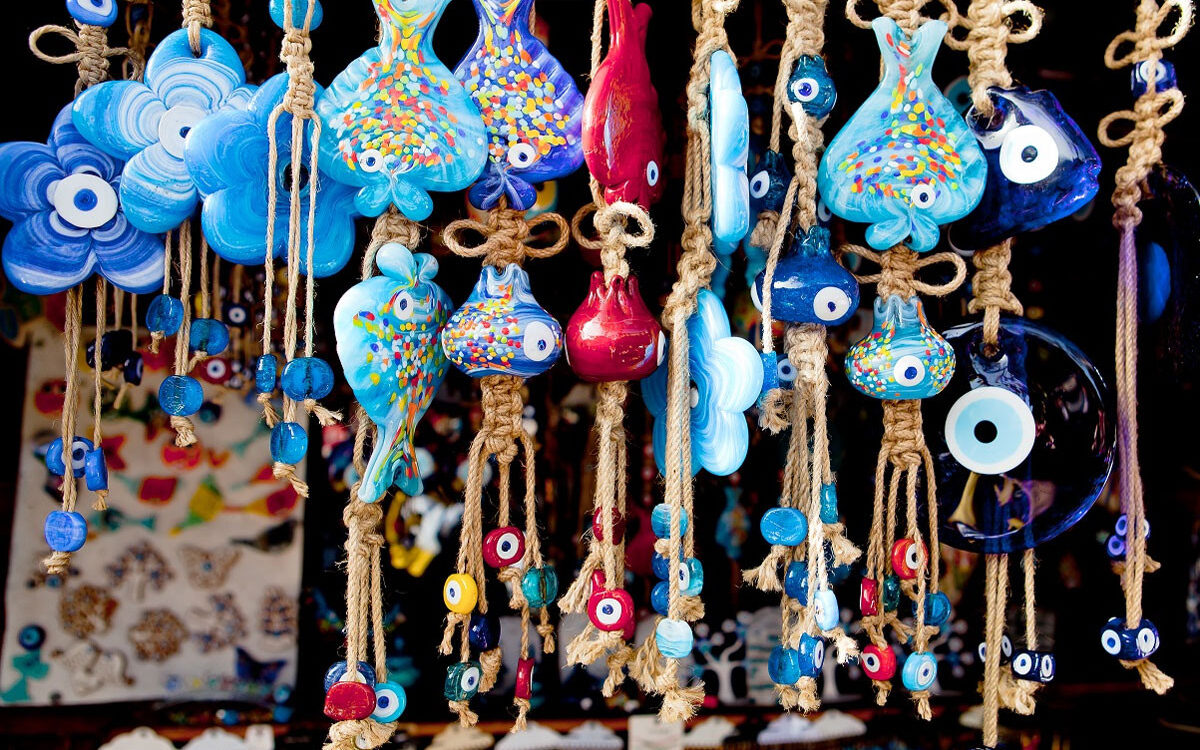
The confusion starts with interpretation. People read it as a protective charm or a curse, and both are valid interpretations. So, what is the evil eye? It is the belief that a malicious or envious look can inflict harm, illness or bad luck upon someone. It can also refer to the blue-eye shaped amulet used to counter the evil gaze. Giving someone the evil eye is the same as glaring at them.
This is one example. Your friend admires your new car, something bad happens to your car a week later, and your older relative says you should have had a blue bead on your mirror. The look is the curse. The bead is the defence.
What does the evil eye mean, exactly?
According to Dictionary.com, there are two definitions. The first states it is a look capable of inflicting bad luck or misfortune. The second states it is the power superstitiously attributed to certain people of inflicting misfortune by a look. Note that both definitions center around the gaze, not an object.
It is usually envy that drives the belief, but the traditional understanding states that excessive admiration or praise can also be damaging, and in turn, the malicious look can be given without any ill will.
The question embodies three answers and this article will cover them in order: the folk curse, the protective amulet, and the English phrase.
Is the evil eye the curse or the protection against it?
Most readers come with the assumption that the blue eye charm is protection, and that’s correct. It is an apotropaic object — one made to absorb or turn away the harmful gaze — and the symbol you see on a bracelet is good luck because the look it answers is bad.
Can someone give you the evil eye without meaning to?
Yes. In most traditions. A grandparent gushing over a healthy baby is the example, and it is the reason protective speech exists; you praise, then say the phrase to nullify the effect.
Where does the belief come from, and how old is it really?
Amulets made to protect from the gaze go back about 5,000 years in the ancient Near East and the Mediterranean, per Wikipedia’s survey of the subject. The Ugaritic texts (c. 1180 BC) are the earliest written references to the concept.
The oldest amulets vs. the oldest written mentions
These are two different things, and conflating this is how the dates are inflated. An amulet is a physical object found in an excavation, and a text describes an idea. The first can be several thousand years prior to the second without any conflict.
It was something Classical writers dealt with as well; they theorized on it, such as Hesiod, Plato, Plutarch, and Pliny the Elder. By their time it was something the Greek and Roman intellectuals debated.
Why you’ll see three different origin dates online
The Google search brings up three supposedly conflicting dates: 5000 BC Mesopotamia, 3300 BCE Tell Brak and 3000 BC Sumer and Babylon. These are not the same and they are not identical claims. Tell Brak is an archaeological site with excavated eye idols; Ugarit is a textual source; and Sumer and Babylon dates are more or less regional claims. If we line these up as one event, we are looking at a time drift of about two thousand years.
What is it called in different cultures, and how does each one ward it off?
The pattern is easier to identify when placed next to each other. Each of them have ways of naming it, blocking it, and a ritual to counter it. And more often than not, they do not correspond.
| Tradition | Name for the gaze | Protective object | Counter-ritual or phrase |
|---|---|---|---|
| Turkish | nazar | nazar boncuğu (blue glass bead) | Hang the bead where visitors look first |
| Greek | mati / kako mati | Blue eye charm | Olive oil dropped into holy water as a test; the xematiasma, a silently recited removal prayer, where yawning signals affliction |
| Arabic | al-ʿayn | Hamsa, though defence is mainly verbal | Say mashallah (“God has willed it”) or tabarakallah over whatever you admire |
| Hebrew / Yiddish | ayin hara | Red string | Say “b’li ayin hara”, or the Yiddish keyn eyn-hore (kinahora), when praising someone |
| Hindu (India) | nazar | Black thread or kajal mark | Red chillies circled around a child’s head |
| Italian | malocchio | Cornicello (horn charm) | Point the horn away to deflect the look |
| Spanish / Portuguese | mal de ojo / mau-olhado | Eye or hand charms | A limpia, a cleansing performed with an egg |
First, the belief cuts across multiple faiths, from the Islamic, Jewish, Christian, Hindu and Buddhist faiths, and more often than not, it exists as a folk belief parallel to the organized faiths. Second, the defenses in both Jewish and Arab traditions are more often than not, verbal, as opposed to the practice of purchasing an amulet.
How widely is the belief still held?
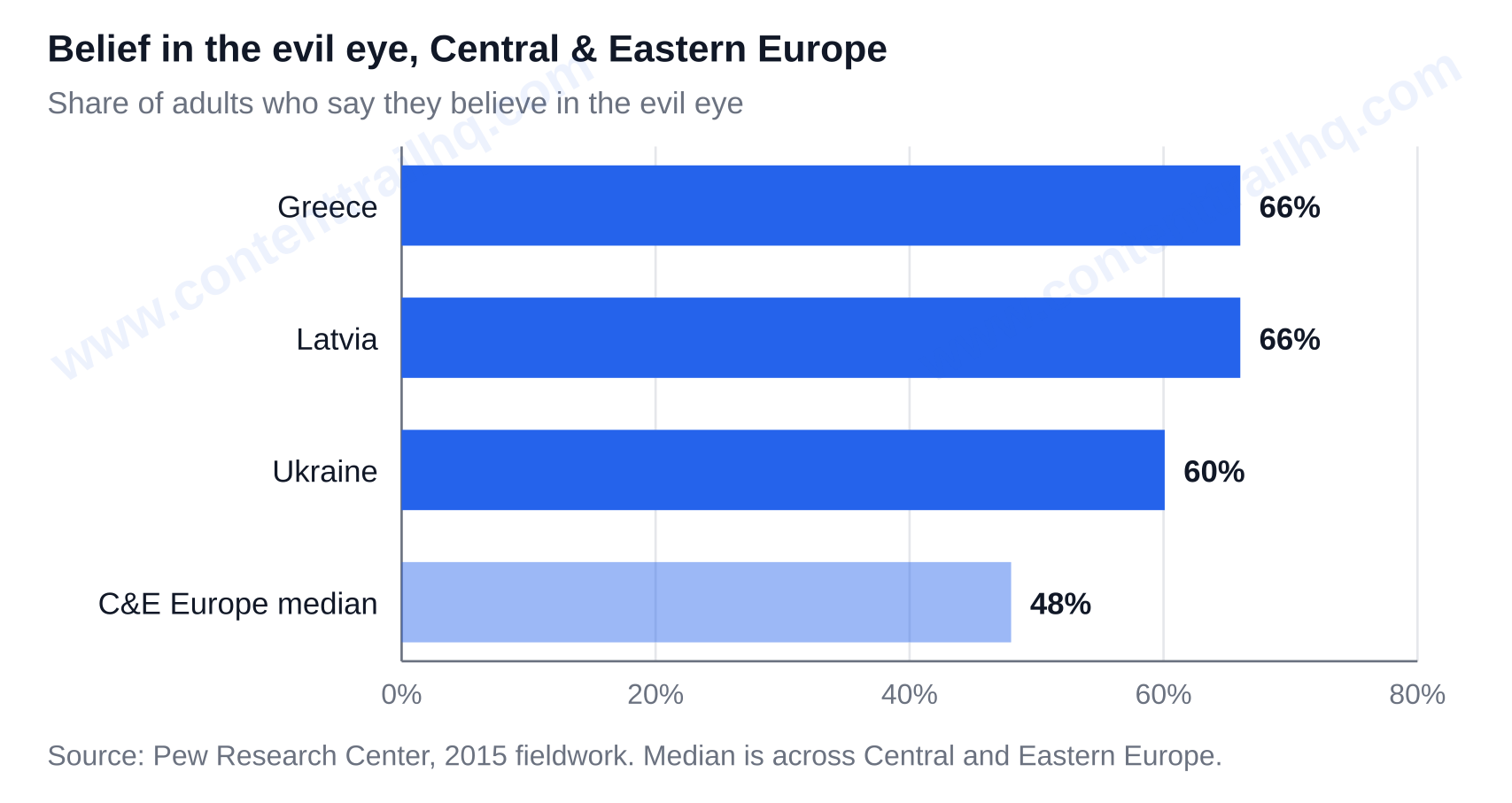
Most explainers say the belief is “still widespread today.” Pew Research Center’s 2015 fieldwork found a median of 48% of adults across Central and Eastern Europe believed in the evil eye, rising to 66% in Greece, 66% in Latvia, and 60% in Ukraine. A different Pew survey in 2012 found that in 20 of 39 Muslim-majority countries surveyed, majorities believed in the evil eye.
Why is the evil eye charm blue, and how is it different from the hamsa?
The Turkish nazar boncuğu is made in concentric rings of dark and light shades of blue, white, and black, and is shaped like a staring eye. The name nazar boncuğu means “evil eye bead”, with nazar coming from the Arabic for “look”, “sight” or “gaze” and boncuk meaning “bead”. The design answers the gaze by staring back at it.
Blue has a long history of protection in the ancient Mediterranean and Near East, and is tied to ancient faience amulets. In fact, blue was an uncommon eye colour in this region, and is another folk explanation tied straight to the gaze.
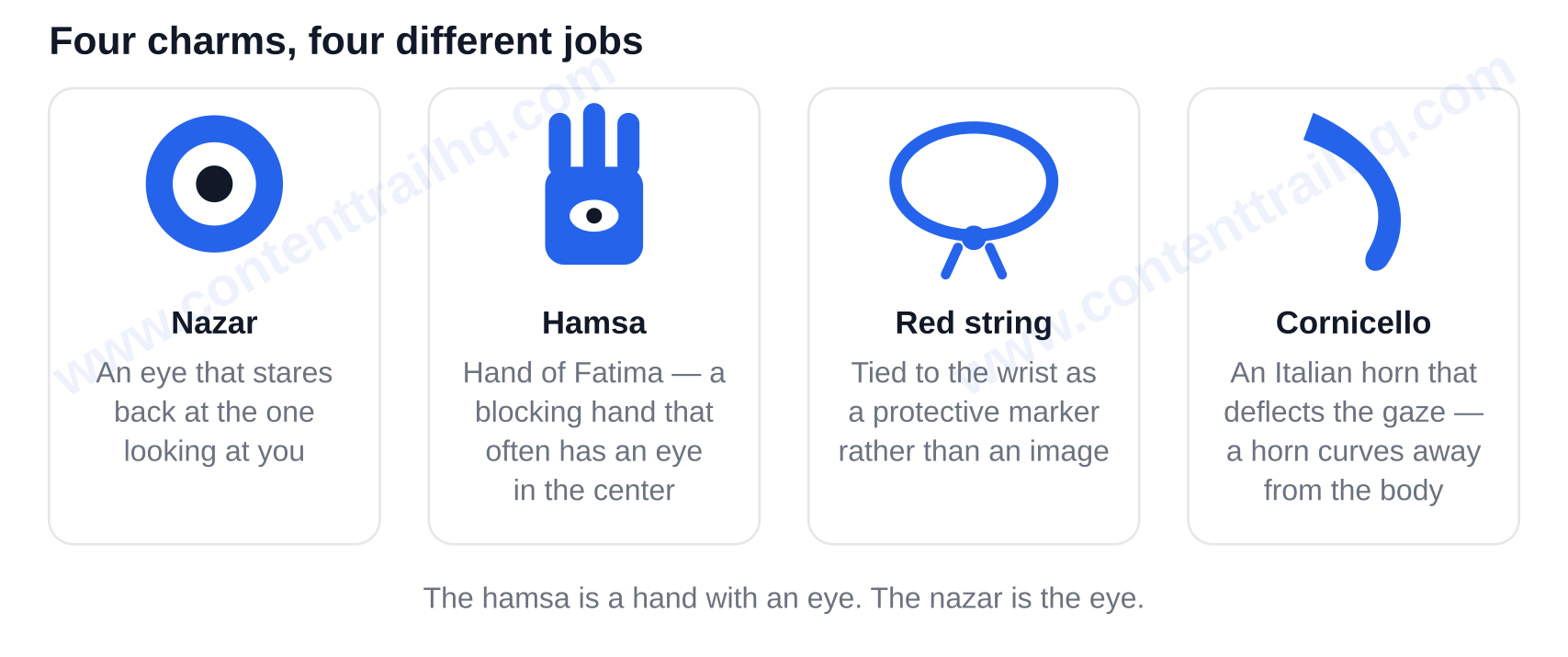
Nazar, hamsa, red string and cornicello: who does what
- Nazar — an evil eye that stares back at the one looking at you.
- Hamsa (Hand of Fatima) — a blocking hand that often has an eye in the center.
- Red string — tied to the wrist as a protective marker rather than an image.
- Cornicello — an Italian horn that deflects the gaze, as a horn curves away from the body.
They are not the same. The hamsa is a hand with an eye. The nazar is the eye. Modern jewelry combines the two and designs them how they like, which is a design choice, not a tradition.
What does it mean when someone gives you the evil eye in English?
This is what the cultural and jewelry pages do not answer. They quickly go from Mesopotamia to the nazar and never address the reader who doesn’t know what the term means.
The dates are there. Dictionary.com says the term “evil eye” first appeared in English before 1000 and is a combination of Middle and Old English. The idiom “give someone the evil eye” first appeared in English in the late 1300s and means to glare malevolently at someone.
From a feared curse to an ironic glare
The term first meant someone could literally cast a malevolent spell and curse someone with a look. Now a days, most people use the term to describe a look without any magical malice. The term can also be used with irony.
Three uses, one phrase. The term can be used with figurative idiom to describe glares, or literally as an amulet. Two common idiom uses include a parent giving a child a glare across the table to quiet them, or a stranger glaring at a patron in a café as they answer a phone call. The term can also describe the amulet, as seen in the 🧿 emoji posted to mean “protect me.”
The one-line test: curse, charm or glare?
In a sentence, what is doing the work? Is it a look someone casts? In that case, it’s a folk belief. Is it an object someone wears? In that case it’s a charm. Is it simply a facial expression across a room? In that case it’s the English idiom.
The commercial layer completed that drift. In 1999, designer Ileana Makri introduced her evil eye jewellery at Barneys New York, and it quickly gained celebrity and social media attention, pushing the motif to global fashion status through the 2010s.
How do people use the charm, and is it okay for anyone to wear one?
Traditionally, the design and placement of evil eye accessories follows one rule: place an eye where a visitor’s attention lands first. Therefore, the first thing people look at could be an evil eye necklace or bracelet. An evil eye bead could be placed over a doorway, inside a front hall, hung from a rear-view mirror, or pinned to a baby’s clothing.
Where to put one, and what a broken bead means
In Greek and Turkish practice, when a evil eye bead cracks or shatters, it is believed to have done its job and absorbed the gaze. In these cultures, people do not repair the bead, and replace it with a new one.
The signs people attribute to it
Traditional attributions include sudden fatigue, headaches, sleep disturbances, a feeling of heaviness, and an unexplained run of small misfortunes or breakages. Those are attributions, not diagnoses. If you feel constantly fatigued and/or suffer from unexplained breakages and unluckiness, it may be a good idea to see a doctor instead of to buy a bead.
The major religious traditions have no core texts that sell the charm, and attitudes split. In both Judaism and Islam, the gaze is recognized, but some authorities within both frown upon the use of amulets and encourage people to rely on prayer and protective words instead.
Is wearing an evil eye cultural appropriation?
This is a contested question, not a settled one. Some people believe the evil eye is a shared human folk symbol rather than a closed practice. Turkish and Greek commentators and student-press writers argue that using evil eye charms as a fashion motif hollows out its protective meaning.
Rather than a ruling, here is the decision rule that falls out of both arguments. Be aware of the tradition behind the evil eye charm. Don’t treat it as a neutral graphic. Understand the verbal component of the practice. In both Judaism and Islam, the first line of defense is saying mashallah, tabarakallah or b’li ayin hara at the moment of praise, not owning an object.
The one thing to remember
Three answers, one phrase. The belief that an envious look is a cause of harm is about 5,000 years old, the blue nazar deflects it, and the English idiom means a dirty look. Before you wear or hang one, find out which tradition your charm belongs to — Turkish nazar, Greek mati, Italian cornicello, Levantine hamsa — and learn the phrase that goes with it. The difference between wearing a symbol and wearing a graphic is context. Browse more explainers on Content Trail HQ for related reads.