You’re at your desk and your overhead light just went sharp. The ache behind one eye is starting to flare. Here are 5 tips for instant migraine relief, in the order that actually matters: take your acute medication while the pain is still mild, lie down in a dark and quiet room, apply an ice or cool compress to the front of your neck, rehydrate, and practice paced breathing and acupressure. Don’t expect full relief — expect roughly a 30% reduction.
This guide differs from the usual list in several ways. Each point offers a time window, a realistic expectation of what it can do and who it doesn’t work for. It also corrects the single most repeated tip on the internet — medication at the first sign of a migraine attack — which the February 2026 International Headache Society acute treatment recommendations contradict.
What are the 5 tips for instant migraine relief?
There are two key points. The first is nothing can truly abort a migraine in 5 minutes. Untreated migraine can last from 4–72 hours. So the goal should be to reduce the severity and shorten the duration of the attack — which is why when you act matters more than what you do. The faster you act the more time you can gain. The fastest single lever is correctly timed acute medication. Everything else you do to help with the pain is adjunctive comfort that measurably lowers the pain load while the medication works.
The five tips at a glance
| Tip | When in the attack to use it | How long to do it | Relief to realistically expect |
|---|---|---|---|
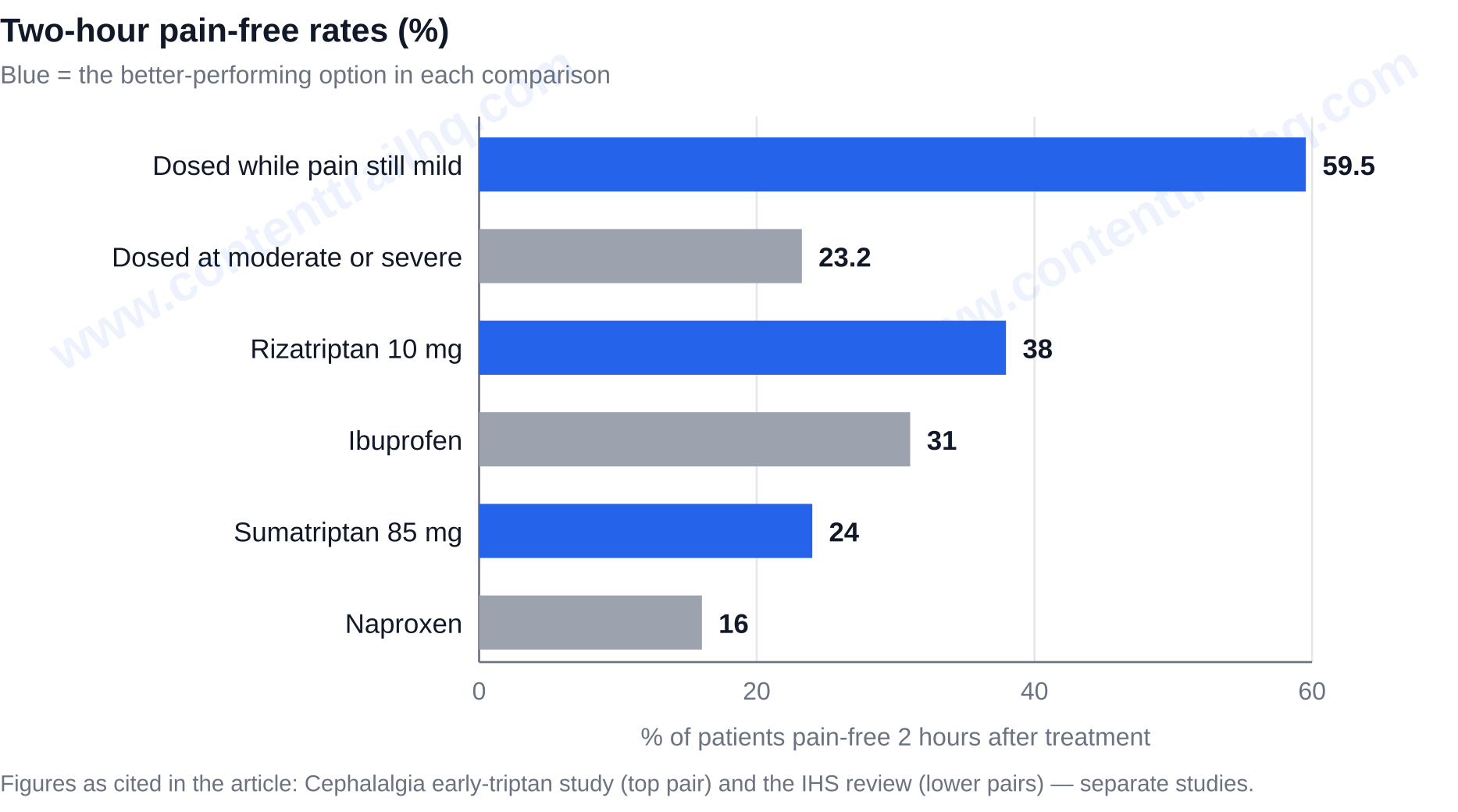
| Acute medication (triptan, NSAID, gepant) | At headache onset, while pain is still mild | One correct dose | 59.5% pain-free at 2 hours vs 23.2% if you wait for moderate or severe pain |
| Dark, quiet, low-stimulus rest | Any point; earliest is best | 20–30 minutes, eyes closed | Removes the light and sound input that amplifies pain |
| Targeted neck cooling | At onset | 15 minutes on, 15 off; judge at 30 minutes | About a 32% pain decrease, against a 32% increase untreated |
| Water, two to four cups | At onset if dehydration is the suspected trigger | Relief over 1–2 hours | Only helps the dehydration-driven share of attacks |
| Paced breathing plus acupressure | During the pain phase | 3–5 minutes breathing; 30–60 seconds per point | Lowers the muscle guarding and stress stacked on top of the attack |
Why ‘instant’ is the wrong expectation
Of the 5 tips for instant migraine relief, one does the heavy lifting and the other four are support tips. Spending your mild-pain window reaching for a compress instead of your prescription means you’ve traded the most effective minutes of the whole attack for a method worth about a third of the pain.
Why ‘take it at the first sign’ is the wrong moment to take your migraine medication
The general consensus is to dose at the first sign and some even interpret it to mean during prodrome or aura — the yawning, the mood shift, the visual zigzag. A summary of the International Headache Society guidance, published in American Family Physician, notes that most acute medications are ineffective during prodrome and aura.
Prodrome and aura are a warning, not the dosing window
The revised rule is to treat as soon as pain begins and is still mild. Use prodrome and/or migraine with aura to signal to you to clear your schedule, stay hydrated and get someplace dark to relax. Don’t use that signal as your cue to take a pill.
The one drug that is the exception
Ubrogepant is also named in that guidance to be effective when taken before the headache phase. If you have ubrogepant, you can take it before pain sets in. If not, you can’t.
What the mild-pain window is worth in numbers
Approximately 2 hours after treatment for mild pain, 59.5% of patients in the Cephalalgia study on early triptan therapy were pain-free. This was in comparison to 23.2% of patients who treated for moderate or severe pain. The sumatriptan research also found the two-hour pain-free rate to be 52%, and 0% for the placebo. Additionally, the IHS review found that in comparison to NSAIDs and acetaminophen, triptans were more effective for two-hour resolution of a migraine attack (rizatriptan 10 mg 38% vs ibuprofen 31%; sumatriptan 85 mg 24% vs naproxen 16%), and dose escalation added 11% or less. The review also stated a fast-release NSAID coupled with a triptan (i.e. sumatriptan with naproxen) was a recommended combination.
How long should you lie down in a dark, quiet room?
You should lie down for 20 to 30 minutes, eyes closed, in the lowest stimulus room you have. That’s the minimum that gives sensory relief time to register.
Why light and sound make the pain worse, not just less pleasant
During an attack, photophobia and phonophobia mean pain signalling in the nervous system is actively amplified by the presence of sound and light. This means that in order to reduce the overall pain signaling in the body, the first step should be to remove sound and light, not just make the sound and light less annoying. Screens are the stimulus most people fail to remove while believing they’re resting: brightness, flicker and scroll all count. The best thing to do is to put your phone face-down and silenced, something over your eyes, and your neck supported rather than craned.
When distraction helps and when it backfires
You can use low-demand audio or a familiar podcast at a low volume early and late in the attack, while pain is still mild. At peak pain and if there’s phonophobia, it will only make it worse. Determine this based on whether sound feels sharp to you. Ultimately, lying down is what you do while waiting for the medication to work, not an alternative to taking it.
Should you use cold or heat for a migraine?
Cold for the migraine. Heat for neck and shoulder tension. If you can’t tell, start with cold and switch if the neck feels tight rather than throbbing.
Where to put the cold pack (the tested placement is not your forehead)
A randomized controlled crossover trial published in Neurology used an adjustable frozen neck wrap with two cold packs targeting the carotid arteries, which are located at the front of the neck, applied at migraine onset. It was not a flannel that you can place on your forehead.
How much relief to expect, and when to judge it
Maximum benefit landed at 30 minutes: a 31.8% ± 15.2% pain decrease in the treatment arm against a 31.5% ± 20.0% pain increase in the control arm. A 2023 meta-analysis of four randomized and two non-randomized studies also put cold therapy’s strongest pain reduction at the 30-minute mark, and found it works for short-term relief only — it did not reduce attack frequency as a preventive. Practically: 15 minutes on, 15 off, cloth barrier against the skin, and re-assess at 30 minutes instead of giving up at five.
When heat is the better call
Heat should be used when the attack is mainly neck and shoulder tension. A warm compress across the neck and shoulders or a warm shower helps when posture, clenching or a tension-type build-up kicked things off. Heat loosens the muscle contribution and does nothing for the vascular and sensory core of the attack.
Does drinking water, caffeine or magnesium actually help during an attack?
Yes to water if the attack was caused by dehydration. Yes to caffeine, occasionally. No to magnesium — not mid-attack.
How much water, and how long it takes to work
Take 2–4 cups at onset, and expect to wait 1–2 hours for relief rather than just a few minutes. That timeline is exactly why water belongs alongside medication, not instead of it. If you were already well hydrated, water is housekeeping, not treatment.
Caffeine: dose, benefit and the withdrawal trap
Adding 100 mg or more of caffeine to a standard dose of a common analgesic helps roughly 5-10% more people get good pain relief, according to Drugs.com’s pharmacist guidance. Excedrin Migraine supplies 65 mg of caffeine per tablet alongside 250 mg acetaminophen and 250 mg aspirin, so the usual two-tablet dose delivers about 130 mg — comparable to an 8–12 oz coffee. The cost side: regular intake of 100–200 mg daily is enough to produce withdrawal headache within 12–24 hours of stopping. Caffeine is a booster for occasional use, not a daily tool. If you already drink coffee every morning, extra caffeine mid-attack adds little, and skipping your usual cup can start one.
Why magnesium is prevention, not rescue
Taking a dose of around 300-400 mg of magnesium daily can reduce attack frequency over weeks, but it will not stop a migraine in progress. Essential oils sit in a similar place: for some, diluted peppermint on the temples or lavender inhalation may provide some relief, but osmophobia is real and any strong scent could escalate an attack. Test it on a mild day, not a severe one.
Which hands-on techniques give relief in the next five minutes?
Breathing and pressure. Neither aborts an attack; both of these help lower the layer of tension brought on by the attack, and help make the wait for medication more tolerable.
The breathing pattern and how long to hold it
For 3–5 minutes, try to inhale for a 4 count, then hold for 2, then exhale for 6. The long exhale is what helps to pull down the sympathetic arousal and helps to relax the jaw and neck.
Pressure points worth trying — and how long to press
The general rule of thumb is 30–60 seconds of constant, firm pressure per point, and repeat as necessary. Some of the more common acupressure points are LI-4, which is located on the web between your thumb and index finger, the temples, and the occipital hollows at the base of your skull. Add one to two minutes of small-circle massage along the occipital ridge and the band above the ears. Stop if the pressure makes the throbbing feel more sharp and intense rather than duller.
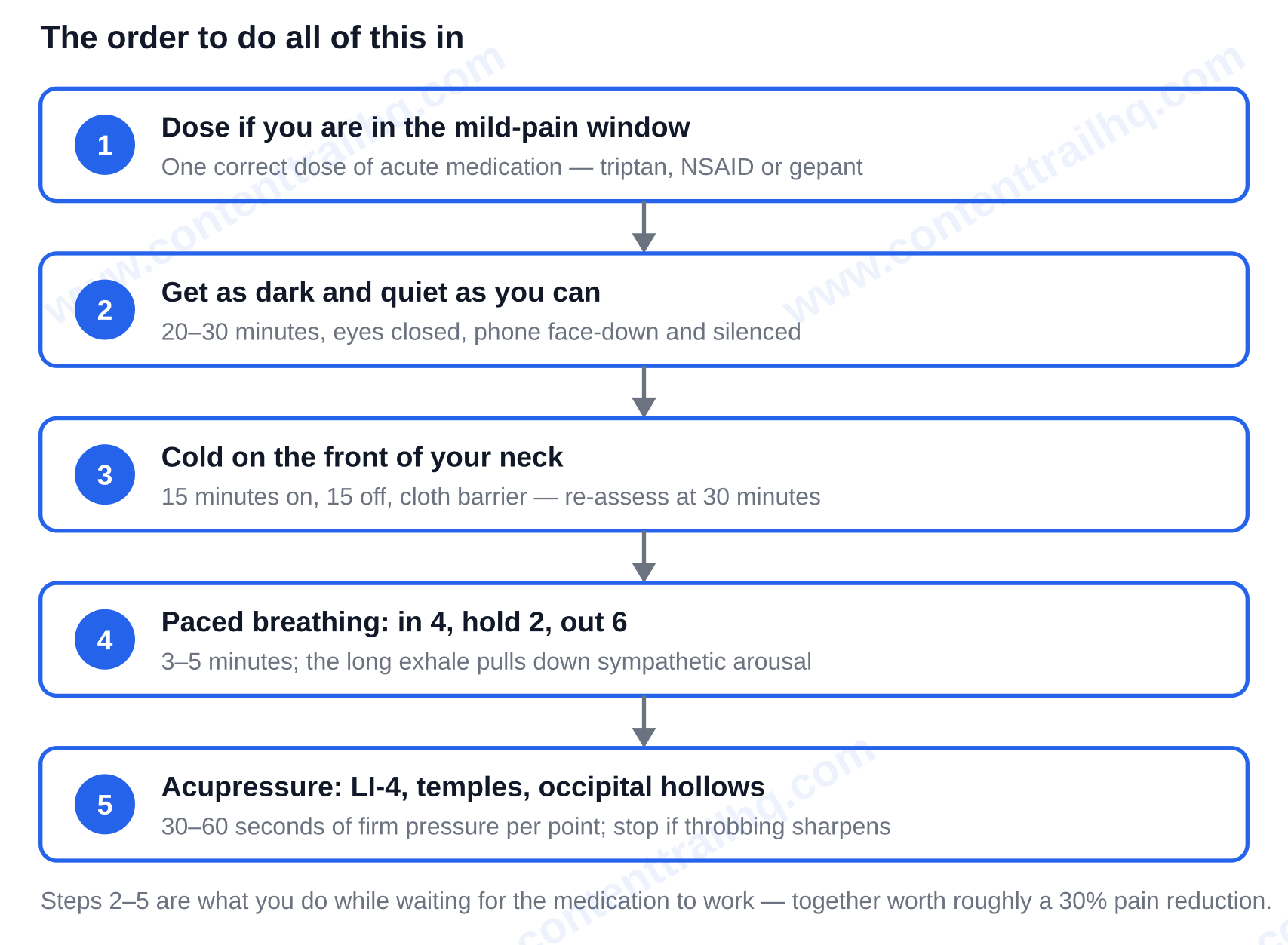
The order to do all of this in
Dose if you are in the mild pain window. Then get as dark and quiet as you can, cold on the front of your neck. Then, try breathing and acupressure to help manage pain while you wait for medication. One sequence, not five competing options. If you need a non-drug option that does more, external trigeminal nerve stimulation (Cefaly) and non-invasive vagus nerve stimulation (gammaCore) are acute-use neuromodulation devices to raise with a clinician — not things to buy mid-attack.
Who should not take a triptan — and what to use instead?
“Just take a triptan early” is the mantra of nearly every migraine resource, but almost no page mentions the exceptions. According to the American Migraine Foundation, triptans are contraindicated for patients who have a history of hemiplegic migraine or migraine with brainstem aura. They are also typically avoided for patients with heart disease, prior stroke or TIA, uncontrolled high blood pressure, peripheral vascular disease or significant liver disease. The concern is vasoconstriction.
Why gepants are the workaround
According to Expert Opinion on Pharmacotherapy, rimegepant will not cause vasoconstriction, and, unlike triptans, is not contraindicated in patients with comorbid cardiovascular disease. For patients who are not candidates for triptans, the gepant class, along with an NSAID strategy or a neuromodulation device, is the practical route.
The exception that is being reconsidered
The hemiplegic and brainstem-aura prohibition rests on an older hypothesis and is being reconsidered: there has not been evidence to suggest that patients in those groups are at increased risk. A patient who has hemiplegic migraine can still use triptans for their typical attacks. This is a conversation to be had with a neurologist, not a decision to make alone.
How often is too often? Rebound thresholds by drug class
Take a close look at the frequency of your rescue medication if you find it has stopped working. Repeated rescue dosing can transform episodic migraine into medication-overuse headache, where the treatment becomes the cause.
The day-count thresholds for each drug class
Most advice about headache drugs is vague, but the National Headache Foundation’s thresholds are specific, and here they are:
- Triptans, narcotics and combination analgesics: overuse above 10 days per month.
- Simple analgesics (acetaminophen, ibuprofen): overuse above 15 days per month.
“More than twice a week” and “don’t overuse it” don’t provide a clear standard. A day count does.
The one class that appears not to carry the risk
In a 52-week study, rimegepant showed sustained efficacy with minimal adverse events, with no evidence of medication-overuse headache and no hepatotoxicity. Frequent use of gepants has been associated with decreased headache frequency rather than transformation to chronic migraine.
What to do if you are already over the line
Track the days you take headache drugs for one month in a calendar or notes app. If you are near or at the threshold for your drug class, the problem to solve is prevention, not a better rescue — and that’s the clearest indication to ask about preventive treatment.
When should you go to the ER for a migraine?
Untreated attacks typically last 4 to 72 hours. Anything outside that pattern deserves assessment rather than another dose.
Red-flag symptoms that need urgent care
- Thunderclap headaches: the worst pain of your life, peaking in seconds
- Sudden numbness or weakness (even if it’s on one side of the body), difficulty speaking, vision loss
- Fever with a stiff neck, or a headache after head injury
- An attack that is completely atypical — unlike any you have had before
Status migrainosus — when an attack passes 72 hours
When a migraine attack continues for longer than 72 hours, it is classified as status migrainosus, and it is a common reason for emergency department treatment. An IV “migraine cocktail” of medications and fluids is typically administered there. Knowing the term makes it much easier to explain to the triage nurse. Prepare to describe four facts: the duration of the attack, medications you’ve taken and when, how many dosing days you’ve had this month, and anything on the triptan contraindications list.
What to do in the hours after the pain fades
Eating and rehydrating are recommended. Sleeping normally rather than oversleeping is better, and ease back to screens and bright light instead of jumping straight in. Skipped meals, sleep debt, alcohol and a missed usual caffeine dose are the common repeat offenders in the 24 hours after an attack.
The one correction that reorders the whole list
For most readers, the best of these 5 tips for instant migraine relief isn’t a technique at all — it’s timing. Medicate during the early, mild phase of the headache, not during prodrome or aura. Stack dark and quiet, front-of-neck cooling, fluids, breathing and acupressure on top to bring the pain down roughly a third while the medication works. Keep in mind that nothing is truly instant and a page that promises instant relief is most likely selling something.
The next step is to log every attack and every rescue dose for a month (date, drug, and time relative to when pain started). If you are close to 10 dosing days on triptans or combination analgesics, or 15 days on acetaminophen or ibuprofen, book a clinician appointment, bring your log, and ask two questions: whether a preventive is appropriate, and whether a gepant or neuromodulation device fits your history.
Rule of thumb: mild pain is the window — if it is still mild, that is the time to act. For other pieces in this vein, see Content Trail HQ.