The question behind sand fleas bites is really two questions: what are these itchy bumps, and what made them? The bumps are small, raised, red, or pink, clustered on the feet, ankles and lower legs, and they start within minutes to hours of exposure. In the US the usual culprit is a biting midge, not a flea.
This guide covers the whole picture — how the bites look and spread, which of the four completely different creatures called “sand fleas” actually bit you, how to calm the itch tonight, how long it should take to clear, the one case where standard anti-itch care does nothing at all, and the two prevention tactics that have real numbers behind them.
What do sand fleas bites look like, and where do they show up?
They look like a loose cluster of small raised bumps, not one isolated spot. That clustering is the first clue, and the location is the second.
How the bites typically appear and spread across the skin
Expect bumps a few millimetres across, red to pink, often slightly puffy. More reactive skin produces welts, and sometimes small fluid-filled blisters. Some people get a flat halo of redness around each bump, which can make a tight cluster look like one spreading patch. The Cleveland Clinic’s account of sand flea bites describes the same picture: small, raised, itchy bumps in groups, sometimes with welts or blisters, starting within minutes to hours of exposure.
The timeline matters as much as the look. Itching usually starts while you are still on the sand or shortly after, which is why so many people first notice the bumps in the car on the way home. Nothing appears days later out of nowhere. If new bites keep arriving after you get home, something indoors is biting you and this is the wrong page for it.
Why the bites cluster on your feet, ankles and lower legs
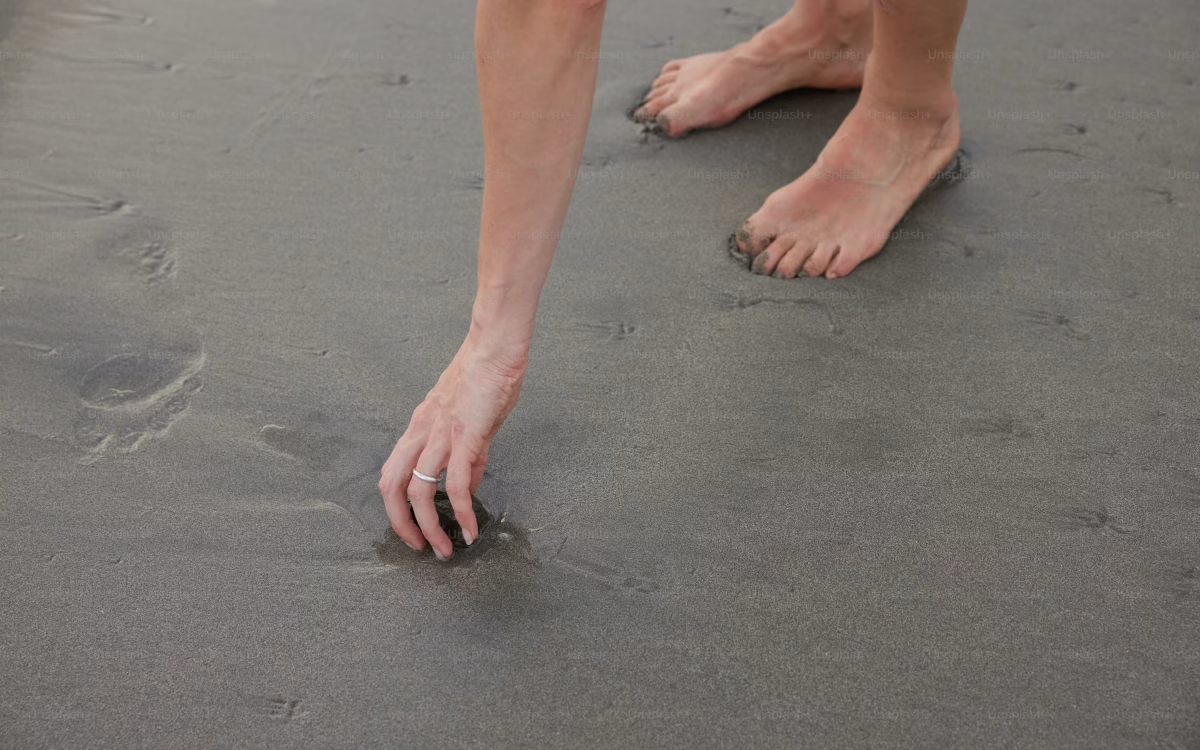
Because that is the skin you left available. Flip-flops expose toes and insteps, shorts expose shins, and socks create a tidy biting line at the ankle. Damp sand, dune grass and marshy edges are where the insects doing the biting breed and shelter, so proximity does the rest.
One caveat on the usual “they stay low to the ground” explanation. A 2025 study of Culicoides insignis and Culicoides stellifer in Florida found these biting midges were actually more active at canopy height than at ground level throughout the night. So bites along your neck, scalp line and arms are not evidence of a different insect — some midges, different altitude.
One picture that does not belong here: a single painful lesion on a toe or sole, a white bump with a black dot in the centre. That is a different organism entirely, and it gets its own section below.
Which of the four things called “sand fleas” actually bit you?
Four unrelated organisms share the nickname, and only three of them bite. The treatment that matters differs between them, so identification is not trivia.
Sand fleas vs. sand flies vs. no-see-ums vs. cat and dog fleas: a side-by-side comparison
| Called “sand flea” | What it actually is | Does it bite you? | What it leaves behind | Where and when |
|---|---|---|---|---|
| True sand fleas (sand hoppers, beach fleas, mole crabs) | Crustaceans — same family as crabs and lobsters | No. Not at all. | Nothing | Wet sand and the surf zone; the thing you dug up with your heel |
| Biting midges (no-see-ums, Culicoides) | Tiny flies, 1–3 mm as adults; only females take blood | Yes — the usual answer in the United States | Clusters of itchy welts and bumps on exposed skin | Dusk and dawn, humid and low-wind conditions, after rain, near marsh and dune grass |
| Sand flies | Small silent biting flies, similar size | Yes | Itchy raised papules, much like midge bites | Dusk biters; warmer, drier inland and tropical settings |
| Chigoe flea (Tunga penetrans) | The smallest known flea; it burrows and stays | It embeds rather than bites and leaves | One painful lesion — a white bump with a black central dot | Tropics only; toes, soles, and nail folds after barefoot exposure |
| Cat and dog fleas | Ordinary household fleas | Yes | Itchy bumps, often around the ankles | Indoors, year-round; a scratching pet is the giveaway. |
How to self-triage in four questions: count, pain, place, and travel history
- How many? Many bumps in loose clusters points to biting midges or sand flies. A single lesion does not.
- Itchy or painful? Pure maddening itch is a bite reaction. Tenderness that sharpens into a foreign-body pain in one spot is an embedded flea.
- Where, and when were you exposed? A still, humid evening near damp sand or marsh, at dusk or dawn, especially after rain, is the classic midge window.
- Any barefoot tropical travel in the last six weeks? That single answer moves tungiasis onto the table and changes what you should do next.
A fifth check settles the rest: if fresh bites keep appearing once you are home and away from the sand, suspect household fleas or bed bugs instead.
How do you stop the itch tonight?
Clean it, cool it, then calm it. Most bites from sand fleas and midges need nothing more than that, and the order genuinely helps.
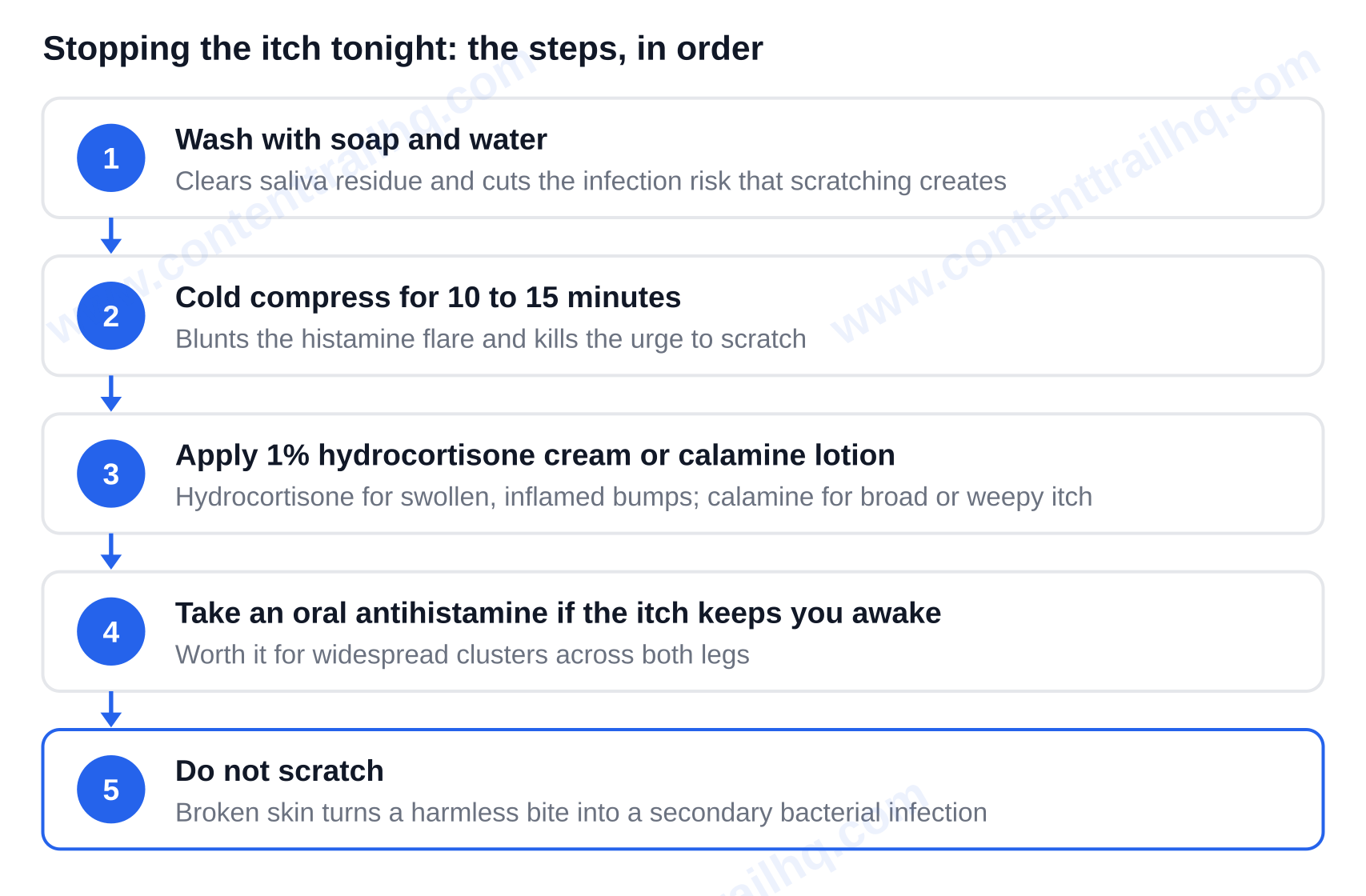
The home treatment steps, in order
- Wash with soap and water. This clears saliva residue off the skin and cuts the infection risk that scratching creates.
- Cold compress for 10 to 15 minutes. Cold blunts the histamine flare and, just as usefully, kills the urge to scratch.
- Apply 1% hydrocortisone cream or calamine lotion. Hydrocortisone is the better pick for bumps that are swollen and inflamed, because it damps the reaction itself. Calamine is the better pick for broad surface itch and weepy, blistered spots, because it soothes and dries.
- Take an oral antihistamine if the itch is keeping you awake. Worth it for widespread clusters across both legs, where topical treatment alone is a losing battle.
- Do not scratch. Broken skin is how a harmless bite becomes a secondary bacterial infection, and scratched bites itch for longer.
What not to do, and what does not help
No bite need to be “drawn out.” Biting midges and sand flies do not leave a stinger, a mouthpart, or a body behind, so there is nothing in there to extract, suck out or neutralise with a paste. Skip the home remedies that promise it.
One explicit caveat: this protocol does nothing for an embedded chigoe flea. That is the single case where ordinary itch care fails completely, no matter how carefully you follow the steps.
How long do sand flea bites last?
Most bites start improving in two to three days and clear in about a week. Itching can run one to two weeks in sensitive people, and in anyone who scratched the bumps open.
The normal arc goes flare and swelling, then flattening, then a fading pink or brown mark where each bump was. On darker skin that mark can take weeks to even out, which is normal pigment change rather than a sign anything went wrong. Some bumps also stay raised and firm longer than the rest — a papular reaction to midge saliva, not an infection.
What separates slow healing from a problem is direction. Lesions should be shrinking. Anything growing, weeping pus, warm to the touch or spreading redness outward has stopped being a simple bite.
When should you see a doctor about bites like these?
Three situations: infection, no improvement, or a reaction that is not local.
Signs the bites have become infected
Pus or drainage from a bump, redness spreading beyond the original cluster, skin that feels warm, red streaks tracking up the leg, or chills and fever. Red streaking plus fever is a same-day issue, not a wait-and-see one.
Reasons to be seen sooner rather than later
- Symptoms past two weeks, or lesions getting worse instead of better.
- Facial or lip swelling, trouble breathing, or widespread hives — that is emergency care, not a clinic appointment.
- Recent travel to tropical regions where burrowing fleas occur, which changes both the diagnosis and the treatment.
- Children who have scratched bites raw, and anyone with diabetes, poor circulation or a compromised immune system who has bites on their feet.
A clinician can add what you cannot buy: prescription-strength topical steroid, oral antibiotics for an infected bite, extraction or dimeticone for an embedded flea, and tetanus prophylaxis if the lesion is open and was contaminated.
Back from the tropics? Why your “bite” may be a burrowing chigoe flea
This is the exception most pages bury at the bottom of a severity list. If you have come back from the Caribbean, Central or South America, India or sub-Saharan Africa, and you walked barefoot or wore open-toed shoes, your painful toe lesion may not be a bite at all. Hydrocortisone, antihistamines and cold compresses will not resolve it.
What tungiasis looks like and how fast it develops
The CDC Yellow Book’s guidance on post-travel skin conditions describes tender papules on the toes or feet within about 24 hours of exposure, turning severely itchy and irritated within two to three days. Then the tell appears: a white bump with a black central dot, which is the back end of the embedded female as she feeds.
She does not leave. According to the Cleveland Clinic, an unfertilised female Tunga penetrans penetrates the skin and stays embedded until she dies in situ after four to six weeks, with severe cases progressing from white bumps with black spots to dark crusty lesions or open wounds. That timeline is the practical dividing line: a cluster of itchy bumps from the beach is settling by day seven, while a lesion still actively painful past two weeks is a different question entirely.
The scale is easy to underestimate from a beach-holiday perspective. The Cleveland Clinic reports tungiasis affecting up to 60% of the general population and up to 80% of children in affected poor rural regions, with the fleas thriving in dry seasons such as August and September.
Why dimeticone has replaced digging the flea out
Consumer pages still frame this as surgical removal by a provider. The treatment evidence has moved. Two-component dimeticone (NYDA) is the option recommended by the World Health Organization, and it is self-applicable. It works by suffocation: two oils of differing viscosity creep into the lesion and clog the flea’s respiratory, intestinal and reproductive systems.
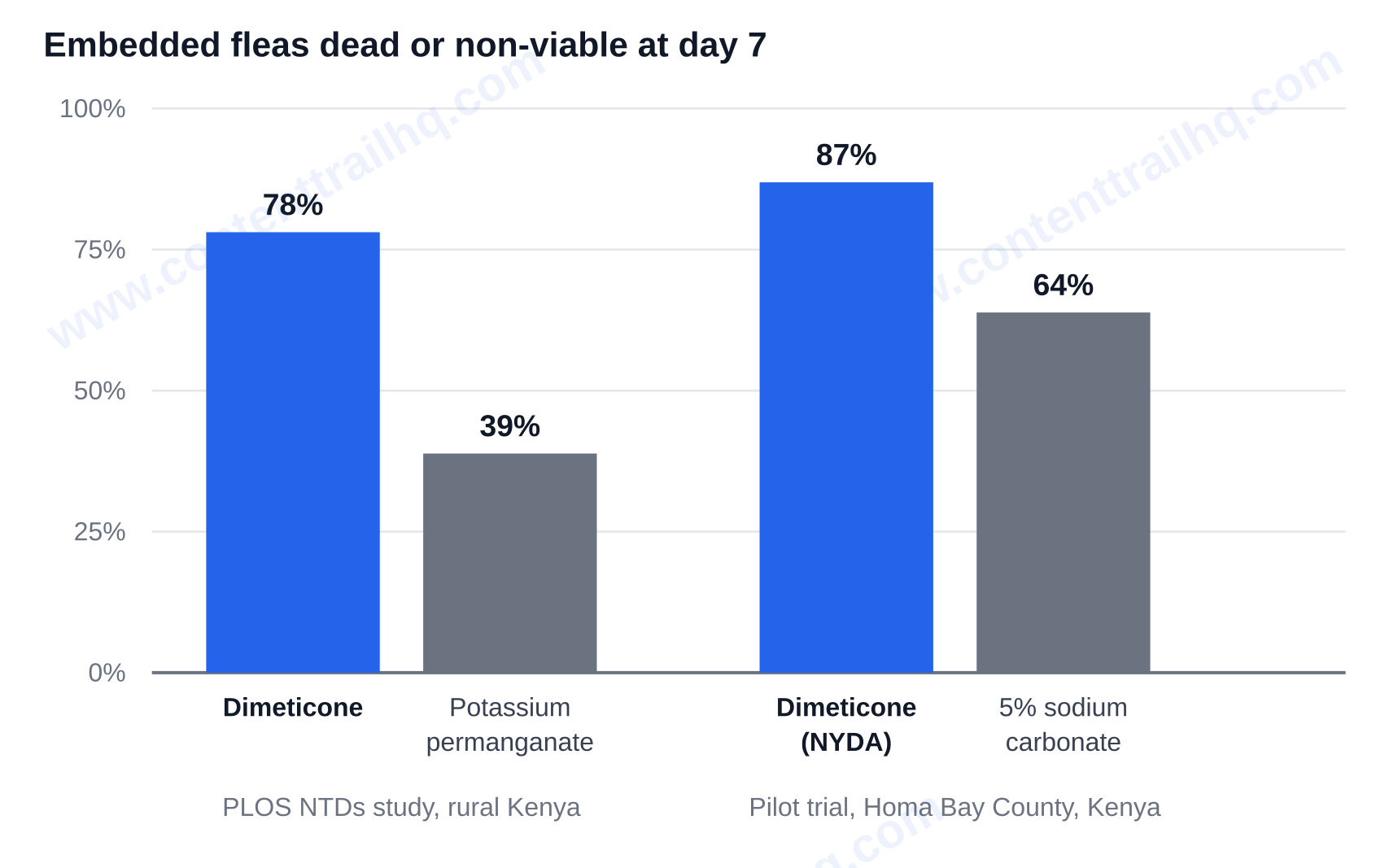
The numbers behind that shift are specific. In a proof-of-principle randomised study in rural Kenya published in PLOS Neglected Tropical Diseases, 78% of embedded fleas showed no signs of viability seven days after dimeticone treatment, against 39% after potassium permanganate. A later randomised cohort pilot trial in Homa Bay County, Kenya found 87% of embedded fleas dead at day 7 with NYDA versus 64% with 5% sodium carbonate, and a non-inferiority trial comparing dimeticone oils against sodium carbonate solution was published in Tropical Medicine and Health in 2026, so the evidence base is still being built out.
What has not changed is the warning against the needle. Digging the flea out at home risks incomplete removal, contamination of an open wound and tetanus. CDC management is extraction by a clinician, antibiotics if there is secondary bacterial infection, and tetanus prophylaxis where required. The escalation triggers are the same ones as for any bite: symptoms past two weeks, spreading redness, pus, warmth, red streaks or fever.
How do you avoid being bitten again for the rest of the trip?
Cover the skin, treat the sock line, and pick your spot by the breeze. The third one is the tactic most people skip.
Repellent, footwear, and timing
Closed-toe shoes and socks whenever you are off the hard-packed wet sand, and always in marshes, mangroves, damp leaf litter and campsite grass. Use an EPA-registered repellent with DEET or picaridin, and put it on feet, ankles, and the sock line rather than just arms and neck — the University of Maine Cooperative Extension reports DEET holding a slight edge over picaridin specifically against biting midges and black flies. Wash feet and lower legs thoroughly after going barefoot, change out of sandy clothes, and choose lightweight long sleeves and pants over bare skin at dusk and dawn. The worst single window is the first calm, humid evening after rain. Children playing low in damp sand get bitten most, which is exactly who most needs shoes on.
Wind speed and mesh size: the two barriers that physically work
Everyone says midges bite in “calm conditions” and then gives no number, which makes the advice unusable. Here is the number: biting midges are weak fliers, and the reported flight threshold for the Highland midge is roughly 8.8 km/h (5.47 mph mph), above which the midges cannot fly, with other sources putting the limit for biting midges somewhere around 3 to 7 mph. In practice that turns an oscillating fan into a mechanical barrier rather than a comfort measure, and it tells you where to sit — the open, breezy stretch of beach, not the sheltered still corner tucked behind the dune grass.
The same gap exists in screen advice. “Repair your window and door screens” is close to useless against an insect that fits through intact ones. Standard insect screening is about 16 mesh, with openings in the region of 1.1 to 1.5 mm — and a no-see-um is a 1 to 3 mm adult, so it walks straight through. Excluding them takes no-see-um mesh of about 20×20, roughly 400 openings per square inch and openings around 0.6 to 0.9 mm. The honest trade-off is airflow: the finer weave noticeably cuts the breeze through a porch on a hot evening, which is why people take it out again.
Can sand fleas follow you home and infest your house or your dog?
No. Biting midges, sand flies and true sand fleas do not establish indoor infestations. They do not live in mattresses, and they do not breed in carpet, so a day at the shore cannot give your house an infestation.
Which makes bites that keep appearing three days later a useful signal rather than a mystery. Something else is biting you: cat or dog fleas, bed bugs, or simply another round of outdoor exposure. An insect can certainly hitch a ride home in a beach bag or a car and bite you once, but without damp outdoor breeding habitat it dies off rather than multiplying.
Pets follow the same logic. A dog that licks its paws and belly raw after the beach is usually dealing with sand, salt and irritated skin, not an infestation — but a dog scratching persistently for a week, with flea dirt in the coat, has ordinary fleas and needs a vet-recommended product. A sensible reset after any beach trip: rinse your pet’s paws and undercarriage, wash the towels and clothing, vacuum the car, and run a flea comb through the coat to check for the real thing.
The short version
A cluster of small itchy bumps on your feet and ankles after a day at the shore is almost always a biting midge or sand fly reaction — not a burrowing flea, and not the harmless crustacean you dug out of the wet sand. Wash it, cool it, treat it with 1% hydrocortisone or calamine, and expect it to settle within a week. Before you go back out, put on closed-toe shoes, hit your ankles with DEET, and choose the breezy open stretch over the still corner by the dune grass. If you have just come back from the tropics with a single painful lesion and a black dot on a toe or sole, skip the anti-itch routine and see a clinician.
Rule of thumb: many itchy bumps mean treat it at home, one painful bump means get it looked at. You’ll find more guides like this across Content Trail HQ.
People Also Ask
Can sand fleas burrow into your skin or lay eggs in you?
The insects behind ordinary beach bites in the US — biting midges and sand flies — do not burrow and do not lay eggs in your skin. They bite, feed and leave. The one exception is the chigoe flea, Tunga penetrans, found in tropical regions: the unfertilised female penetrates the skin and stays embedded until she dies in situ after four to six weeks, according to the Cleveland Clinic. That produces a single painful lesion with a white bump and a black central dot, not a cluster of itchy bumps, and it needs a clinician rather than hydrocortisone.
What time of day do sand fleas bite, and which season is worst?
Biting midges bite mainly at dusk and dawn, in humid, low-wind conditions, and they pick up after rain. The worst single combination is the first still, muggy evening following a rainy day. Sand flies are also dusk biters, more typical of warmer, drier inland and tropical settings. Season tracks warmth and moisture, so the active window is long in subtropical areas like Florida. For tungiasis in endemic regions, the pattern is different: the Cleveland Clinic notes the fleas thrive during dry seasons such as August and September.
Do sand flea bites spread from person to person?
No. The bumps are your immune system reacting to insect saliva, so they are not contagious and cannot be passed on by touch, sharing a towel or sleeping beside someone. If several people in a group come back from the same beach covered in bites, they were all bitten by the same swarm — not by each other. What can spread is a secondary bacterial infection in skin you have scratched open, which is a different problem and a reason to keep your nails off the bumps.
Can you get sand flea bites through a towel, blanket or thin clothing?
Biting midges need to reach skin, so a towel or blanket is a genuine barrier while it stays in place. Thin, loose fabric is less reliable, because these insects are 1 to 3 mm and will find a gap at the ankle, waistband, or sleeve rather than bite through a weave. The practical failure point is usually the edges: bare feet sticking out, a rucked-up hem, or the sock line. Lightweight long sleeves and pants plus repellent on the sock line cover the gaps that fabric alone leaves open.
Why are my bites itchier on the second day than the day I got them?
Because the reaction builds. The immediate flare is a histamine response, but the delayed phase of the skin’s reaction to insect saliva peaks over the following day or two, which is why bites often feel worse the morning after than they did on the sand. Scratching makes it last longer, since irritated skin stays itchy and inflamed. This is normal and not a sign of infection. Infection looks different: pus, warmth, redness spreading outward, red streaks, or fever.
Is it safe to pop the blisters that form on sand flea bites?
Leave them alone. Intact blister skin is a sterile cover, and opening it hands bacteria a direct route into the wound — which is how a harmless bite turns into a secondary bacterial infection needing antibiotics. Wash the area with soap and water, use a cold compress, apply calamine or 1% hydrocortisone around the area, and cover a large blister with a clean dressing if it is rubbing inside a shoe. If a blister bursts on its own, clean it, keep it covered, and see a clinician if pus, warmth, or spreading redness follows.