This guide covers the symptoms of a heart attack, what happens during an attack, the length of an attack, why someone may feel no pain, what happens when the pain stops, how long it takes to recover, and numerous other questions. The answer: a heart attack lasts longer than 15 to 20 minutes, though episodes range from a few minutes to several hours. The pain doesn’t happen constantly; symptoms often come in waves rather than one steady pain, and the heart muscle starts to die within 20 to 30 minutes of a fully blocked artery, so pain stopping does not mean the attack has.
That last sentence is what most pages leave out. Each source gives a range and stops there; the real answer describes what goes on in those minutes to give people a frame of reference to describe what is happening to them.
How long does a heart attack last, in plain numbers?
The short answer and the ranges behind it
Start with the figures, then we will take them apart.
- Typical duration: beyond 15 to 20 minutes. Mercy Health describes 15 to 20 minutes as the commonly cited typical length, with episodes involving a total blockage persisting past 20 minutes.
- Short end: low, mild cases may last only two to five minutes and ease with rest, according to Mercy Health.
- Long end: several hours when the blockage is not treated.
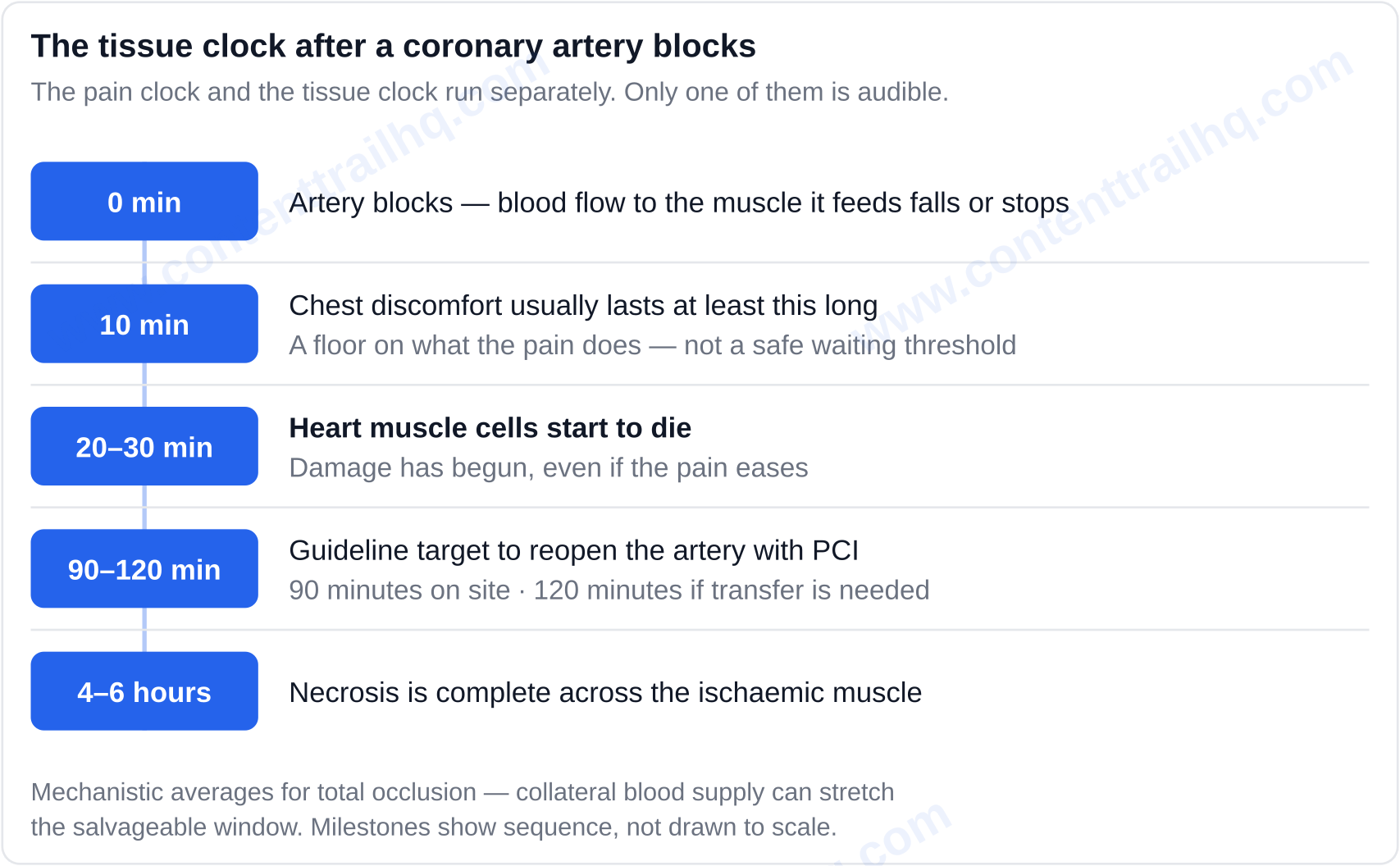
- Lower bound worth knowing: Cleveland Clinic says the duration of chest discomfort from a heart attack is usually at least 10 minutes. Don’t rely on that as a safety threshold to wait out — treat it as a floor on what the pain typically does.
There is no single answer because duration doesn’t always correlate to severity. It’s more accurate to say the duration is how long an artery stayed blocked. Two minutes of total occlusion and two hours of partial occlusion are different events, and a stopwatch can’t tell the difference.
Why two people can both be having a heart attack and report wildly different durations
Symptoms don’t always come on continuously. More often it is in a stop and start pattern. Pressure that builds, eases off, then returns twenty minutes later is still one ongoing heart attack — not two separate scares. This is the single most misread signal in this topic and will be discussed in a separate section.
It’s also important to be specific about what it is that “lasts”. The correct answer: the time period between the closure of the artery and the restoration of blood flow. That window can be cut short by treatment, so the length of a heart attack is determined by the health care system, and how quickly they intervene, more than it is about the condition of the body.
What is actually happening inside your heart during those minutes?
From plaque to blockage
A coronary artery is narrowed over a period of years due to atherosclerotic plaque, a blood clot forms across the narrowed area, and blood flow to the slice of heart muscle fed by that artery falls or stops. This is a myocardial infarction.
The starved muscle is ischaemic and this is what produces the pain. This is why the pain of a heart attack is a symptom of the blockage, and not a timer on the damage. The two run on separate clocks, and only one of them is audible.
Why you can be fully conscious the whole time
The heart keeps beating during a heart attack. The American Heart Association defines a heart attack as a blood-flow issue and cardiac arrest as an electrical issue in which the heart stops. That is why people walk around, finish a shift, or drive themselves to hospital mid-infarction. Because staying upright and talking does not indicate the event is minor, we can see the need for a differentiating factor between a heart attack and angina.
Angina is related, but different. Demand-driven chest pain that arrives with exertion and eases with rest is angina. However, unlike angina, a heart attack will not stop when a patient is not exerting himself. It does not resolve because you sat down, and the cells will continue to die unless the blockage is cleared.
Like the blockage, the location of the issue can also alter the stakes. A blockage high in a major artery will starve a large area of muscle, and a blockage in a small downstream branch will starve a smaller area. The same diagnosis can occur with very different amounts of heart at risk.
Why does the 20-minute mark matter more than the total length?
What “minutes count” means in tissue, not slogans
The important number in this case is the 20 to 30-minute timeframe after total occlusion of the vessel, where heart muscle cells start to die. The necrosis travels through the ischaemic muscle, and is complete within 4 to 6 hours of occlusion, according to the ischaemic heart disease pathology literature.
If we bring together these figures, the search term rearranges itself. The length of time blood flow was cut off is the most important figure in assessing the consequences of the condition, not how long the pain lasted.
This is the kind of reassurance “it only lasted 25 minutes” is not. Total occlusion for 25 minutes is not a near miss — it is a description of damage that has already started. The relief you feel when the occlusion is released is real, but it is not a report on the status of your heart muscle, which is exactly why hospitals don’t diagnose a heart attack based on how long the patient reports the pain lasted. They perform an ECG and test the levels of a protein in the blood (called troponin) that’s released when the muscle of the heart is damaged and the cells break down. These tests report on the tissue clock. The patient’s report on how long the pain lasted reports on the pain clock.
Collateral blood supply: the reason some people get a longer grace period
The honest caveat. Those timings are mechanistic averages drawn from pathology work on total occlusion. Real arteries are messier. Some people have collaterals — small connections built up over years of gradual narrowing that help carry a trickle of blood to the threatened muscle and reduce damage. Partial flow stretches the salvageable window. Without the presence of collaterals, a blockage sets the time to the fast end of the range.
One cannot know if he or she is in the fast end of the range from the outside, and certainly not during an episode. Hence, it is better to act as quickly as possible, rather than assuming you have been granted extra time.
My chest pain stopped — is the heart attack over?
Why come-and-go symptoms are a warning, not a reprieve
This is the real question behind most Internet searches on how long a heart attack can last, and here is the answer.
Calling 911 is triggered by pattern, not by time. The American Heart Association’s warning signs provide two separate examples of when to be alert and seek help. The first states chest discomfort lasting more than a few minutes. The second states, “or if discomfort goes away and comes back.” These are two separate, and equally important warnings.
The second example shows us the mechanism behind this. Repeated and intermittent symptoms of pain before a heart attack are called “prodromal” symptoms, and research on prodromal symptoms in myocardial infarction patients describes them as caused by spontaneous episodes of reopening of the blocked artery, called reperfusion, and subsequent reblocking, or reocclusion — over hours, days, weeks or even months before the acute event. It’s been noted that more than four in ten patients report prodromal symptoms.
So when the pain eases, the most likely explanation is that the artery reopened by itself, and spontaneous reopening is usually temporary. The clot that formed once can form again across the same narrowed section, and the muscle is still salvageable in the meantime. Because symptoms often ease, many patients are falsely reassured. Baptist Health makes the same point from the symptom side: even when the pain subsides, damage to the heart muscle can still be occurring.
Which produces an uncomfortable conclusion. The next time you think pain has eased, remember that pain stopping is the worst possible reassuring sign in this entire topic. Relief is information about blood flow at this moment. It is not an all-clear.
What to do about an episode that has already ended
If you’re reading this after the fact…the pressure came, lasted a few minutes, went and now you’re searching to see if it counted. Same-day emergency assessment is required. An ECG and a blood test to measure the troponin can show damage your symptoms have stopped announcing. Waiting to see whether it comes back is a way of letting the artery decide.
What makes one heart attack last minutes and another last hours?
STEMI vs NSTEMI: total versus partial blockage
The duration of symptoms better indicates the type of blockage versus the severity, and this is an explanation that almost no ranking page addresses.
Cleveland Clinic clearly states that a STEMI (ST-elevation myocardial infarction) describes a completely blocked coronary artery, while an NSTEMI (non-ST-elevation myocardial infarction) is a partial blockage that significantly reduces blood flow without stopping it.
Map that onto what people actually experience:
- Total occlusion (STEMI) — think of it as a long, unrelenting and crushing episode that does not let up, where nothing is reaching the muscle, and there is nothing that will relieve it except for reopening the artery.
- Partial blockage (NSTEMI) — some flow persists and the balance between supply and demand keeps shifting. Think of it as the shorter, recurring pattern.
Also, consider other factors that contribute to a blockage, like where it sits along the artery and how much muscle that particular branch supplies, plus any collateral supply that has developed, and you can better explain the completely different durations two different people describe during a heart attack.
How fast treatment arrives decides when the clock stops
The other half of the answer is not biological at all. An untreated heart attack runs until the artery reopens. A treated heart attack ends when the cardiology team ends it.
Current guideline targets for stopping a STEMI are primary percutaneous coronary intervention — PCI, the catheter procedure that opens the artery, usually with a stent — within about 90 minutes of first medical contact where PCI is available on site. The time window extends to roughly 120 minutes when transfer to a PCI-capable centre is needed. That is the door-to-balloon time. If PCI cannot be reached within these windows, clot-busting thrombolytic drugs serve the same purpose.
Those two numbers are the honest answer to the question: how long does a heart attack last once someone has called for help? As long as it takes to get the artery open, and the system is designed to make that well under two hours.
How do heart attack, panic attack and cardiac arrest differ by duration?
Duration comparison at a glance
These four timeframes span four different types of pages and no one puts them side by side, even though “how long” is literally the axis that separates them.
| Event | How long it lasts | How it behaves | What it needs |
|---|---|---|---|
| Panic attack | Peaks within about 10 minutes; typically 5 to 20 minutes, rarely beyond 30 | Eases on its own as the episode passes | Assessment if recurrent; not an emergency in itself |
| Heart attack | Persists beyond 20 to 30 minutes, or recurs in waves over hours | Holds steady or worsens; does not resolve by itself | Call 911; ECG, troponin, then PCI or thrombolytics |
| Cardiac arrest | No duration to speak of — unresponsive within seconds | Electrical failure; no pulse, no normal breathing or only gasping | CPR now and an AED; fatal within minutes without both |
| Prodromal warning symptoms | Intermittent episodes over hours, days, weeks or months beforehand | Come and go as the artery reopens and recloses | Same-day assessment; they precede the full event |
Cleveland Clinic gives the time frames for panic attacks: symptoms reach peak intensity within about 10 minutes, typically last 5 to 20 minutes and rarely more than 30, and ease as the episode ends. Symptoms of heart attacks do not subside, rather worsen, and persist beyond 20 to 30 minutes.
Trajectory is the tiebreaker. Panic fades. A heart attack holds or escalates.
When it is cardiac arrest, not a heart attack
The American Heart Association’s cardiac arrest versus heart attack resource is blunt about the difference: in cardiac arrest the heart suddenly stops, the person is unresponsive within seconds, not breathing or only gasping, and death follows within minutes without CPR and an AED.
When a collapse leads to a loss of normal breathing, how long becomes irrelevant. CPR needs to be performed while someone else locates a defibrillator.
What if there is no duration to measure at all?
Silent and unrecognised heart attacks
Here is the group that a page framed entirely around how long fails completely: people having a silent heart attack. These are episodes with minimal, atypical or no recognised symptoms, and the most common way to identify one is to look for it after the fact on an ECG or cardiac imaging. Time plays no role in this. There is nothing to time.
According to the CDC’s page on heart attack symptoms, risk and recovery, the average annual number of heart attacks in the United States is about 805,000. Roughly one in five of these are silent — undiagnosed at the time, meaning the person has a heart attack and is completely unaware that it has happened. Cleveland Clinic cites a broader researcher estimate that 22% to 60% of heart attacks are undiagnosed. Thus, the “one in five” figure is best treated as the conservative end of a broader range rather than a settled number. People with diabetes and older adults are over-represented among these unrecognised events.
When symptoms don’t look like the movie version
Women’s symptoms skew away from the crushing central chest pain of the stereotype and toward unusual fatigue, nausea, shortness of breath, and discomfort in the jaw, back, neck or shoulder. The American Heart Association’s full list of signs worth recognising includes:
- Chest discomfort — uncomfortable pressure, squeezing, fullness or pain in the centre of the chest
- Pain or discomfort spreading to one or both arms, the jaw, neck, back or stomach
- Shortness of breath, with or without chest discomfort
- Cold sweat, nausea or lightheadedness
In this section, duration, or how long something lasts, plays absolutely no role. The presence of unexplained symptoms plays the primary role. “Wait and see how long it lasts” is absolutely no help and utterly useless in this case, because the event never announces itself long enough to time.
What should you do in the first few minutes?
Calling 911 versus going in yourself
Call 911. Do not drive yourself and do not have someone drive you. Having paramedics begin treatment and perform an ECG en route means the clock starts before you reach the building, not after. The American Heart Association says to call 911 immediately for anyone displaying the symptoms listed above.
Take the AHA’s recommended action: call if the symptoms persist for more than a few minutes, or if it stops and comes back. While you wait —
- Unlock the front door so responders can get in without you having to move.
- Sit or lie down, stay still, and stop any exertion.
- Give the person chewable aspirin only if instructed by emergency services or a clinician who knows your history.
- If the person is unresponsive and not breathing normally, you should begin CPR and have someone get an AED. That means the person is experiencing a cardiac arrest, not a heart attack, and it needs different hands-on action.
What happens on arrival at the hospital
An ECG within minutes of arrival. Serial troponin blood tests to measure whether heart muscle cells have died and how many. Then, for a STEMI, PCI with a stent to reopen the artery, or thrombolytic drugs where a catheter lab is not reachable inside the guideline window. That sequence is what stops the clock this article has been describing.
How long does recovery take after the heart attack itself ends?
In hospital and the first weeks home
The event is minutes to hours. This article describes a recovery that can take weeks to months, and it helps to know the average recovery time to manage expectations appropriately.
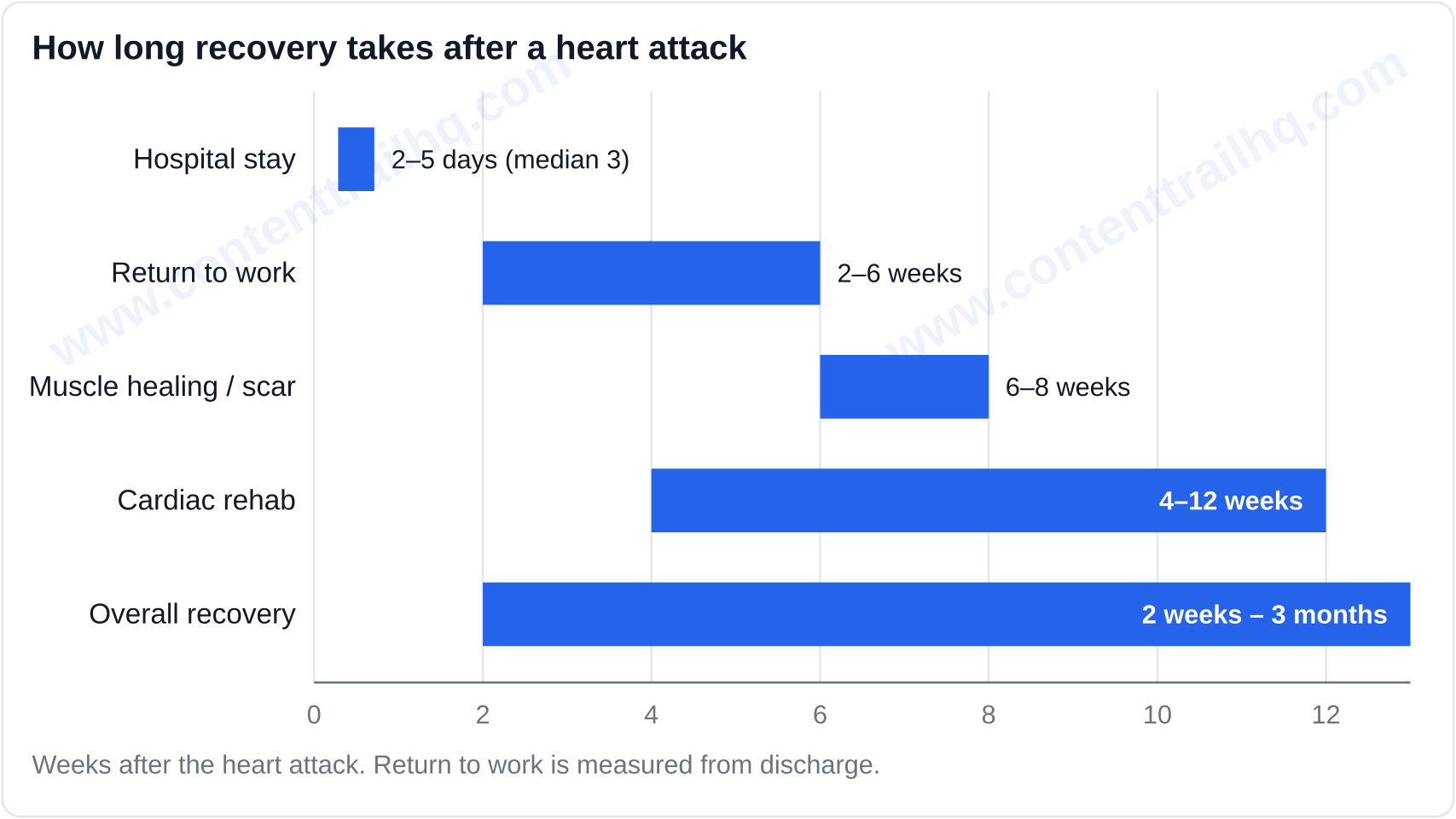
A typical length of stay after a heart attack is two to five days, with a median stay of three days, according to an HSE-cited US analysis of more than 11.6 million admissions. It takes roughly six to eight weeks for healing of the cardiac muscle and scar formation. Return to work commonly falls between two and six weeks after discharge, depending on what muscle was affected and the demands of the job. The Cleveland Clinic states that, after a heart attack, recovery takes anywhere from two weeks to three months.
Cardiac rehab and the longer timeline
Cardiac rehabilitation is an outpatient program that generally lasts four to 12 weeks. If you only take one thing from this section, take that one — the supervised exercise and risk-factor work that is an integral part of the program shapes the long recovery more than anything else that is done after discharge.
It is at this point that the length of time the event occupied loops back into the rest of your life. Less time with the artery blocked means less dead muscle, less scar, better pump function, and a quicker road back. The minutes really do matter when talking about a heart attack.
What changes next in how this clock gets measured
The direction of travel in this space is away from duration as the thing anyone relies on. We want to know the answer to “How long does a heart attack last?” because for a long time the only instrument a person at home had been a Stopwatch. That is changing. Pre-hospital ECGs in ambulances move the diagnosis to the kerbside. Newer, high-sensitivity troponin assays allow us to detect muscle damage at lower levels and earlier than older tests. Door-to-balloon targets keep tightening around the 90 and 120-minute marks. All of these do the same thing. They replace your estimate of how long it hurt with a measurement of what actually happened to the muscle.
Of course, until the symptoms themselves can be read — and consumer wearables picking up arrhythmias can be considered an early and imperfect step toward this end — this is where the American Heart Association keeps the line. More than a few minutes, or gone and come back, means call. Let the ECG and the troponin answer the question. That is how we find out what those minutes actually cost. There’s plenty more to dig into on Content Trail HQ.
Common Questions
Can a heart attack last for days?
The acute event itself does not run for days, but the symptoms around it can. Research on prodromal symptoms in myocardial infarction patients describes intermittent, “stuttering” episodes occurring over hours, days, weeks or even months before the acute event, caused by the artery repeatedly reopening and reclosing. More than four in ten patients report them. Therefore, it is not uncommon for someone to have days of come-and-go chest discomfort, each episode lasting minutes, before the full infarction. If you are having repeated symptoms of chest pain, you should be assessed now. You should not have to wait for the full infarction to occur to see a doctor.
Can heart attack symptoms come and go over several hours?
Yes, and that is one of the two official warning triggers. The American Heart Association names chest discomfort that goes away and comes back as a reason to call 911, separately from discomfort lasting more than a few minutes. The mechanism is repeated cycles of spontaneous reperfusion and re-occlusion — the blocked artery opening up on its own and then closing again. Pressure that eases and then returns is still one ongoing event. Do not restart the stopwatch each time your symptoms fade.
What does mild heart attack pain feel like?
Often less dramatic than people expect. According to Mercy Health, mild episodes may last only two to five minutes and ease with rest. The sensation is typically uncomfortable pressure, squeezing or fullness in the centre of the chest rather than a sharp stabbing pain. Mild episodes can also present with shortness of breath and can cause you to feel nauseous, break a cold sweat, and feel lightheaded. You can also feel discomfort in your arm or jaw; your back, neck and stomach can also feel discomfort. Even with a mild-feeling episode, the feel of the pain isn’t a good indicator of the condition of your heart. A blocked artery can still be present during a mild attack.
How long before a heart attack do warning signs usually start?
There is no concrete time, but the window is often far longer than a day. Prodromal symptoms — the intermittent warning episodes that precede an infarction — are reported over hours, days, weeks or even months beforehand, and more than four in ten patients experience them. Because each episode is short and goes away on its own, many people explain them away as indigestion, fatigue or stress. However, if you experience new or changing chest discomfort, breathlessness or unusual fatigue, you should see a doctor. Same-day assessment is advised rather than a wait-and-watch approach.
Can you have a heart attack while asleep and not wake up?
Yes. About one in five of the roughly 805,000 US heart attacks each year are silent — undiagnosed at the time — reports the CDC, and Cleveland Clinic cites researcher estimates ranging from 22% to as high as 60%. Silent events produce minimal, atypical or no recognised symptoms, and these are often discovered at a later time on an ECG or cardiac imaging. People with diabetes and older adults are over-represented. This is the clearest case where duration is the wrong measure, because there’s nothing to time.
Does a heart attack always hurt?
No. A substantial share of heart attacks involve little or no pain, and that’s exactly why silent and unrecognised events are so common. Unusual fatigue and shortness of breath are also symptoms, and other atypical presentations include nausea, cold sweat, lightheadedness, or discomfort in the jaw, back, neck or shoulder with no chest pain at all — a pattern more common in women. Because the heart keeps beating throughout, a person can stay fully conscious and active the whole time. Judge by the presence of unexplained symptoms, not by how much they hurt or how long they last.