This question is more narrow than it seems. When people ask about metric system units, they want the official list, and the converters between the units, and sometimes both. People usually assume the converters will be between units of different magnitudes. The metric system has 7 base units and everything else is defined relative to them. The SI (International System of Units) is the modern form of the metric system, which is a decimal-based system of measurement. SI defines 7 base units: metre (m), kilogram (kg), second (s), ampere (A), kelvin (K), mole (mol) and candela (cd). Each base unit is scaled with prefixes that multiply or divide it by a power of ten, to define units of different magnitudes.
A concrete example: a kilometre is not a new unit. It is 1,000 metres. The kilo- (103) is attached to the base unit of metre, thus kilo- means 1,000. That is the structure of the entire system.
What are the units of the metric system?
There are seven, and almost everything in science and technology is built with or aligned with the 7 base units of the SI. The metric system and SI are not two systems — SI is the metric system’s current official form. So, for everyday usage, an “SI unit” and a “metric unit” mean the same thing.
The seven SI base units at a glance
| Base unit | Symbol | Quantity measured |
|---|---|---|
| metre | m | Length |
| kilogram | kg | Mass |
| second | s | Time |
| ampere | A | Electric current |
| kelvin | K | Thermodynamic temperature |
| mole | mol | Amount of substance |
| candela | cd | Luminous intensity |
Metre, gram and litre: the three units most people mean by “metric”
When people think of metric, metre, gram and litre are the units people mean. Only the metre is the base unit of the system.
- The gram is not the base unit — the kilogram is. That is the system’s one structural oddity. Prefixes attach to “gram” (milligram, kilogram, megagram) even though the base unit already carries a prefix of its own.
- The litre is not an SI unit at all. It is a metric unit, accepted for use with the SI. The SI unit of volume is the cubic metre.
Metric system vs SI: is there a difference?
Historically there is a difference, practically there is not. The SI is overseen internationally by the BIPM via the General Conference on Weights and Measures (CGPM), and published in the SI Brochure, 9th edition. In the US, NIST is the national authority. The seven base units of the SI (m, kg, s, A, K, mol, cd) are followed downstream by square metre, newton, litre and tonne.
How metric prefixes work — and all 24 of them
As mentioned above, the international system prefixes change a unit by a power of ten. The prefixes apply to either the name of the unit, or the symbol of the unit. A kilometre is 1,000 metres, a milligram is 1/1,000 of a gram. Nothing else changes.
This is where most charts are out of date. The official NIST table has 24 prefixes, from quetta (1030) down to quecto (10-30). Charts that stop at tera (1012) and pico (10-12) — the standard on education pages — are 12 rows short.
The full SI prefix table, largest to smallest
| Prefix | Symbol | Power of ten | Plain value |
|---|---|---|---|
| quetta | Q | 1030 | Nonillion |
| ronna | R | 1027 | Octillion |
| yotta | Y | 1024 | Septillion |
| zetta | Z | 1021 | Sextillion |
| exa | E | 1018 | Quintillion |
| peta | P | 1015 | Quadrillion |
| tera | T | 1012 | Trillion |
| giga | G | 109 | Billion |
| mega | M | 106 | Million |
| kilo | k | 103 | Thousand |
| hecto | h | 102 | Hundred |
| deka | da | 101 | Ten |
| deci | d | 10-1 | Tenth |
| centi | c | 10-2 | Hundredth |
| milli | m | 10-3 | Thousandth |
| micro | µ | 10-6 | Millionth |
| nano | n | 10-9 | Billionth |
| pico | p | 10-12 | Trillionth |
| femto | f | 10-15 | Quadrillionth |
| atto | a | 10-18 | Quintillionth |
| zepto | z | 10-21 | Sextillionth |
| yocto | y | 10-24 | Septillionth |
| ronto | r | 10-27 | Octillionth |
| quecto | q | 10-30 | Nonillionth |
The four newest prefixes (2022)
Ronna (R, 1027), quetta (Q, 1030), ronto (r, 10-27) and quecto (q, 10-30) were approved by a vote of the General Conference on Weights and Measures held in Versailles on 18 November 2022, according to The Register‘s report from the conference. These prefixes are the first additions to the SI prefixes since 1991. A table that ends at pico and tera would be older than this change to the SI system. NIST’s prefix table lists the full current set.
The prefixes you will actually use
Seven prefixes, kilo-, centi-, milli-, micro-, nano-, mega- and giga-, are used the most. One irregularity is worth memorising — prefixes always stack onto “gram” and never onto “kilogram”. Thus, “kilo-kilogram” does not exist. A million grams is a megagram, better known as a tonne.
Metric units for length, mass, volume, area and temperature
The chart you were looking for. Each row represents the same decimal step size, but representing different physical quantities.
| Quantity | Common units | Key relationships |
|---|---|---|
| Length | mm, cm, m, km | 1 cm = 10 mm · 1 m = 100 cm · 1 km = 1,000 m |
| Mass | mg, g, kg, t | 1 g = 1,000 mg · 1 kg = 1,000 g · 1 t = 1,000 kg |
| Volume | mL, L, cm³, m³ | 1 L = 1,000 mL · 1 mL = 1 cm³ · 1 m³ = 1,000 L |
| Area | cm², m², ha, km² | 1 ha = 10,000 m² · 1 km² = 100 ha |
| Temperature | K, °C | 0 °C = 273.15 K · one degree is the same size in both |
| Time | s, min, h, d | 1 h = 3,600 s · 1 day = 86,400 s |
Kelvin is the base unit for temperature, and absolute temperature is given in terms of the Kelvin scale. Degrees Celsius (°C) is the accepted, commonly used everyday unit of temperature. The size of each step in the Kelvin scale and Celsius scale is the same. Thus, a temperature difference of 5 K and 5 °C represent the same difference.
How do you convert between metric units?
Because each step is a power of ten, a unit can be easily converted by just moving the decimal point. For example, 0.5 mL = 500 µL. No fractions, no conversion factors to memorise.
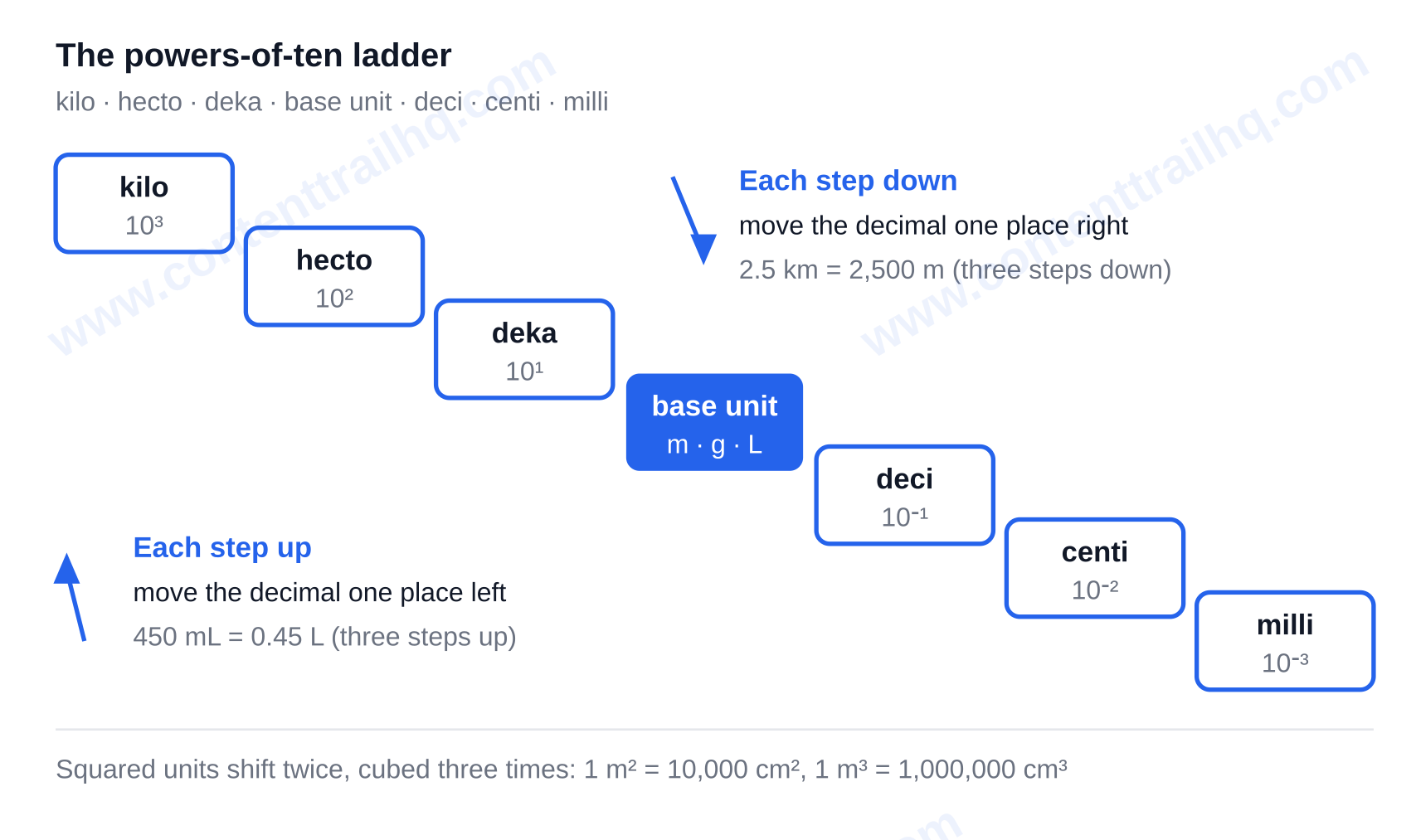
The powers-of-ten ladder
In order: kilo · hecto · deka · base unit · deci · centi · milli. Each step down the ladder moves the decimal one place right. Each step up moves it one place left.
Worked examples, step by step
- 2.5 km to metres. Kilo to base is three steps down: move the decimal three places right → 2,500 m.
- 450 mL to litres. Milli to base is three steps up: move three places left → 0.45 L.
- 7,250 g to kilograms, then tonnes. Three places left gives 7.25 kg; three more gives 0.00725 t. Chaining is just repeating the same move.
Why area and volume conversions are not a single decimal shift
Squared and cubed units shift twice and three times over. 1 m² = 10,000 cm², not 100, because the 100-fold metre-to-centimetre step applies to both dimensions. Likewise 1 m³ = 1,000,000 cm³. Millimetres to kilometres is also not one step — it is six places.
One metric-adjacent conversion that is not a simple decimal shift at all is time. Minutes and hours are run by 60, which is why 1 hour is 3,600 seconds instead of a round power of ten.
Practice conversions (with answers)
- 35 cm to metres → 0.35 m
- 4.2 kg to grams → 4,200 g
- 8,500 mm to kilometres → 0.0085 km
- 0.75 L to millilitres → 750 mL
- 3 m² to square centimetres → 30,000 cm²
SI base, derived and accepted non-SI units: which is which?
Three categories, side by side — the distinction behind the question “is a litre an SI unit?”
| SI base units | SI derived units | Non-SI units accepted with the SI |
|---|---|---|
| metre (m) | square metre — area (m²) | litre (L) |
| kilogram (kg) | cubic metre — volume (m³) | tonne (t) |
| second (s) | metre per second — speed (m/s) | hectare (ha) |
| ampere (A) | metre per second squared — acceleration (m/s²) | degree Celsius (°C) |
| kelvin (K) | newton — force (kg·m/s²) | minute (min) |
| mole (mol) | — | hour (h) |
| candela (cd) | — | day (d) |
So is a litre an SI unit?
No. The litre and the tonne are entirely legitimate in metric and are accepted for use with the SI, but not part of it. The SI units of volume and mass are the cubic metre and the kilogram respectively.
How derived units are built from base units
In words: a newton is the force that accelerates one kilogram at one metre per second squared, which is why it reduces to kg·m/s². Derived units are not extra vocabulary — they are base units multiplied and divided.
The rules and definitions the usual metric charts leave out
There are some rules and definitions that are usually left out of metric charts. There are 2 main things that separate a page written from the current standard from a page copied from a 1990s textbook: what the units are pegged to and how the units are written.
Metric units are now defined by constants, not objects
Since 20 May 2019, no metric unit is defined by a physical object. The kilogram is fixed by the Planck constant at exactly 6.62607015 × 10⁻³⁴ when expressed in J s, retiring the International Prototype of the Kilogram; the ampere, kelvin and mole were redefined the same day, per NIST’s definitions of the SI base units. Practically, that means every unit is reproducible in any properly equipped lab instead of being referenced to one metal cylinder near Paris.
How to write metric unit symbols correctly
There are some rules that are straight from NIST’s guide to writing with SI units. These are the rules that students lose marks on, and the rules that writers get wrong the most.
- Space between number and unit. There has to be a space between the number and unit. For example, the unit for 250 mm, not 250mm. The angle symbols °, ′ and ″ are exceptions.
- Symbols are never pluralised. For example 250 mm, not 250 mms.
- No full stop. There is no period at the end of the symbol. Symbols are mathematical entities, not abbreviations.
- Capitals only for people. K (kelvin), A (ampere), N (newton) get capital letters because the units are named after people. The written-out English names stay lower case: kelvin, ampere, newton.
- Prefix symbols follow the same logic: k for kilo, M for mega, m for milli.
Why the litre has two symbols
Both l and L are acceptable, and L is the recommended symbol in the US because lowercase l is easily mistaken for a 1.
Which countries use the metric system — and what does the US actually use?
Really every country uses the metric system officially. The US is the only large economy that doesn’t use the metric system for everyday commerce, along with Myanmar and Liberia.
| US customary / imperial | Metric equivalent |
|---|---|
| 1 inch | 2.54 cm exactly |
| 1 foot | 0.3048 m exactly |
| 1 mile | ≈ 1.609 km |
| 1 pound | ≈ 0.4536 kg |
| 1 US gallon | ≈ 3.785 L |
The US foot is defined in metres
A popular misconception is that America rejects the metric system. The accurate version: the US customary length was legally tied to the metre in 1959 when the yard was redefined and the foot was fixed at exactly 0.3048 metre. The older US survey foot — which differs from the international foot by about 2 parts per million, with the international foot equalling 0.999998 US survey feet — became obsolete at midnight on 1 January 2023, NIST reports. “Foot” in US surveying and mapping now refers to the metric-defined international foot. American measurements are metric underneath.
Where Americans already use metric units
- Medicine: doses in mg and mL
- Food: nutrition labels in grams
- Cars: engine displacement in litres
- Running: the 5K
- Photography: lens focal lengths in millimetres
- Science and the military: throughout
The creation of a unit explains its shape. The unit system was invented in revolutionary France and was linked to decimal relationships and to a unit of length tied to the Earth. It has since shifted steadily from physical artefacts to natural constants.
The three things to take away
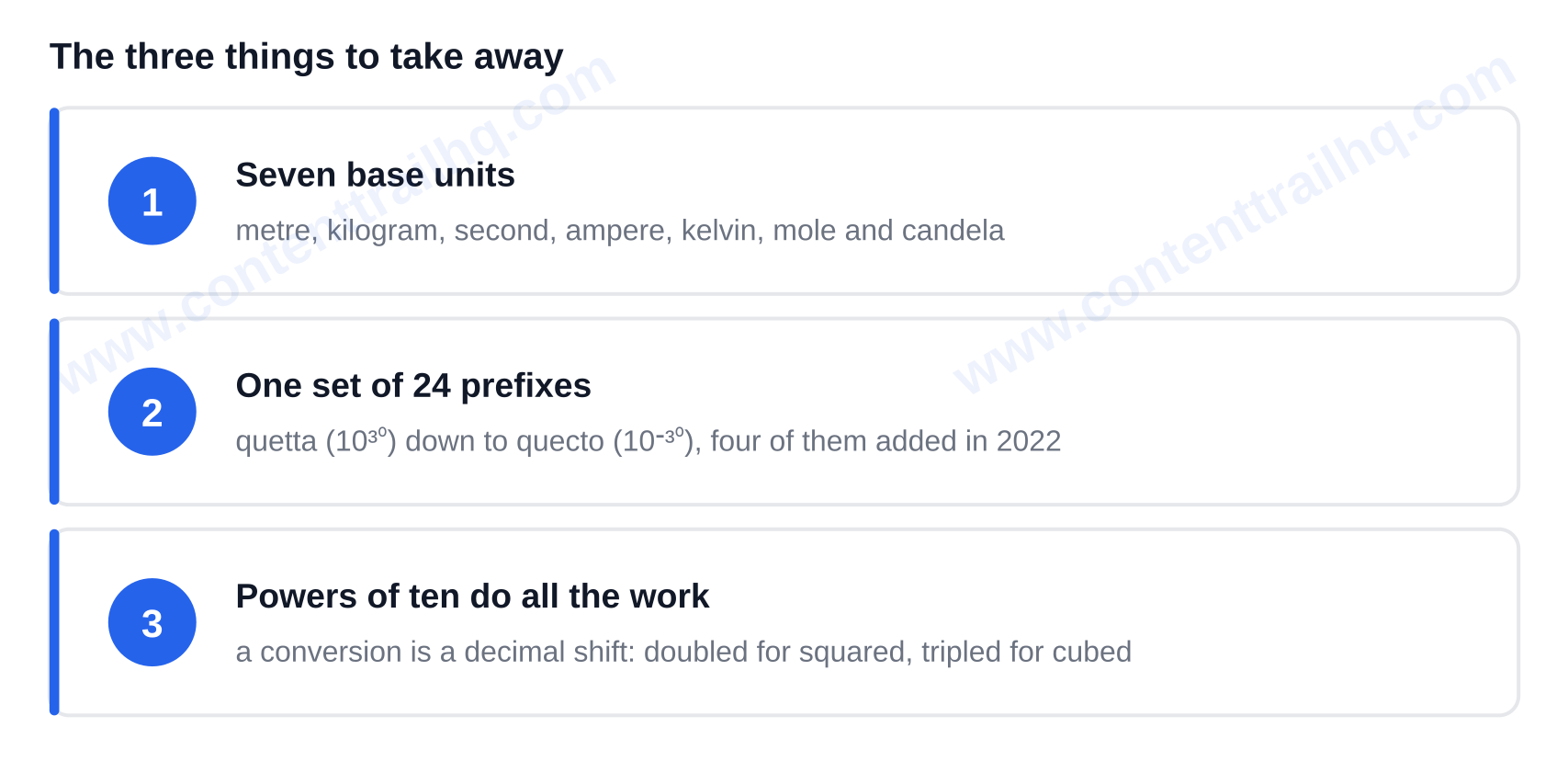
- Seven base units. The metre, kilogram, second, ampere, kelvin, mole and candela. All other units are either derived from them or accepted with them.
- One set of 24 prefixes. The quetta to quecto series, with the four most recent additions made in 2022. Any chart ending at tera and pico is incomplete.
- Powers of ten do all the work. A conversion is a decimal shift, not an arithmetic problem — doubled for squared units, tripled for cubed.
What to do next? Bookmark or print the quantity chart and the full prefix table provided above, and consult NIST’s rules before you write any unit symbol. For other pieces in this vein, see Content Trail HQ.