Spanish adjectives to describe a person are descriptive words — adjetivos calificativos — that describe someone’s appearance or personality. Most of them appear after the noun and agree with it in gender and number: alto (tall), rubio (blond), amable (kind), trabajador (hardworking), perezoso (lazy). The verb is usually ser for a lasting trait and estar for a passing state, e.g. Mi hermana es muy trabajadora.
That is roughly where most word lists stop. What they rarely cover are the three ways a correctly spelled adjective can still produce the wrong sentence. The vocabulary is the easy part; the grammar around it takes time and practice, and the last third of this page is the part that stops you saying something you didn’t mean.
What are the most useful Spanish adjectives to describe a person?
Five Spanish adjectives to describe a person (and a sentence for each)
The five below cover most of what a beginner needs. Copy the sentence pattern, not just the word.
- amable (kind) — Lucía es muy amable con todos.
- simpático (likeable) — Mi vecino es simpático.
- inteligente (intelligent) — Ana es muy inteligente.
- trabajador (hardworking) — Mi padre es trabajador.
- alto (tall) — Carlos es alto y delgado.
How a Spanish description is normally built
The structure of a Spanish description is as follows: subject + ser + optional intensifier + adjective. Lucía es muy amable. A complete description should include all of the following: appearance, personality and one concrete detail. It is this last element that makes the description sound natural and not a mere list of words.
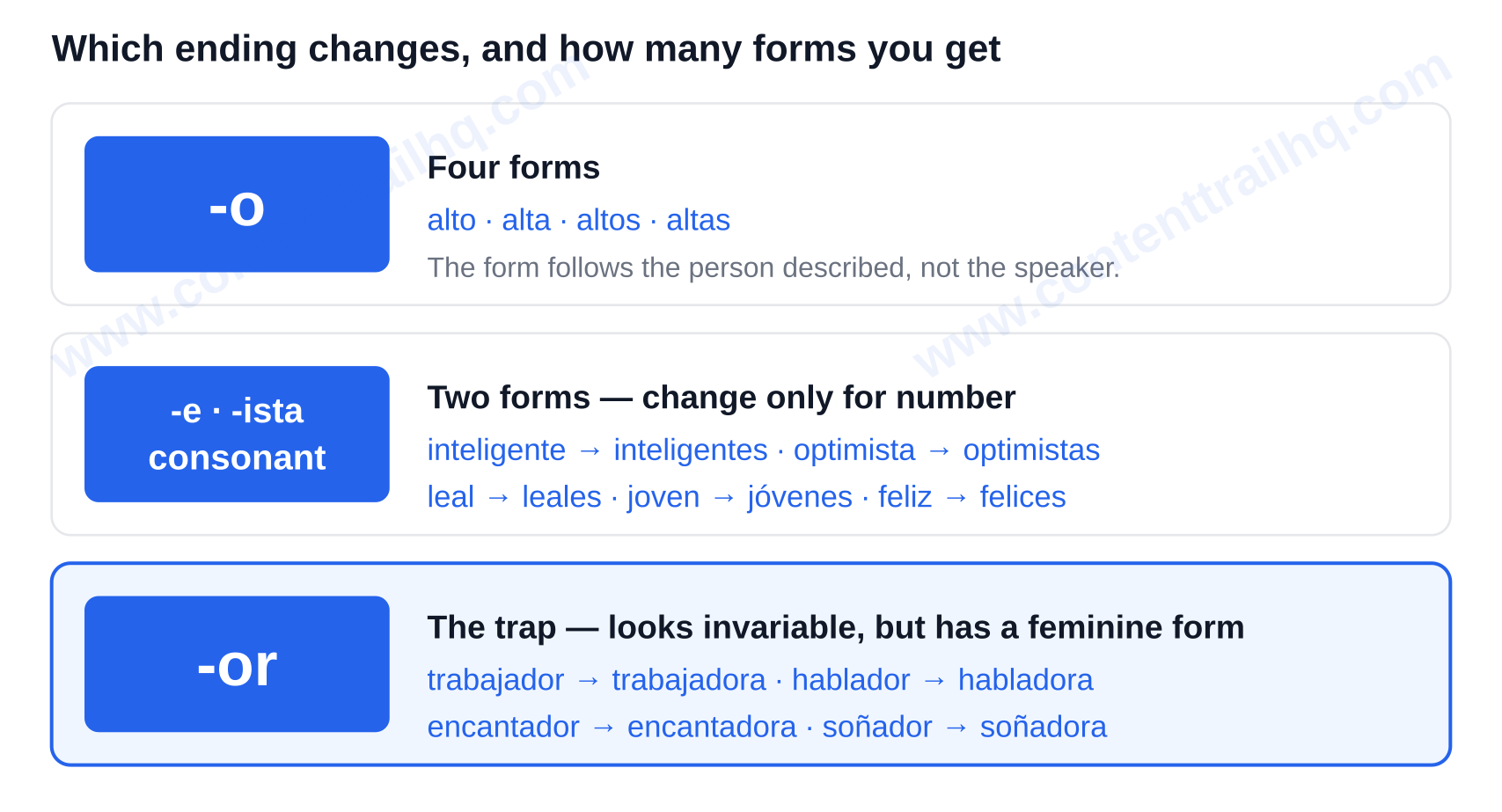
One aspect is common to every entry in the tables and lists that follow, and most word lists leave you to work it out for yourself. There are four variations of adjectives ending in -o. There are two variations of adjectives ending in -e, -ista or most consonants. And adjectives ending in -or look invariable but are not — they are the trap.
How do you describe someone’s physical appearance in Spanish?
Height, build, and age
Height — alto/alta/altos/altas (tall), bajo/baja/bajos/bajas (short), de estatura media (of average height, invariable). Build — delgado/delgada (slim), flaco/flaca (skinny), gordo/gorda (fat), fuerte/fuertes (strong), atlético/atlética (athletic). Age — joven/jóvenes (young), mayor/mayores (elderly), de mediana edad (middle aged).
Hair, eyes, and features: use tener, not ser
Hair colours can be used as adjectives to describe someone: rubio (blond), moreno (dark-haired), castaño (brown-haired), pelirrojo (red-haired), canoso (grey-haired), calvo (bald). Hair texture and eye colour cannot be described this way. As Tell Me In Spanish sets out, appearance is normally described with tener plus a noun phrase: tener el pelo rizado / lacio / corto / largo, tener los ojos verdes / azules / marrones, tener barba, tener pecas. Es pelo rizado is not a sentence a native speaker would produce — it says “he is curly hair.” So to say someone has curly hair you should say Tiene el pelo rizado.
Words for good-looking — guapo, bonito, hermoso, atractivo
Guapo/guapa describes a person. Bonito/bonita more often describes a thing or a child. Hermoso/hermosa is warmer and more literary; atractivo/atractiva has a neutral meaning, and feo/fea means plain “ugly” and lands harder in Spanish than its English gloss suggests. Avoid using bueno to describe looks until you read the ser/estar section — it does not mean what a vocabulary table implies.
Two models to adapt: Mi hermana es baja y delgada. Tiene el pelo castaño y los ojos verdes. Es muy cariñosa y bastante organizada. And for yourself: Soy de estatura media. Tengo el pelo corto y lacio. Soy trabajador pero un poco impaciente.
Which Spanish adjectives describe personality — the positive ones?
Positive personality adjectives, grouped and with all their forms
The reason the last column is in the table is that certain Spanish adjectives agree with their subject and the lists almost never say which ones. Lingoda and Tell Me In Spanish both explain the agreement rule and both still publish flat masculine columns, so the reader ends up with the rule and the words but no mapping between them. It is also easy to assume bueno simply means “good” or “nice,” but that is not always the case.
| Masculine singular | Feminine singular | English | Ending class |
|---|---|---|---|
| amable | amable | kind | -e (two forms) |
| simpático | simpática | likeable — false friend | -o (four forms) |
| cariñoso | cariñosa | affectionate | -o (four forms) |
| agradable | agradable | pleasant | -e (two forms) |
| generoso | generosa | generous | -o (four forms) |
| trabajador | trabajadora | hardworking | -or (inflects) |
| responsable | responsable | responsible | -e (two forms) |
| organizado | organizada | organised | -o (four forms) |
| puntual | puntual | punctual | consonant (two forms) |
| dedicado | dedicada | dedicated | -o (four forms) |
| inteligente | inteligente | intelligent | -e (two forms) |
| listo | lista | clever — ser/estar flip | -o (four forms) |
| creativo | creativa | creative | -o (four forms) |
| curioso | curiosa | curious | -o (four forms) |
| gracioso | graciosa | funny | -o (four forms) |
| divertido | divertida | fun to be around | -o (four forms) |
| honesto | honesta | honest | -o (four forms) |
| leal | leal | loyal | consonant (two forms) |
| valiente | valiente | brave | -e (two forms) |
| paciente | paciente | patient | -e (two forms) |
| humilde | humilde | humble | -e (two forms) |
| alegre | alegre | cheerful | -e (two forms) |
| optimista | optimista | optimistic | -ista (two forms) |
| extrovertido | extrovertida | outgoing | -o (four forms) |
| bueno | buena | good, kind — ser/estar flip | -o (four forms) |
| educado | educada | well-mannered — false friend | -o (four forms) |
| sensible | sensible | emotionally sensitive — false friend | -e (two forms) |
Which ‘nice’ do you want — simpático or amable?
Amable is more suitable to use in formal or service situations. Use amable when talking about a helpful official or a patient receptionist. Simpático is the everyday “nice person,” the one you enjoy being around. In much of Latin America the colloquial equivalent is buena gente, as in Mi jefe es buena gente.
How do you describe negative traits in Spanish without causing offence?
Negative personality adjectives and their forms
There are various terms in Spanish to refer to negative personality traits. Here are some examples, with their forms inline: antipático/antipática (unpleasant), perezoso/perezosa and vago/vaga (lazy), egoísta/egoístas (selfish, -ista so invariable for gender), aburrido/aburrida (boring as a trait), tacaño/tacaña (stingy), grosero/grosera (rude), mentiroso/mentirosa (dishonest), terco/terca and testarudo/testaruda (stubborn), celoso/celosa (jealous), orgulloso/orgullosa (proud in a negative way), maleducado/maleducada (poorly mannered).
Softening a criticism: un poco, algo, a veces
There are four words you can use to soften your criticism: un poco, algo, a veces and no muy. When you use Es perezoso you are making a statement about someone’s character. Es un poco perezoso is something you can say when making an observation at the dinner table. A veces es un poco terco is softer still because it confines the statement to only some of the time.
Why slang insults don’t travel — the pendejo problem
A universal adjective list largely fails here. Lists of negative personality traits are usually published without any note about which region the words are safe in. This is also the area where the wrong word carries a real social cost. In Wiktionary’s entry for pendejo it is noted that in Mexico and Central America it means “foolish or careless,” in Argentina and Uruguay it is a comparatively mild “naive” or “inexperienced,” and in Peru it means “clever” or “sly” and thus is almost the exact opposite of the first meaning.
The practical rule: verify any insult or slang-adjacent descriptor against the specific country you are speaking in, and in general it is best to stick with the neutral core — perezoso, egoísta, antipático — if you are not certain who you are speaking to.
How do you make a Spanish adjective match the person you’re describing?
The four-form pattern for -o adjectives
According to Lingoda, most Spanish adjectives have four forms: alto, alta, altos, altas. The form is decided by the person described, not the speaker. A man saying Mi madre es alta uses the feminine because his mother is the one being described.
Adjectives that don’t change for gender (-e, -ista, consonants)
Some adjectives change only to indicate number: -e (inteligente, amable, responsable, alegre, fuerte), -ista (optimista, pesimista, egoísta, idealista), and most consonants (leal, feliz, joven, capaz). Both of these sentences are correct as written: Él es inteligente and Ella es inteligente. If you want more information about the full inflection system behind it, the Wikipedia reference on Spanish adjectives is a decent, neutral resource.
Making adjectives plural
- Add an -s if the word ends in a vowel: amable becomes amables and alto becomes altos.
- Add an -es if it ends in a consonant: leal becomes leales and joven becomes jóvenes.
- Ends in -z → change to -ces: feliz becomes felices and capaz becomes capaces.
The -or trap: trabajador becomes trabajadora
Most learners miss this one. Because they end in a consonant they look invariable, but they do have a separate feminine form: trabajador/trabajadora, hablador/habladora (talkative), encantador/encantadora (charming), soñador/soñadora (dreamy). Mi hermana es trabajador is incorrect. Mi hermana es trabajadora is correct.
Describing a mixed group of people
Use the masculine plural to refer to a group made up of both males and females. Mis primos son muy simpáticos describes cousins of both genders. Only an all-female group takes the feminine plural: Mis primas son muy simpáticas.
Ser, estar, and word order: three ways a correct adjective still makes the wrong sentence
There are three ways to fail to make a correct sentence using adjectives even when the words are correctly spelled, and all three happen with words already in the tables above. In practice, this is also where most intermediate mistakes come from — not from missing vocabulary, but from a word that was spelled perfectly and still meant something else.
Trap 1 — ser or estar? The adjectives whose meaning flips
One way to confirm whether you are using the correct verb is to determine if you are describing someone’s personality or their state of mind at the time. Ser states what someone is like. Estar states how they are right now. Check your sentence against this list:
- ser listo = clever · estar listo = ready
- ser aburrido = boring · estar aburrido = bored
- ser bueno = kind, good · estar bueno = (informally, of a person) good-looking; of food, delicious
- ser nervioso = a nervous type · estar nervioso = nervous at this moment
- ser rico = wealthy · estar rico = delicious
- ser malo = bad, unkind · estar malo = unwell
SpanishEnglish.com documents the first three pairs; SpanishGrammar.net gives the nervioso contrast directly — Juan es muy nervioso means Juan is a nervous person in general, while Juan está muy nervioso means he is nervous right now. Here is the consequence you actually hit: take “aburrido = boring” from a vocabulary table, say Estoy aburrido, and you have reported being bored. The word was spelled correctly; the verb changed what it meant.
Trap 2 — false friends: simpático, sensible, educado
A one-word gloss makes a false friend look settled, when the gloss itself is what teaches the wrong meaning. All three of these words appear in vocabulary tables with that one-word gloss and no warning, which is exactly how the mistranslation gets learned.
- Simpático means likeable, not “sympathetic” — that is compasivo.
- Sensible means emotionally sensitive, not “level-headed” — that is sensato/a.
- Educado means well-mannered, not formally educated — that is culto/a.
SpanishDict’s false cognates guide and Wiktionary’s appendix of English–Spanish false friends both carry these. Neither guide, though, is specifically about adjectives, so the warning rarely reaches someone who is simply looking up a word to describe a person.
Trap 3 — before or after the noun? viejo, pobre, grande
Adjectives typically follow the noun: un amigo generoso. Move one in front and it becomes subjective — and sometimes changes the meaning outright. SpanishDict’s placement guide sets out the flips: un viejo amigo is a long-time friend, un amigo viejo is an elderly one; un pobre hombre is an unfortunate man, un hombre pobre has no money; un gran hombre is a great man, un hombre grande is a big one. All three are words about people, and most person-adjective lists never mention them.
Buen or bueno, gran or grande: the shortened forms
Bueno, malo and grande are shortened before a masculine singular noun — apocopation. Consequently, one would say un buen amigo, not un bueno amigo. Un mal jefe, not un malo jefe. Likewise un gran amigo — and grande is shortened before feminine singular nouns too: una gran amiga.
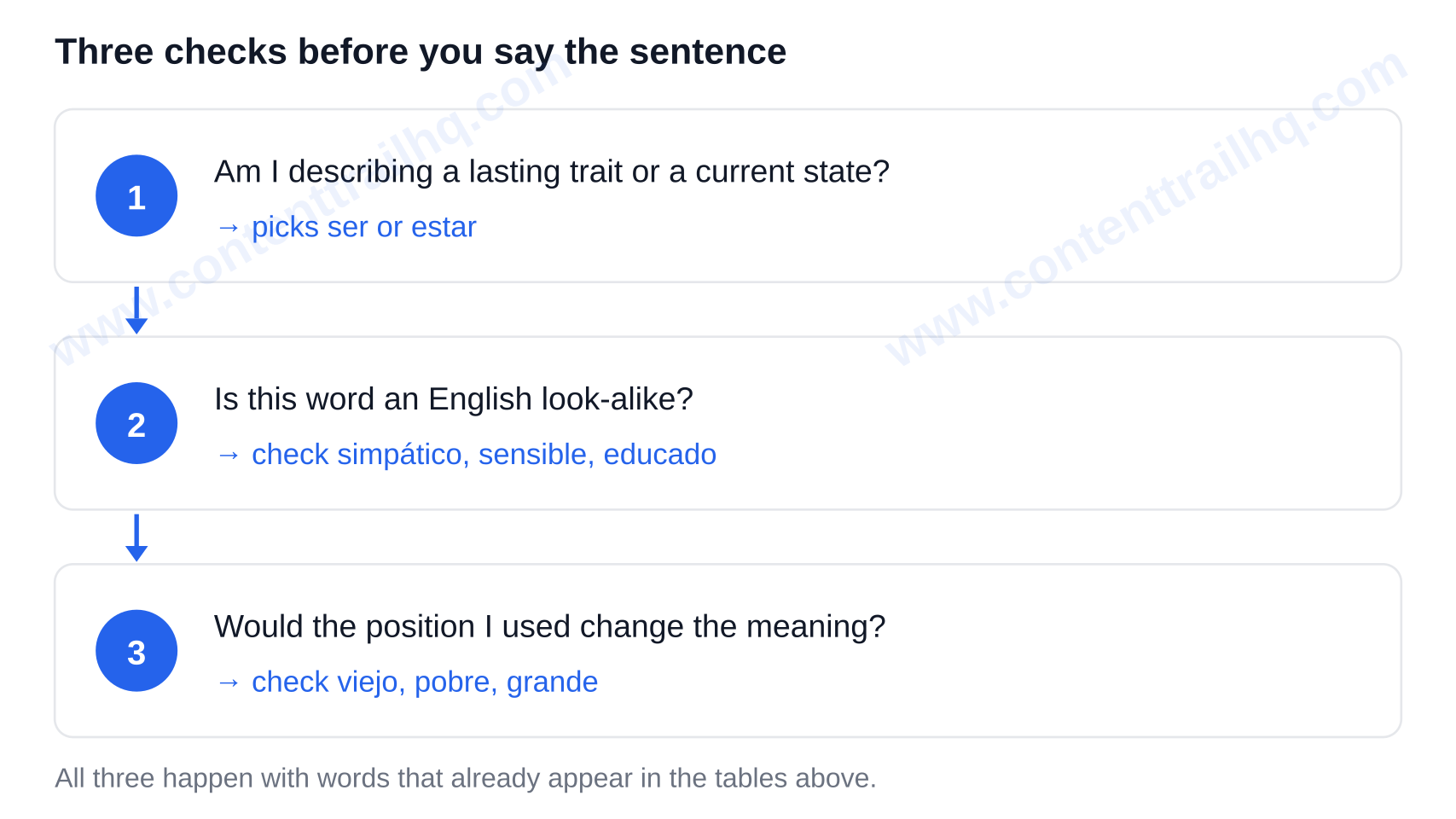
A three-question check before you say it
- Am I describing a lasting trait or a current state? → picks ser or estar.
- Is this word an English look-alike? → check simpático, sensible, educado.
- Would the position I used change the meaning? → check viejo, pobre, grande.
How do you put it together and describe yourself in Spanish?
A fill-in frame for describing yourself
For your first speaking exam or conversation: Me llamo … / Soy … (appearance) / Tengo … (hair, eyes, features) / Soy una persona … (character) / Lo que más me gusta de mí es que soy …
Sounding natural: muy, bastante, un poco, demasiado
Six words stop a description reading like a word list: muy (very), bastante (fairly), un poco (a bit), demasiado (too), algo (somewhat), nada (not at all). You can use un poco to lessen a trait and demasiado to overstate one. Soy bastante organizado pero un poco impaciente sounds like a person. Soy organizado. Soy impaciente sounds like flashcards. The best descriptions go beyond labeling and name the individual characteristics of a person — and knowing category names is not the same as knowing which word to use to express an idea, much like knowing what a common noun is versus knowing which one to pick.
Two model descriptions to adapt
About yourself: Me llamo Daniel. Soy de estatura media y delgado. Tengo el pelo corto y los ojos marrones. Soy una persona trabajadora y bastante tranquila, aunque a veces soy un poco terco.
About your friend: Mi amiga Clara es alta y atlética. Tiene el pelo rizado y los ojos verdes. Es muy simpática y encantadora, y es la persona más generosa que conozco.
Practice task: make three statements about someone you know — one about their appearance using tener, one positive trait, and one hedged with un poco — then run each sentence through the three-question check above.
The one thing to do next
These Spanish adjectives to describe a person cover almost anything you need to say about someone’s appearance and character. Knowing them, however, is not as simple as learning the definitions. You also need to choose between ser and estar, look for a look-alike, and put the adjective in the right position. If you take just one thing from this page, take the three-question check — it is the part no other list gives you, and it is the part that fixes sentences you would otherwise get wrong with perfectly spelled words. Write your three sentences, run them through it, then read them aloud.
Frequently Asked Questions
What is the difference between ‘es aburrido’ and ‘está aburrido’?
Es aburrido means ‘that person is boring’ and speaks to that person’s character. Está aburrido means ‘that person is bored’ and speaks to their state of mind at the moment. The adjective is spelled the same way in both cases, but using one verb or the other makes the difference in meaning. This is the single most common way a learner takes a word from a vocabulary table and says the opposite of what they meant.
How many Spanish adjectives do I need to describe a person in a speaking exam?
Way fewer than the 100-plus lists suggest. Between five and eight adjectives you can inflect correctly, along with the tener pattern to describe hair and eyes, plus a couple of hedges like muy, bastante and un poco, should cover a full description. Examiners reward correct agreement and the right choice of ser or estar over volume of vocabulary.
Can I use the same adjectives for men and women in Spanish?
Yes, but most take different endings. Adjectives ending in -o take four forms (alto, alta, altos, altas). Adjectives ending in -e, -ista or most consonants are the same for both genders and only change for number (inteligente, optimista, leal). Of note is the -or group, which looks invariable but inflects: trabajador, for example, changes to trabajadora.