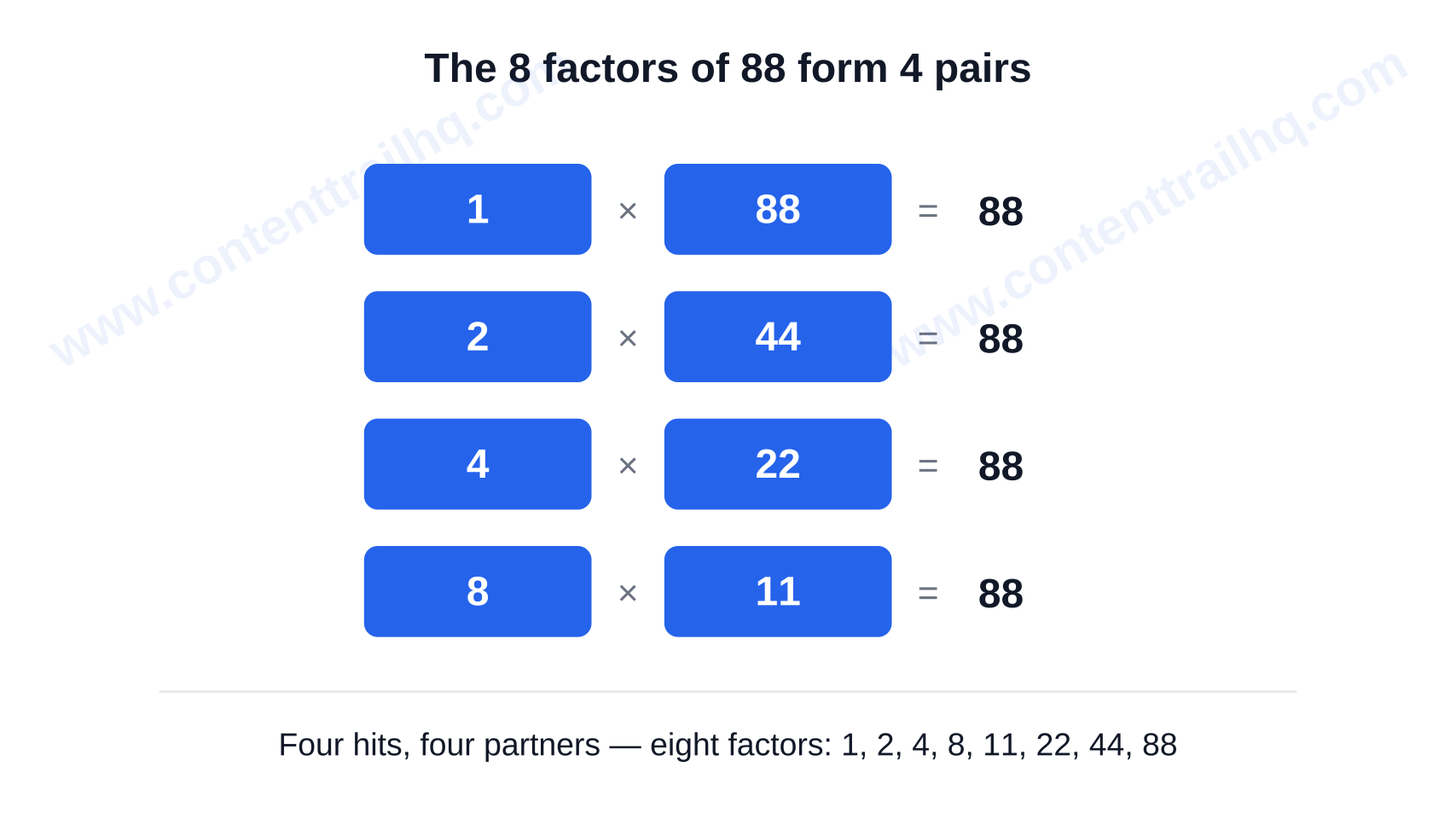
Most people assume you have to test every number up to 88 to be sure you’ve found them all. You don’t. The factors of 88 are 1, 2, 4, 8, 11, 22, 44 and 88 — eight factors in total. A factor is a whole number that divides 88 with no remainder. In pairs they are (1, 88), (2, 44), (4, 22) and (8, 11), and the prime factorization of 88 is 2 × 2 × 2 × 11, or 2³ × 11.
Every page ranking for this question lists the same eight numbers and the same factor tree. What they fail to provide is what saves you time: where are you allowed to stop dividing? How do you verify the completion of your list before handing it in? This page will cover those things.
What are the factors of 88?
To factor 88, start from 1 and increase by 1 until you reach 88. The factors of 88 are 1, 2, 4, 8, 11, 22, 44, 88. The smallest factor is 1, and the largest factor is 88. There are 8 factors total, which is confirmed by Cuemath.
A factor is a whole number that divides 88 leaving a remainder of zero. Because 88 ÷ 4 = 22 with nothing left over, 4 is a factor — and so is 22. You can verify the whole list with eight divisions:
- 88 ÷ 1 = 88
- 88 ÷ 2 = 44
- 88 ÷ 4 = 22
- 88 ÷ 8 = 11
- 88 ÷ 11 = 8
- 88 ÷ 22 = 4
- 88 ÷ 44 = 2
- 88 ÷ 88 = 1
Factor pairs of 88 (including the negative pairs)
Factors of a number can be positive or negative. For example, pairs (1, 88) and (-1, -88) both factor into 88. Similarly, the pairs (2, 44) and (-2, -44) both factor into 88. The other pairs are (4, 22) and (-4, -22), (8, 11) and (-8, -11) — Byjus also lists the negative pairs. The sum of all the factors of 88 is 180.
Factors vs. prime factors vs. multiples of 88
There are three things that are commonly mixed up and confused. They are factors (or divisors), prime factors and multiples.
- Factors (or divisors): are all 8, which are 1, 2, 4, 8, 11, 22, 44, 88.
- Prime factors: there are only two, which are 2 and 11. The rest are composite, and 1 is neither prime nor composite.
- Multiples: they include 88, 176, 264, 352 and upward. Factors of 88 divide it, multiples grow out of it.
How do you find the factors of 88 without missing any?
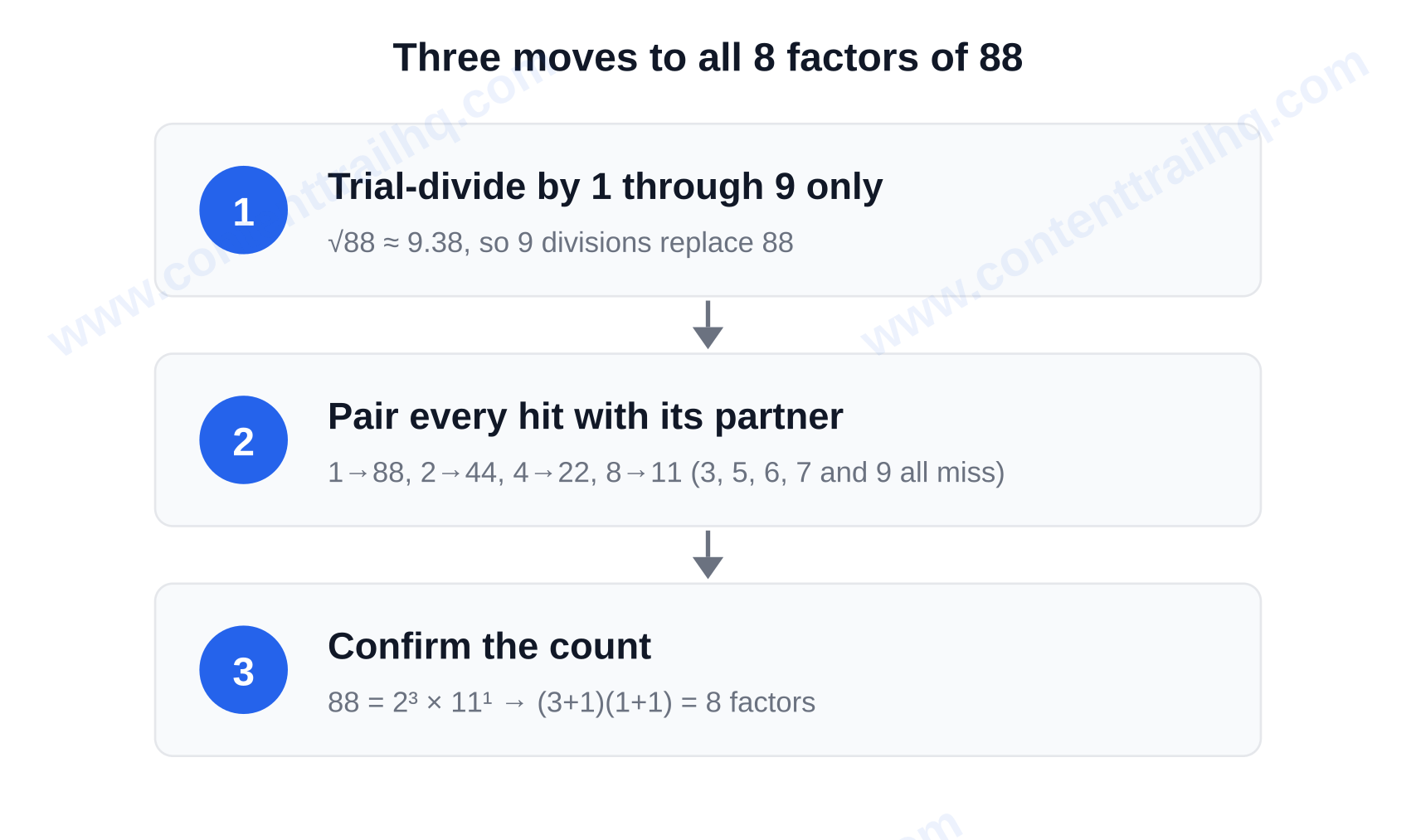
Trial divide up to 9 and pair every hit. Three moves and the third will finish your factors. Finding the factors of 88 can be tricky. Here is a method that won’t miss any.
Stop at 9: the square-root rule for 88
The square root of 88 is approximately 9.38. This is the number that nobody tells you about. You only have to test the whole numbers from 1 to 9. Anything larger would already have been partnered with something smaller and therefore not necessary to test. Nine divisions instead of 88.
Here are the nine tests, written out to show the method.
- 1 ✓ → partner 88
- 2 ✓ → partner 44
- 3 ✗ (8 + 8 = 16 is not divisible by 3)
- 4 ✓ → partner 22
- 5 ✗ (doesn’t end in 0 or 5)
- 6 ✗ (fails the ÷3 test, so it can’t work)
- 7 ✗
- 8 ✓ → partner 11
- 9 ✗ (and you’ve reached 9.38, so stop)
Four hits, four partners, eight factors. In practice this is the step that stops students grinding through the teens and twenties for no reason.
Prove nothing is missing: (3+1)(1+1) = 8
Now confirm the count. The divisor function τ(n) = (e₁+1)(e₂+1) …, documented at the Prime Pages, multiplies each exponent in the prime factorization after adding one. For 88 = 2³ × 11¹ that gives (3 + 1)(1 + 1) = 4 × 2 = 8.
Why it works is simple once you see it: every factor is built by choosing a power of 2 (2⁰, 2¹, 2², 2³ — four options) and a power of 11 (11⁰ or 11¹ — two options). Four times two is eight combinations, and those combinations are the factor list. Count 7 or 9 and you know you slipped, before the marker does.
One more sanity check worth remembering: 88 has 8 factors and 88 ÷ 8 = 11 exactly. That makes it a refactorable number — one of the first fifteen, alongside 1, 2, 8, 9, 12, 18, 24, 36, 40, 56, 60, 72, 80 and 84.
What is the prime factorization of 88?
88 = 2 × 2 × 2 × 11, or 2³ × 11 in exponent form. Give both — teachers accept either, and some ask for one specifically.
Division method (division ladder) for 88
Divide by the smallest prime that fits, repeatedly, and collect the divisors down the left:
- 88 ÷ 2 = 44
- 44 ÷ 2 = 22
- 22 ÷ 2 = 11
- 11 is prime, stop.
Left column: 2, 2, 2, 11
Factor tree of 88
Same answer, drawn as branches. 88 splits into 2 × 44; 44 splits into 2 × 22; 22 splits into 2 × 11. Both 2 and 11 are prime, so they’re the leaves. Starting from a different split changes nothing — 88 → 4 × 22 and 88 → 8 × 11 both bottom out at 2³ × 11, because prime factorization is unique.
Exponent form is a shortcut to figuring greatest common factors, the least common multiples, and reducing fractions, which is why it is usually asked for instead of the list form.
Which method should you use for your problem?
Pick by what the question asks for instead of what you remember. The four methods appear on every tutoring page as an undifferentiated sequence; here’s the mapping.
| What the question asks | Method to use, and why |
|---|---|
| “List all the factors of 88” or a rectangle/array problem | Pair-hunting with the square-root rule — it produces the list and the four pairs in one pass |
| “Show your work” / “Find the prime factorization” | The division ladder — the written steps are the answer the marker wants |
| The worksheet prints a branching diagram | The factor tree — same result as the ladder, in the shape they asked for |
| GCF, LCM, or simplifying a fraction with 88 in it | Start from 2³ × 11 and compare exponents; never list factors by hand |
| “Is 88 prime?” / “What is 88 divisible by?” | One divisibility check — 88 is even, so it has a factor beyond 1 and itself and is composite |
Rule of thumb: if the answer is a list, hunt pairs; if the answer feeds another calculation, use 2³ × 11.
What are the common factors and GCF of 88 and another number?
List the prime factors of both numbers, retain factors that are the same, and the largest of those factors is the GCF. Using exponent form allows you to write down the answer without listing anything.
- 88 and 99: 99 = 3² × 11 and its factors are 1, 3, 9, 11, 33, 99. Only the 11 is shared, so the common factors are 1 and 11 and the GCF is 11.
- 88 and 72: 72 = 2³ × 3², 88 = 2³ × 11. The shared part is 2³, giving common factors 1, 2, 4, 8 and a GCF of 8.
- 88 and 98: GCF = 2
- 88 and 121: GCF = 11
- 88 and 120: Common factors = 1, 2, 4 and 8
Using 2³ × 11 to simplify fractions with 88
This is where most readers are actually headed. Divide top and bottom by the GCF: 88/99 reduces to 8/9 (divide both by 11), and 88/120 reduces to 11/15 (divide both by 8). For the LCM, take the highest power of each prime instead — LCM(88, 99) = 2³ × 3² × 11 = 792.
For true/false questions: 88 is even, composite, not prime, and not a perfect square, since 9.38 sits between 9² = 81 and 10² = 100.
What mistakes do students make with the factors of 88?
The halving mistake is the most common and is specific to this number. Because 88 is even, the instinct is to keep halving — 88, 44, 22, 11 — and stop there. You are also losing factors. The lowest odd prime factor is 11, and you have to re-pair every power of 2 with it to get 11, 22 and 44.
- Assuming an even number has no odd factors. 11 is odd and divides 88, therefore 1 and 11 belong on the factor list.
- Forgetting 1 and 88. Every number has factors 1 and the number itself. Leaving them out reduces the factors from 8 to 6.
- Checking just small divisors. Pairing fixes this. For example, finding 2 gives you 44 for free.
- Confusing factors with multiples. 176 is a multiple of 88, not a factor of it.
- Giving the wrong notation. Write 2 × 2 × 2 × 11 and 2³ × 11 — same answer, two forms.
Quick practice set with answers
- List the factor pairs of 88. → (1, 88), (2, 44), (4, 22), (8, 11)
- Find the GCF of 88 and 44. → 44
- Is 88 divisible by 6? → No; it fails the ÷3 check
- What is the sum of the factors of 88? → 180
- Write 88 in exponent form. → 2³ × 11
The one method worth keeping
Eight factors, four pairs, built from 2³ × 11. But the answer is the cheap part — the routine is what transfers: trial-divide up to the square root, let every hit hand you its partner, then confirm the count with exponent-plus-one. Run those three moves on the other number in your problem and compare the two prime factorizations to read off the GCF or LCM directly.
Rule of thumb: stop at the square root, pair as you go, and let (3+1)(1+1) = 8 tell you when you’re done. There’s plenty more to dig into on Content Trail HQ.
Quick Answers
What is 88 divisible by?
88 is divisible by 1, 2, 4, 8, 11, 22, 44 and 88; those 8 numbers divide it with zero remainder. It is not divisible by 3, 5, 6, 7 or 9. The quickest check: 88 is even, so 2 divides it immediately, which also confirms 88 is composite rather than prime.
Is 88 a perfect square?
No. The square root of 88 is approximately 9.38, which is not a whole number, so 88 is not a perfect square. It is between 9² = 81 and 10² = 100. A perfect square always has an odd number of factors and 88 has even, 8, factors.
What two numbers multiply to make 88?
Four pairs of whole numbers multiply to 88: 1 × 88, 2 × 44, 4 × 22 and 8 × 11. Negative pairs work too since a negative times a negative gives a positive: (-1, -88), (-2, -44), (-4, -22) and (-8, -11).
What are the first five multiples of 88?
The first five multiples of 88 are 88, 176, 264, 352, and 440. Multiples are values that grow without limit, like 88 × 1, 88 × 2, 88 × 3, etc. Factors stop at the number itself. For 88, the factors are 1, 2, 4, 8, 11, 22, 44, and 88.
What is the prime factorization of 88 in exponent form?
88 = 2³ × 11, which in expanded form is 2 × 2 × 2 × 11. The prime factors of 88 are only 2 and 11; 4, 8, 22, 44 and 88 are factors but composite, and 1 is neither prime nor composite. Exponent form is used in the reduction of fractions and the finding of the GCF and LCM.
How do you know you have found all the factors of 88?
Use the divisor-count formula. For 88 = 2³ × 11¹, add 1 to each exponent and multiply them: (3 + 1)(1 + 1) = 8. If you have 7 or 9, you made a mistake. Pair the hits you find while trial-dividing up to 9 and you will land on exactly eight.