There are two choices available to you tonight: you can begin swallowing tablets in whichever order you find them, or you can begin to do five things which protect your comfort and your diagnosis. This page outlines the five things. Learning how to stop burning sensation after urinating takes around 10 minutes to do the five things outlined on this page and then 48 hours of patience. To help ease the discomfort and to help you rest, you should drink 2–3 litres of clear fluid across the day, apply a warm compress to your lower abdomen, take ibuprofen or paracetamol (at the dose shown on the packet) and cut down on bladder irritants. The majority of burning sensations associated with urination are caused by infections; if the burning sensation lasts beyond two days you should get a urine test.
You should also know that there is one thing you should do before you do the others and that is to provide a urine sample to a clinic or lab if that is possible in the next couple of hours. Give that sample before you take any over-the-counter urinary analgesic. The reason for this is explained under mistakes and it is the most useful sentence on this page.
What exactly is the burning, and does when it burns tell you anything?
Dysuria is the medical term for pain or discomfort when you pass urine. It is a symptom not a diagnosis. Cleveland Clinic’s page on dysuria states that Dysuria is something that men and women of any age can experience, with it being more common in women, with higher risk in pregnancy, diabetes and bladder disease. In this case, “stopping it” means you have to do two things. The first is to sooth and calm the irritated urinary lining, and the second is to work out what is irritating the lining.
The timing within the stream is an important clue:
- Burning at the start suggests the urethra (urethritis) which can be caused by an irritant (or reaction to one), or by chlamydia or gonorrhoea.
- Burning at the end of the stream, or lingering after the stream stops suggests the bladder and/or neck of the bladder — cystitis, bladder stones, interstitial cystitis.
- Burning that is on one side, positional, or paired with flank pain is yet a different signal, and likely not the bladder lining, but the kidney and/or a stone.
Of course, all this is before you self-medicate or do anything. The self-care that soothes cystitis does nothing for urethritis from an STI, and holding off from treating can be dangerous for a few specific groups, listed below.
How to stop burning sensation after urinating in the first few hours
Get a 1L (large) bottle or glass that you can fill, and refill, with water. Get paracetamol or ibuprofen. Get a heating pad or hot water bottle. Clear 48 hours of alcohol and coffee. The hands-on time is just a few minutes. The rest is drinking, steady and slowly.
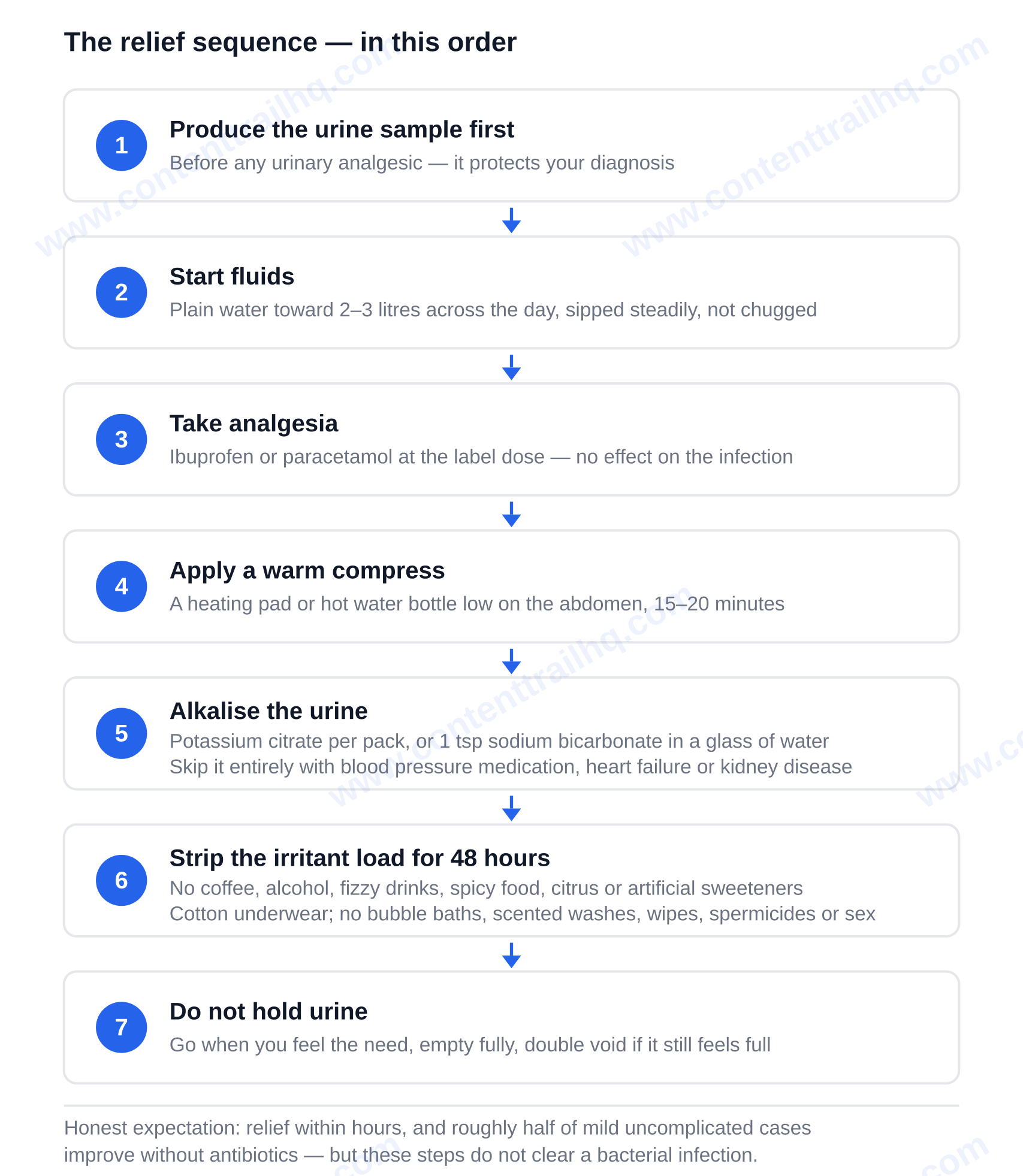
The step-by-step relief sequence (in order)
- Produce the urine sample first — if you can reach a clinic, pharmacy, or lab today, provide the sample before taking any urinary analgesic. This will protect your diagnosis.
- Start fluids — after, drink water! Plain water toward 2–3 litres across the day, sipped steadily, not chugged. Concentrated urine is itself a chemical irritant; the goal is to dilute the irritating substances in your urine. This should lessen the burning sensation.
- Take analgesia — ibuprofen or paracetamol at the label dose. This reduces the inflammatory burn. It has no effect on the infection.
- Apply a warm compress — a heating pad or hot water bottle low on the abdomen or perineum, 15–20 minutes. This helps with bladder spasm and the referred pain behind it.
- Alkalise the urine — alkalising the urine with either a commercial urinary alkaliser (potassium citrate) per pack directions, or one teaspoon of sodium bicarbonate in a glass of water, the dose Better Health Channel specifies for cystitis. Skip this completely if you take blood pressure medication, have heart failure or have kidney disease. Use fluids and analgesia instead.
- Strip the irritant load for 48 hours — this means no coffee, alcohol, carbonated drinks, spicy food, citrus or acidic juice and artificial sweeteners. Switch to breathable cotton underwear, and stop bubble baths, scented washes, douches, wipes, spermicides, and sex for 48 hours.
- Do not hold urine — make sure you do not hold your urine. Go when you feel the need, and empty your bladder fully. Double void if your bladder feels full after.
Honest expectation: These steps should bring relief within hours and roughly half of mild uncomplicated cases improve without the use of antibiotics. However, they do not clear a bacterial infection.
How to check it worked before you move on
At the 48 hour mark, you want to ask yourself 3 questions. Is the burning clearly milder than when you started, not just different? Is your urine pale rather than dark and strong-smelling? And is there still no fever, flank pain or blood? If you answered yes to all these questions, then continue to drink fluids and finish the irritant free window. If you answered no to any of these questions, or if your burning eased then returned within a fortnight, then stop self treating and get a urine test.
The five mistakes that make the burning last longer or come straight back
Although the remedy lists are fairly similar, the differences are often found in self-care mistakes that quietly extend the length of the episode — and the first one is the most common and the least discussed.
Mistake 1: taking AZO or Uristat before your urine test. Phenazopyridine is an azo dye that turns urine vivid orange, and that colour interferes with colour-reaction dipstick pads — nitrite, leukocyte esterase, protein, ketone, bilirubin and urobilinogen — producing false positives and false negatives. Microscopy and culture are unaffected. The rule: sample first, AZO after. If you have already taken it, tell the lab and ask for a culture rather than trusting the dipstick.
Mistake 2: Using phenazopyridine to “cure” a UTI. This drug numbs the bladder lining, and is a temporary relief at that. It does not even kill bacteria. Two consecutive days is the ceiling without medical supervision, expect a shocking orange colour to your urine, and take soft contact lenses out — it stains them permanently.
Mistake 3: Stopping antibiotics when the burning stops. Symptom relief lags behind bacterial kill by a few days. After stopping antibiotics before the course is finished, the bacteria can learn to evade the drug, and a reinfection is likely. Finish the prescription.
Mistake 4: Using ibuprofen to treat a UTI if you’re not in the group that can. In a double-blind non-inferiority trial of ibuprofen versus pivmecillinam for uncomplicated UTI in women (PLOS Medicine, 2018), about half the ibuprofen group recovered antibiotic-free. However, all 7 cases of pyelonephritis occurred in the ibuprofen group, making the number needed to harm 26. A 48-hour symptomatic trial of ibuprofen is reasonable for an otherwise healthy non-pregnant adult with mild isolated burning. It is the wrong call if you are pregnant, diabetic, immunosuppressed, male with urinary symptoms, over 65, or have any fever or flank pain.
Mistake 5: Reading a clear urine dipstick as an all-clear, then flushing with cranberry juice. A negative dipstick does not mean there is not a different problem, e.g. chlamydia, gonorrhoea, stones or interstitial cystitis. And cranberry’s acidity can sharpen the burn tonight, while its real evidence is preventive — which brings us to the remedies worth your money.
Does cranberry, D-mannose or water actually work — or only prevent?
The evidence for treatment and prevention are conflated in the available research. Here they are separated.
| Remedy | Best evidence | Prevention or treatment? |
|---|---|---|
| Cranberry (proanthocyanidins) | 2023 Cochrane review (Williams et al., CD001321.pub7; 45 studies, 26 in meta-analysis): moderate-certainty evidence, RR 0.70 (95% CI 0.58–0.84) for symptomatic, culture-verified UTIs; RR 0.74 in women with recurrent UTIs | Prevention only — not a cure for tonight |
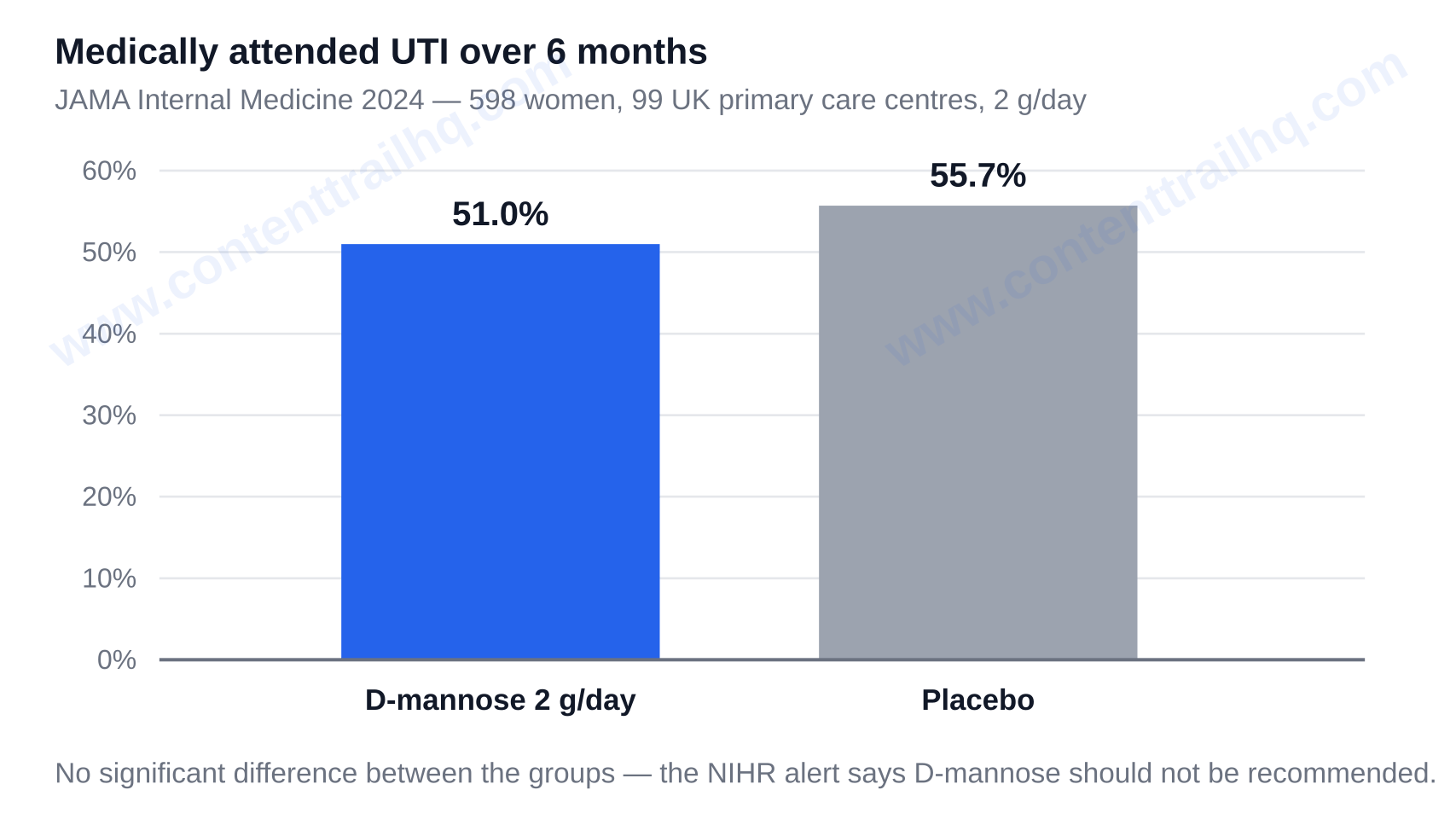
| D-mannose | JAMA Internal Medicine 2024: 598 women, 99 UK primary care centres, 2 g/day for 6 months — medically attended UTI in 51.0% versus 55.7% on placebo, no significant difference | Neither; the NIHR alert says it should not be recommended for recurrent UTI in primary care |
| Water and fluids | Dilutes irritant concentrated urine and supports clearance; increased intake has prevention evidence | Both — but does not reliably eradicate an established infection |
| Phenazopyridine (AZO, Uristat, Pyridium) | Effective urinary analgesia, zero antibacterial action, 2-day ceiling | Symptom relief only |
So: cranberry for prevention if you get recurrences, skip d-mannose, fluids and analgesia for the episode, antibiotics for the infection.
What is causing it — and which test should you ask for by name?
The causes are either infectious or non-infectious. Infectious include UTIs and cystitis, as well as kidney infections, urethritis and prostatitis. Others include chlamydia, gonorrhoea, genital herpes, yeast infections, bacterial vaginosis, cervicitis and vaginitis. Non-infectious causes include dehydration and concentrated urine, use of scented soaps and bubble baths, douches and spermicides, friction from sex, kidney and bladder stones, interstitial cystitis, urethral stricture, pelvic floor dysfunction and bladder-irritating medicines including chemotherapy.
Translating your pattern into a specific test request is what gets you answered in one visit instead of three.
| Your pattern | Likely cause | Test to ask for by name |
|---|---|---|
| Burning plus frequency, urgency, cloudy urine | Cystitis / UTI | Urine dipstick plus urine culture with sensitivities |
| Burning plus discharge, or a negative dipstick after a new partner | Urethritis (chlamydia, gonorrhoea) | Chlamydia/gonorrhoea NAAT — swab or first-void urine; a UTI dipstick and culture will miss it |
| Burning plus one-sided flank pain and visible blood | Kidney or bladder stone | Imaging — CT or ultrasound |
| Burning plus fever, chills or vomiting | Possible kidney infection (pyelonephritis) | Same-day assessment, not a test you schedule |
| Burning recurring for months, cultures repeatedly negative | Interstitial cystitis, pelvic floor dysfunction, or prostatitis in men | Specialist referral — not another antibiotic course |
The sex difference is worth stating. According to Mayo Clinic’s list of painful urination causes, UTIs are a common cause in women, and in men, urethritis and prostate conditions dominate, so “burning with no STD” in a man usually means prostatitis, a stricture or an irritant rather than nothing at all. Keep in mind, the dipstick test measures’ leukocyte esterase and nitrite, and the culture test is the one that names the organism and its antibiotic sensitivity.
When should you see a doctor, and when do you need antibiotics?
Get same-day or urgent care for a fever, chills or shaking, flank or back pain, vomiting, visible blood in urine, severe pain on every urination, abnormal vaginal or penile discharge, inability to urinate, or confusion in an older adult.
Do not wait at all if you are pregnant, diabetic, immunosuppressed, over 65, a man with urinary symptoms, or if the patient is a child. All others should follow the 48 hour rule. The 48 hour rule states that if the burning has not clearly improved within 48 hours, or it settles and comes back within a fortnight, you need to get a urine test rather than another round of self-care. Self care cannot cure a bacterial infection — that needs a short antibiotic course, finished in full even after the symptoms clear. At the visit, expect urinalysis, culture with sensitivities, STI NAAT testing where the pattern fits, imaging if a stone is suspected, and prostate assessment in men.
Once this episode clears, there are things you can do to prevent getting UTIs, and prevention is unglamorous and effective: 2–3 litres of fluid daily, urinate after having sex, wipe front to back, breathable cotton underwear, never hold urine, keep the irritant list short, review any spermicide or scented product you use, and if you get three or more infections a year, ask a clinician about recurrent-UTI options.
The one-line rule
Burning after you urinate has a short job and a long one. Tonight: sample first if a test is within reach, then fluids, pain relief, a warm compress, an alkaliser if it is safe for you, and to top it off, a clean 48 hours free of irritants. Beyond that, the burn is a signal to identify, not to numb. Your next step: if it hasn’t clearly improved within 48 hours, or any red flag appears, book a urine test and ask for a culture by name — plus an STI NAAT if discharge or a new partner is part of the picture.
Rule of thumb: soothe the burn, but never let the painkiller be the last decision you make about it. For more like this, explore Content Trail HQ.